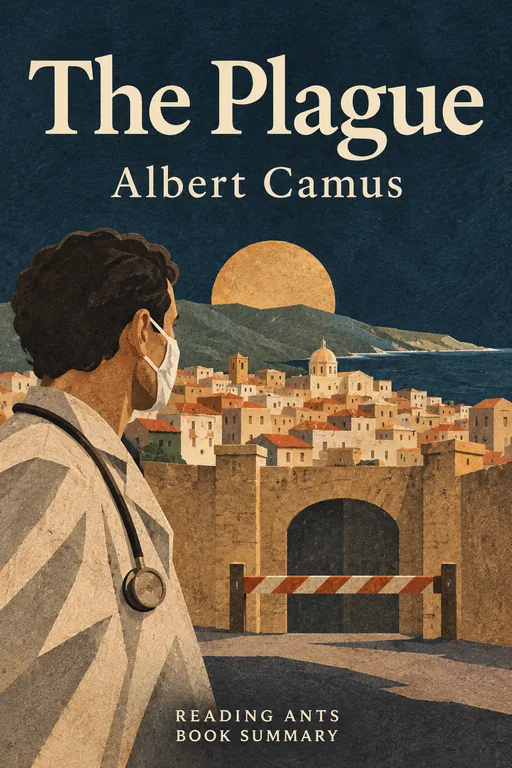
The Plague
Original title: La Peste
When plague seals an Algerian city off from the world, ordinary people must choose between denial, private escape and the patient shared work of resisting suffering.
Overview
Published in 1947, The Plague is Albert Camus’s novel of an epidemic in Oran, a coastal city in French-ruled Algeria. It begins when dead rats appear in streets and buildings. As residents fall ill, officials hesitate to name the danger, but rising deaths force them to close the gates. Dr. Bernard Rieux and a group of companions spend months treating patients, organizing volunteers and enduring separation from those they love. The disease is literal, yet it also works as an allegory for fascism, occupation and any evil that spreads when people call it someone else’s problem. Camus avoids a simple story of heroes defeating a monster. Instead, he asks how decent people should act when suffering is widespread, victory uncertain and no explanation can make innocent death acceptable.
Main Characters
- Dr. Bernard Rieux: a practical physician who treats the sick without claiming to be heroic.
- Jean Tarrou: a thoughtful visitor who organizes volunteer sanitation teams and seeks a way to live without harming others.
- Raymond Rambert: a journalist trapped away from the woman he loves, who first plans escape.
- Joseph Grand: a modest city clerk who helps collect epidemic records and endlessly revises one sentence of a novel.
- Father Paneloux: a Jesuit priest whose interpretation of the plague changes after he witnesses a child’s death.
- Cottard: a troubled man who prospers during the crisis and fears the return of normal law.
- Dr. Castel: an older doctor who recognizes the plague and works on a serum.
Full Summary
The Rats
Oran is an ordinary, business-minded city whose residents assume tomorrow will resemble today. Dr. Rieux finds a dying rat outside his office. Soon thousands of rats crawl into the open and die. Officials remove them, and the strange event seems to end. Then people develop fever, swollen glands and severe illness. Rieux and the older Dr. Castel suspect plague.
Authorities avoid the frightening word and debate whether the evidence is certain enough. Rieux argues that the label matters less than acting before more people die. As deaths rise, the city finally declares an epidemic. Gates close, trains stop and messages are restricted. Families and lovers who happened to be apart become separated without warning. Rieux’s own wife had left for treatment elsewhere shortly before the lockdown.
Exile Inside the City
The people of Oran first treat the closure as a temporary inconvenience. They continue private plans and imagine exceptions for themselves. Gradually, shared exile replaces individual hope. They miss absent loved ones but cannot picture when reunion will come. Funerals become hurried and impersonal as cemeteries fill.
Rambert, a visiting journalist, insists that the plague is not his affair. He asks Rieux for a certificate that would let him leave and, when refused, contacts smugglers. Cottard helps him. Before the epidemic, Cottard had attempted suicide and feared arrest for an unspecified past crime. Under plague conditions everyone else shares his fear, while black-market business makes him useful. He becomes happier as the city suffers.
Fighting Without Glory
Tarrou, who has been observing Oran and keeping notebooks, proposes volunteer sanitation teams. Rieux agrees. Grand joins despite his quiet, unimpressive life. By day he is an underpaid clerk; at night he struggles to perfect the opening sentence of a book. His persistence, both comic and admirable, represents the ordinary effort on which the response depends.
Father Paneloux preaches that the plague is divine punishment and urges the city to accept its lesson. Rieux, who does not believe in God, refuses to explain suffering. He focuses on treating bodies. Rambert comes close to escaping, but when he learns that Rieux is also separated from his wife and still stays at his post, he changes his mind. He decides he cannot seek private happiness while others fight the same danger.
The Child
Castel develops a serum, and it is tried on the young son of the magistrate Othon. Rieux, Tarrou, Paneloux and others watch the child endure a long, painful death. The scene breaks through abstract arguments. Rieux angrily tells Paneloux that the child was innocent. Paneloux’s next sermon is less certain: rather than speaking of other people’s guilt, he says believers must accept everything or reject everything.
Paneloux later becomes ill and at first refuses a doctor’s care, though Rieux attends him. His symptoms are unusual, and his death is recorded as a doubtful case. The narrator does not settle whether his faith strengthened or trapped him. Othon, changed by his son’s death, volunteers to remain at the quarantine camp after his own isolation period ends. The plague reveals both selfishness and unexpected solidarity.
A Turning Tide
Winter arrives, and the epidemic finally begins to weaken. Grand becomes ill and appears close to death. He asks Rieux to burn his manuscript, but then unexpectedly recovers after receiving serum. Other patients also survive more often. Rats reappear alive, suggesting ordinary life may return.
Hope remains dangerous. Earlier, on a quiet night, Tarrou had confessed to Rieux that his prosecutor father’s pursuit of a death sentence led him to oppose capital punishment, and that he nevertheless felt complicit in killing; the two friends then swim together in the sea. Just as the end seems near, Tarrou catches plague. Rieux and his mother care for him at home, but after a fierce struggle he dies. Rieux then receives news that his wife has died away from Oran. The epidemic’s retreat cannot restore those already lost. Cottard, terrified by reopening, becomes unstable because normal life means renewed attention from the police.
Gates Open
The authorities announce that the gates will reopen. Crowds celebrate, lovers reunite and trains arrive. Rambert finds the woman he waited for, though both have been changed by separation. Cottard fires at people from his apartment and is arrested. Grand returns to his sentence with a willingness to begin again.
The narrator reveals that he is Rieux. He has written the chronicle from records and Tarrou’s notes so that victims will not be forgotten and so that he can testify to what people learned: there is more to admire than despise in human beings. Yet celebration is not final victory. The plague bacillus can remain hidden for years and return when cities believe themselves safe. Vigilance and decency must therefore continue after the crisis passes.
Why It Matters
Written soon after the Second World War, The Plague was widely read as an allegory of Nazi occupation and the French Resistance. The sealed city represents a society overtaken by a force that people first deny, then accommodate and finally resist. Camus broadens that history into a lasting moral problem: destructive systems and public disasters thrive when individuals assume someone else will respond.
The novel gained renewed attention during later epidemics because it understands both the medical and emotional patterns of quarantine: delayed official action, rumors, separation, exhausted workers, unequal access and the strange mixture of boredom and fear. Its central heroism is deliberately ordinary. Rieux does not promise salvation; he keeps doing his job. Tarrou organizes neighbors. Grand maintains records. Their solidarity offers an ethics for crises in which no one can remain completely innocent or safe.
Key Takeaways
- Denial gives danger time to spread. Officials wait for certainty while the evidence grows, showing why early action matters in collective emergencies.
- Suffering is shared but not identical. The whole city is confined, yet people’s duties, resources, losses and chances remain unequal.
- Decency is often ordinary work. Treating patients, keeping records and joining sanitation teams matter more than dramatic speeches about heroism.
- Private happiness has public conditions. Rambert learns that escaping alone would tie his happiness to abandoning people facing the same threat.
- No victory is permanent. Disease and political evil can return, so memory and vigilance are responsibilities rather than sources of panic.
What We Can Learn
The novel teaches the value of acting before certainty is perfect. In a crisis, waiting for every doubt to disappear may itself be a harmful choice. We can listen to qualified people, share accurate information and accept small inconveniences that protect those at greater risk.
It also offers a realistic model of service. Most people cannot solve a disaster, but they can take a shift, check on a neighbor, keep careful records or support workers carrying the heaviest burden. Such tasks may feel repetitive rather than heroic; that is precisely why they matter. Finally, The Plague asks us to remember after normal life returns. Celebrating recovery is necessary, but preserving the stories of loss can improve preparation and resist the temptation to pretend that suffering belonged only to the past.
Criticism and Counterpoints
Although set in colonial Algeria, the novel gives little attention to Arab Algerians, who formed most of the population. Its main characters are European settlers, and colonial inequality remains largely outside the frame. This omission complicates a book that presents itself as a broad account of shared human suffering.
Some readers find the allegory too clear or the philosophical conversations heavy. Others question Rambert’s decision to stay, arguing that loyalty to a distant loved one is also a moral duty. Public-health readers may note that the epidemic serves literary purposes and should not be treated as a precise model of disease. The women are also mostly absent, distant or supporting figures, limiting the range of lives represented in the supposedly collective chronicle.
Who Should Read It
This novel suits teens and adults interested in ethics, epidemics, political allegory and ordinary courage. Its pace is reflective rather than action-driven, and its repeated illness and death can be emotionally heavy. Readers who enjoy philosophical fiction grounded in practical choices will find much to discuss.
Want the whole book?
A summary is a taste, not the meal. Here is where to find the full book.
You reached the end 🎉
Nicely done. Mark this one as read, and we will suggest what to read next.
Read this next
The Stranger
Albert Camus
An emotionally detached office worker kills a man on an Algerian beach and discovers that society condemns him as much for refusing its expected feelings as for the murder itself.
🌍 World Literature
Blindness
Jose Saramago
When a mysterious epidemic of blindness strikes a city, one woman who can still see helps a small group survive the collapse of order and human decency.
🌍 World Literature
Station Eleven
Emily St. John Mandel
After a flu kills most of humanity, a traveling troupe of actors and musicians carries Shakespeare and music through the empty land, and the lives of the survivors turn out to be linked.
🚀 Sci-Fi & Fantasy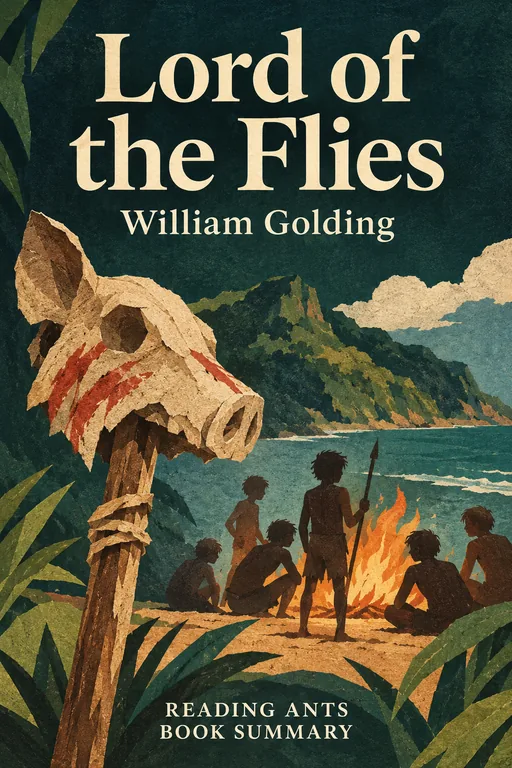
Lord of the Flies
William Golding
A group of British schoolboys stranded on a deserted island try to govern themselves, but fear and the desire for power slowly turn them into savages, revealing the darkness inside human nature.
📜 Classics
The Little Prince
Antoine de Saint-Exupery
A pilot stranded in the desert meets a small boy from a tiny planet, who teaches him that the most important things in life, like love and friendship, can only be seen with the heart.
🌍 World Literature
Things Fall Apart
Chinua Achebe
Okonkwo, a proud and fearsome leader in an Igbo village in Nigeria, struggles against his own fears and against the arrival of British missionaries and colonial rulers, who change his world forever.
🌍 World LiteratureWant something different?
Pick another topic and we will show you three books to start with.