 Reading Ants
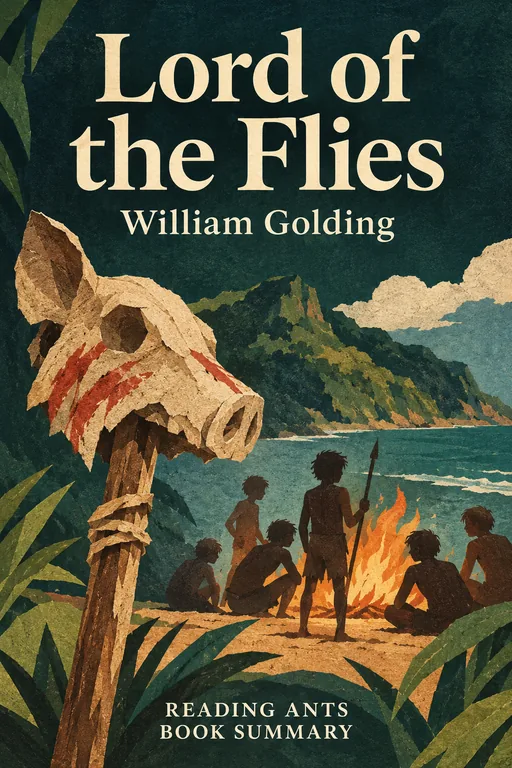
Lord of the Flies
A group of British schoolboys stranded on a deserted island try to govern themselves, but fear and the desire for power slowly turn them into savages, revealing the darkness inside human nature.
Overview
Lord of the Flies, William Golding’s first novel, was published in 1954. During a war, a plane evacuating British schoolboys is shot down, and the boys, aged about six to twelve, find themselves alone on a tropical island with no adults. At first the island seems like paradise, and the boys organize themselves, electing a leader and making rules. But as fear of a mysterious “beast” grows and a rival leader rises, order breaks down, and the boys begin to hunt, fight and kill. Golding, who had served in the Royal Navy in the Second World War, wrote the novel as a response to adventure stories that showed English boys as naturally civilized. It became one of the most widely read novels in schools.
Main Characters
- Ralph: a fair, sensible boy elected leader, who tries to keep order.
- Piggy: an intelligent, overweight boy with glasses and asthma, often mocked.
- Jack Merridew: the proud leader of a boys’ choir, who becomes a hunter.
- Simon: a quiet, gentle and thoughtful boy.
- Roger: a secretive boy with a growing cruel streak.
- Sam and Eric: twins, known together as “Samneric.”
- The littluns: the youngest boys, about six years old.
Full Summary
The Conch
Ralph and Piggy meet on the beach after the crash. They find a large conch shell, and Ralph blows it to call the other survivors. Boys emerge from the jungle, including a group of choirboys in black cloaks led by Jack Merridew. The boys hold a meeting and elect Ralph as chief. They agree that whoever holds the conch has the right to speak, making it a symbol of order and democracy. Jack is put in charge of the choir, who will be hunters.
The Signal Fire
Ralph decides that the most important task is to keep a signal fire burning on the mountain so that passing ships can see it. Using the lenses of Piggy’s glasses, they light a fire, but it spreads out of control and burns part of the forest. A small boy with a birthmark is missing afterward, presumably killed in the blaze.
Ralph tries to build shelters, while Jack becomes obsessed with hunting pigs. One day, a ship passes, but the fire has gone out, because Jack’s hunters left it to chase a pig. Ralph is furious. Jack returns triumphant with a pig, chanting with his hunters, and in anger hits Piggy, breaking one lens of his glasses.
The Beast
The littluns are terrified of a “beast” they believe lives on the island. At night, a dead parachutist from an air battle drifts down onto the mountain, and in the darkness the twins see it moving in the wind and believe it is the beast. Ralph, Jack and Roger climb the mountain and see the shape, then run away in terror.
Jack challenges Ralph’s leadership and, when the boys refuse to vote him chief, leaves to form his own tribe. Most of the older boys gradually join him. Jack’s hunters paint their faces, which makes them feel free of shame. They kill a sow and put its head on a sharpened stick as an offering to the beast.
The Lord of the Flies
Simon, alone in the forest, comes upon the pig’s head swarming with flies, the “Lord of the Flies.” In a kind of hallucination, the head seems to speak to him, telling him that the beast is not something they can hunt, because it is part of them. Simon faints. When he wakes, he climbs the mountain and discovers that the “beast” is only a dead parachutist. He runs down to tell the others.
At that moment, Jack’s tribe is holding a wild feast and dance during a storm, with Ralph and Piggy joining in. When Simon stumbles out of the dark forest, the frenzied boys mistake him for the beast and beat him to death. His body is carried out to sea by the tide.
The Death of Piggy
Ralph and Piggy, horrified, try to convince themselves it was an accident. That night, Jack’s hunters raid their camp and steal Piggy’s glasses, the only way to make fire. Ralph, Piggy and the twins go to Jack’s fortress at Castle Rock to demand them back. Ralph and Jack fight. Piggy, holding the conch, pleads for reason, asking whether it is better to have rules and agree, or to hunt and kill. From above, Roger deliberately sends a huge boulder crashing down. It strikes Piggy, who falls onto the rocks below and is killed, and the conch shatters into pieces.
The Hunt for Ralph
Ralph flees alone. Jack’s tribe captures Samneric and forces them to join. They then hunt Ralph across the island, and Jack sets the forest on fire to smoke him out. Roger has sharpened a stick at both ends, suggesting they intend to put Ralph’s head on it. Running desperately through the burning jungle, Ralph falls on the beach at the feet of a British naval officer, whose ship has seen the smoke.
The officer, amused at first, assumes the boys have been playing games, and says he expected British boys to put up a better show. Ralph bursts into tears, weeping for the end of innocence, the darkness of the human heart and the death of his wise friend Piggy. The other boys begin to cry too. The officer turns away, embarrassed, and looks at his warship waiting offshore.
Why It Matters
Lord of the Flies is one of the most influential novels of the twentieth century and a classic of school reading lists in many countries. Golding won the Nobel Prize in Literature in 1983. Written after the horrors of the Second World War and at the start of the nuclear age, the novel questions the belief that civilization naturally makes people good. It suggests that cruelty and violence exist inside everyone, held back only by rules and social order.
Its symbols, such as the conch for order, Piggy’s glasses for reason and the pig’s head for evil, are among the most studied in literature, and the phrase “Lord of the Flies” is used to describe situations where order breaks down into cruelty. The book has been adapted into films and stage plays.
Key Takeaways
- Civilization is fragile. Without rules and order, people can quickly turn violent.
- Fear drives cruelty. The imaginary beast leads the boys to terrible acts.
- Evil lies within. The real beast is human nature, not a monster.
- Reason and kindness are often ignored. Piggy and Simon are mocked and killed.
- Power corrupts. Jack’s thirst for control turns him into a tyrant.
What We Can Learn
The novel reminds us how important rules, fairness and listening to others are in any group, whether a classroom, a team or a country. When people stop respecting each other’s right to speak, things can fall apart quickly.
It also shows how fear can be used to control people. Jack gains power by playing on the boys’ fear of the beast. In our own lives, it helps to ask whether a fear is real, and who benefits from making us afraid.
Finally, the book teaches us to stand up for people who are bullied. Piggy is mocked from the start, and that disrespect grows into something much worse. Small acts of kindness and defense can prevent bigger cruelty.
Criticism and Counterpoints
Some critics argue that the novel’s view of human nature is too pessimistic. In 2020, the historian Rutger Bregman described a real case in 1965 in which six boys from Tonga were stranded on an island for over a year and cooperated peacefully, taking care of each other. He argued that this shows people can be naturally cooperative.
Others note that the book features only white British schoolboys, with some differences of class and background, and question whether it can represent all of humanity. Its portrayal of hunting and “savagery” has also been criticized for using colonial stereotypes. The heavy symbolism can feel obvious to some readers. Nonetheless, the novel continues to provoke powerful discussion.
Who Should Read It
This book suits teenagers and adults, and it is a common choice in high school literature classes. Its violence and deaths can be disturbing, so it works best with discussion. Readers interested in psychology, politics and human nature will find it thought-provoking.
Want the whole book?
A summary is a taste, not the meal. Here is where to find the full book.
You reached the end 🎉
Nicely done. Mark this one as read, and we will suggest what to read next.
Read this next
Animal Farm
George Orwell
The animals of an English farm overthrow their cruel human owner to create a fair society, but the clever pigs who lead them slowly become just as tyrannical as the humans they replaced.
📜 Classics
Nineteen Eighty-Four
George Orwell
In a future Britain ruled by an all-seeing Party, one man secretly rebels by keeping a diary and falling in love, and discovers just how completely a totalitarian state can crush the human mind.
📜 ClassicsThe Catcher in the Rye
J. D. Salinger
After being expelled from his boarding school, a lonely, sarcastic sixteen-year-old wanders New York City for three days, struggling with grief, phoniness and the frightening idea of growing up.
📜 Classics
A Separate Peace
John Knowles
Looking back from adulthood, a man recalls the summer of 1942 at a New England boarding school, when a moment of jealousy led him to injure his best friend, and how that act haunted his youth.
📜 Classics
Pride and Prejudice
Jane Austen
Quick-witted Elizabeth Bennet and the proud, wealthy Mr. Darcy badly misjudge each other, and only by facing their own faults do they find their way to love.
📜 Classics
To Kill a Mockingbird
Harper Lee
In a small Alabama town in the 1930s, young Scout Finch watches her father, a lawyer, defend a Black man falsely accused of a crime, and learns hard lessons about prejudice, courage and seeing the world through other people's eyes.
📜 ClassicsWant something different?
Pick another topic and we will show you three books to start with.