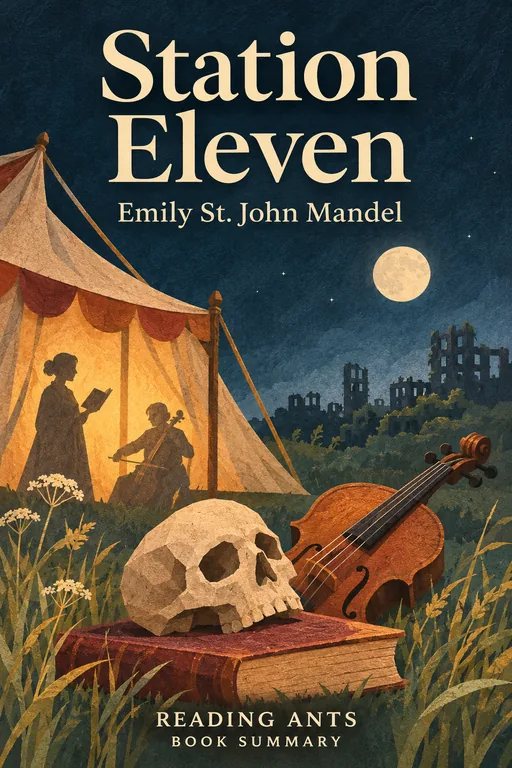
Station Eleven
After a flu kills most of humanity, a traveling troupe of actors and musicians carries Shakespeare and music through the empty land, and the lives of the survivors turn out to be linked.
Overview
Station Eleven is a novel by Emily St. John Mandel, published in 2014, and it was a finalist for the National Book Award and won the Arthur C. Clarke Award. It moves between the time just before a deadly flu sweeps the world and the time twenty years later, when small communities struggle to survive. The story is built around a famous actor, Arthur Leander, who dies on stage on the night the flu begins, and around the people whose lives he touched. It is quiet and thoughtful, more about memory and art than about action, and it asks what is worth saving when civilization falls.
Main Characters
- Arthur Leander: a famous actor whose death on stage opens the book.
- Kirsten Raymonde: a child actor on stage that night, later a member of the Traveling Symphony.
- Jeevan Chaudhary: a former paparazzo training as a paramedic, who tries to help Arthur.
- Clark Thompson: Arthur’s old friend, who survives in an airport.
- Miranda Carroll: Arthur’s first wife, who draws a comic called Station Eleven.
- The Prophet: the leader of a violent cult, with a hidden link to Arthur.
Full Summary
The Night of the Play
At a theater in Toronto, Arthur Leander is playing King Lear when he collapses and dies on stage of a heart attack. A man in the audience, Jeevan, who is training as a paramedic, rushes to help, but cannot save him. A little girl, Kirsten, who is playing a small role, watches. That same night, a deadly flu, which had begun elsewhere, arrives in the city. Jeevan, who has been warned by a friend, goes to the apartment of his brother Frank, and the world’s collapse begins.
The flu, called the Georgia Flu, is extremely fast. Within weeks, most people are dead, and the power, the internet and air travel are gone. Jeevan and Frank, who uses a wheelchair, shelter in Frank’s Toronto apartment until they realize that no rescue is coming. Frank dies by suicide, and Jeevan sets out alone. In time he settles far away and becomes the doctor of a small settlement.
Arthur’s Life
Alongside the main story, the book goes back through Arthur’s life. We see his youth, his rise to fame, his marriages, and his friendships with Clark and with Miranda, his first wife. Miranda draws a comic book, Station Eleven, about a space station, which she prints in a very small number of copies and gives to only a few people, including Arthur. She never publishes it commercially. The comic becomes a key to the book.
We also see how Arthur’s success costs him, and how he becomes cut off from his old friends and his family. His life shows how fame can be empty, and how a person can be loved by many and still be alone.
The Traveling Symphony
Twenty years after the flu, Kirsten, now an adult, is part of the Traveling Symphony, a troupe of musicians and actors who travel between the small settlements of the Great Lakes region in wagons, performing Shakespeare and classical music. A saying painted on one wagon holds that survival is not enough. Kirsten keeps two issues of the comic Station Eleven, which Arthur gave to her as a child.
The Symphony arrives at a town that has been taken over by a man who calls himself the Prophet. He is a cult leader, who abuses young girls he claims as wives. When the Prophet’s men threaten them, the troupe must flee.
The Prophet
Members of the troupe disappear one by one. Kirsten and her remaining companion travel through a landscape of empty towns, abandoned cars and memories, heading toward a place called the Museum of Civilization at an airport.
The book reveals that the Prophet is Tyler, the son of Arthur and his second wife, Elizabeth. Years before, after the collapse, Elizabeth and the boy joined a religious cult, and Tyler grew up to lead it. The Prophet captures Kirsten and nearly kills her, but she quotes lines from the comic, and a young sentry in the cult, troubled in his faith, shoots him and then himself.
The Airport
At the Severn City Airport, a group of survivors, among them Clark, has built a small community. They have made a Museum of Civilization from the items that no longer work: cell phones, credit cards and laptops. Clark curates the museum, to keep alive the memory of the old world, and to show the children what it was like. Jeevan, who has become a healer far away, appears in the story’s later chapters, though he does not meet Kirsten at the airport, and the paths of the characters cross in other ways.
When Kirsten arrives, she finds that she and Clark have a link: he was a friend of Arthur’s, and she has the comic. The two talk about the old world, and about whether it is better to remember or to look forward.
A Light in the Distance
The novel ends as Clark shows Kirsten the distant electric lights of a town, a sign that civilization is beginning to recover, and the Symphony, reunited with its members, later moves on toward it. There is no triumphant ending, but a sense that things may be starting again. Art, memory and the bonds between people have survived.
Why It Matters
Station Eleven is one of the best-known post-apocalyptic novels of the twenty-first century. Unlike many stories of collapse, it does not focus on violence and survival alone, but on what people want to preserve: music, theater, stories, memory. The idea that survival is not enough has been widely quoted. It was also adapted into a television series in 2021, and it was read widely during the Covid-19 pandemic, as readers found parallels with the world they were living in.
Its structure, which moves through time and links many lives, has been praised, and it has been compared to the work of David Mitchell and other writers who use interlocking stories.
Key Takeaways
- Art matters in hard times. The Symphony performs even when the world is falling apart.
- Everything is connected. The characters’ lives link in surprising ways.
- Survival is not enough. People need meaning, beauty and company.
- Memory is precious. The Museum preserves objects from a lost world.
- Stories can be misused. The Prophet bends a comic into a weapon.
What We Can Learn
The book invites us to think about what we would want to keep if we lost most of what we have. For many of its characters, the answer is not gadgets, but people, music and stories. In everyday life, we can make time for the things that feed us, such as reading, music or friends.
It also reminds us to value the present. The characters remember a world that they took for granted, and they long for small things, such as hot water or a plane. We can practice gratitude for the things we have now.
Finally, the story shows that even in a crisis, people can choose to be kind and to create. A small group with a few instruments can bring comfort to many people.
Criticism and Counterpoints
Some readers find the book slow, since it moves between many time periods and characters, and the plot is less about events than about connections. Others say that the coincidences that link the characters are hard to believe, and that the Prophet is a thin villain. A few critics point out that the picture of a flu that ends civilization in weeks is not realistic, and that the book does not explore the harder aspects of survival, such as hunger and disease.
Still, many readers value its calm, hopeful tone.
Who Should Read It
This book is for teenagers and adults who like thoughtful, character-driven stories. It contains deaths and some violence, and some readers may find its pandemic setting upsetting. It is a good choice for people who enjoy literary fiction, and for anyone who wants a story that finds hope in art.
Want the whole book?
A summary is a taste, not the meal. Here is where to find the full book.
You reached the end 🎉
Nicely done. Mark this one as read, and we will suggest what to read next.
Read this next
The Road
Cormac McCarthy
A father and his young son walk through a burned, ash-covered America after an unexplained catastrophe, struggling to stay alive and to stay good in a world where hope has almost died.
✨ Modern Fiction
Never Let Me Go
Kazuo Ishiguro
Looking back on her childhood at an English boarding school, a young woman gradually reveals that she and her friends were created to donate their organs, and that they accept their fate without ever trying to escape.
✨ Modern Fiction
The Handmaid's Tale
Margaret Atwood
In a near-future United States taken over by a religious dictatorship that strips women of their rights, a woman forced to bear children for a powerful couple secretly remembers her old life and searches for a way to survive.
✨ Modern Fiction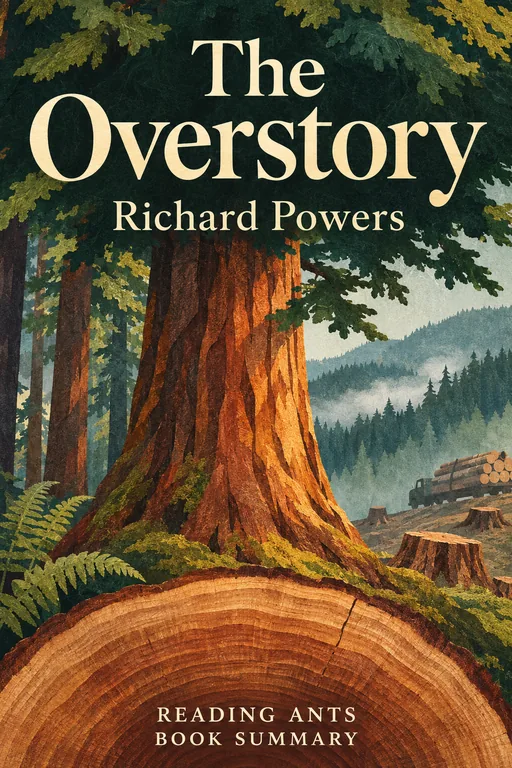
The Overstory
Richard Powers
Nine strangers, each changed by an encounter with trees, are drawn together to defend America's old-growth forests, in a novel that treats trees as characters and invites us to see human life as one small part of a much longer one.
✨ Modern Fiction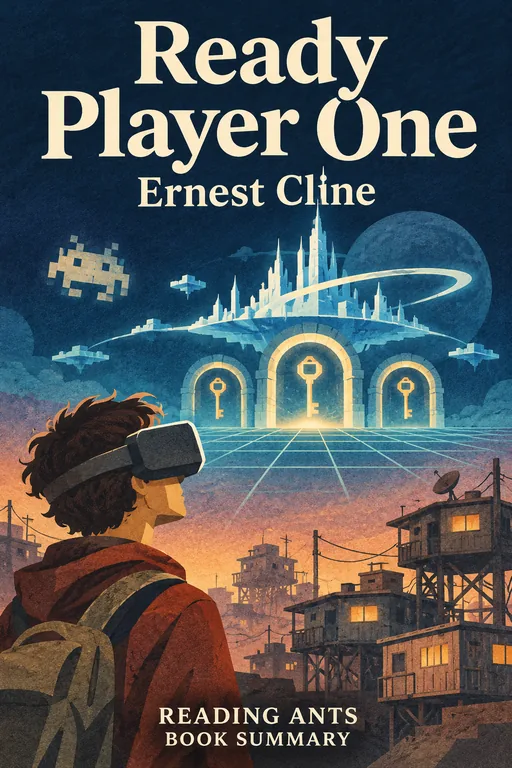
Ready Player One
Ernest Cline
In a bleak future where most people escape into a vast virtual world, a poor teenager joins a worldwide hunt for a hidden prize left by the world's creator.
🚀 Sci-Fi & Fantasy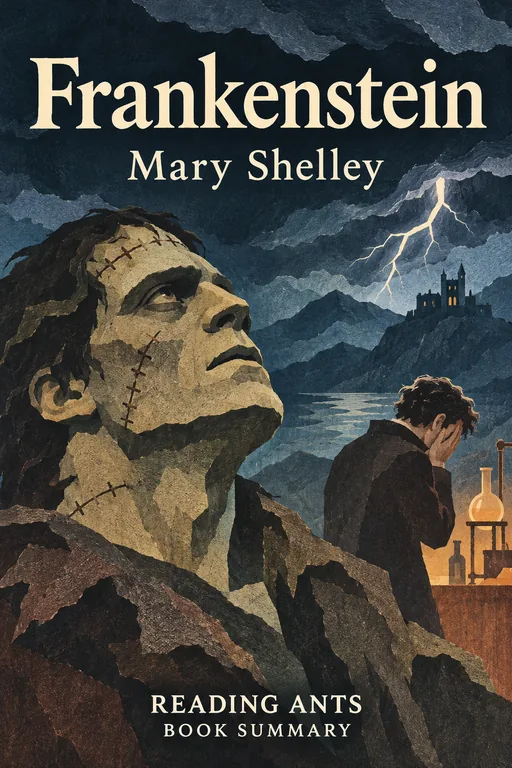
Frankenstein
Mary Shelley
A young scientist creates a living being from dead body parts, then abandons it in horror, and his rejected creation, longing for love, turns to revenge.
🚀 Sci-Fi & FantasyWant something different?
Pick another topic and we will show you three books to start with.