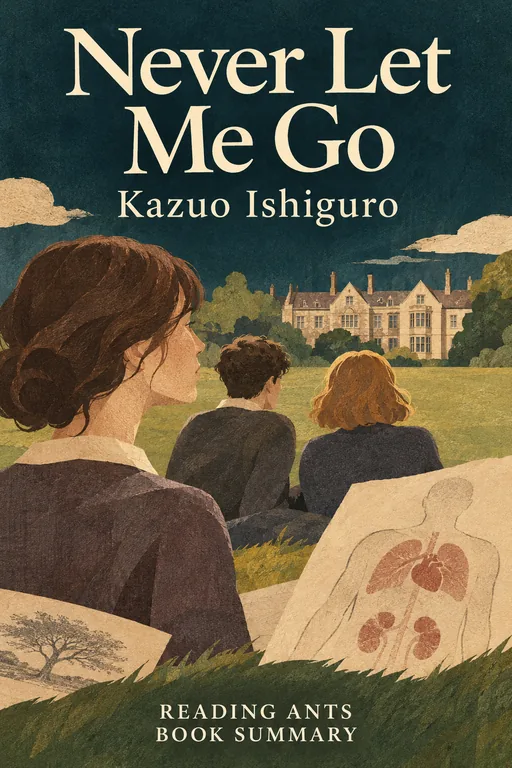
Never Let Me Go
Looking back on her childhood at an English boarding school, a young woman gradually reveals that she and her friends were created to donate their organs, and that they accept their fate without ever trying to escape.
Overview
Never Let Me Go, published in 2005, is a novel by Kazuo Ishiguro, who won the Nobel Prize in Literature in 2017. It is narrated by Kathy H., a thirty-one-year-old “carer” who looks after “donors” in the English countryside, in a version of the late twentieth century. She remembers Hailsham, an apparently idyllic boarding school where she grew up with her close friends Ruth and Tommy. Teachers, whom the children call “guardians,” encourage the children to make art, play sports and stay healthy. Only slowly does the reader realize why. The book is science fiction in a quiet, restrained style, closer to a sad, gentle memoir than an adventure, and it asks what it means to be human.
Main Characters
- Kathy H.: the thoughtful narrator, a carer.
- Ruth: Kathy’s close friend, bold, controlling and insecure.
- Tommy: a gentle boy with a quick temper, Kathy’s other close friend.
- Miss Emily: the head guardian of Hailsham.
- Miss Lucy: a guardian who tells the children the truth.
- Madame: a mysterious woman who collects the students’ artwork.
Full Summary
Hailsham
Kathy grew up at Hailsham, a boarding school in the English countryside. The children are healthy, well taught and closely supervised. They are encouraged to create art and poetry, and their best works are chosen by a mysterious woman, Madame, who comes to take them for the “Gallery.” They are told often how special they are and how important it is to take care of their health.
One of Kathy’s treasured possessions is a music tape by a singer called Judy Bridgewater, with a song titled “Never Let Me Go.” She loves to dance alone to it, holding a pillow like a baby, and one day she is watched, tearful, by Madame, who seems strangely moved. Years later, Kathy learns why.
Kathy, Ruth and Tommy are close friends. Tommy is teased because he cannot draw. Once, Miss Lucy, a young guardian, makes him feel better, and later tells the children the truth, which the other guardians avoid: they are “students” in a world apart from the rest, they will never grow up to have careers or families, and their lives are meant to be short.
The Cottages
At sixteen, Kathy, Ruth and Tommy leave Hailsham for the Cottages, a farm where students live until they begin their lives as carers and donors. There they meet people from other schools, and Ruth and Tommy, who were already a couple at Hailsham, stay together. A rumor spreads that couples who are truly in love may be granted a “deferral,” a few years’ delay before donations begin, if they can prove it to the school.
Kathy is deeply in love with Tommy. She leaves the Cottages to become a carer, partly because she is jealous of Ruth.
Carer and Donor
Years pass. Kathy works as a carer, looking after donors who recover from their operations. Many donors “complete,” meaning that they die, after their third or fourth donation, and some die earlier. When she meets Ruth again, Ruth has already donated once and is in poor health. She is full of regret. She admits that she kept Kathy and Tommy apart out of jealousy, and she gives them the address of Madame, urging them to apply for a deferral together.
Madame and Miss Emily
After Ruth dies after her second donation, Kathy and Tommy, now a couple, visit Miss Emily and Madame, in the hope of a deferral. They bring Tommy’s artwork as proof of love. But Miss Emily explains that no deferrals exist. The Gallery was meant to show that the clones have souls, to persuade society to treat them better. At the time, people feared them as less than human. Hailsham was an experiment in treating them with kindness. It has now closed, and public support has faded.
Tommy is devastated. Miss Emily tells them that they were always meant to be donors, and that Hailsham’s students were lucky compared with others, raised in horrible institutions.
The End
Before his fourth donation, Tommy asks Kathy to stop being his carer, and he completes without her by his side. Kathy continues working as a carer, soon expecting to become a donor herself. She drives to a field in Norfolk, where lost things are said to wash up, and imagines Tommy waiting. She allows herself a small tear, and then drives on to wherever she is supposed to go.
Why It Matters
Never Let Me Go was shortlisted for the Booker Prize and named by Time magazine as the best novel of 2005. It was adapted into a 2010 film starring Carey Mulligan, Andrew Garfield and Keira Knightley. Ishiguro’s Nobel Prize citation praised the emotional force of his novels.
The book is a haunting meditation on mortality, memory and the ethics of science, written after the cloning debates of the 1990s and before gene editing became widely discussed. Instead of focusing on rebellion, it asks a more unsettling question: why do the clones accept their fate? Many readers find that the book says as much about all human lives, short and shaped by forces beyond our control.
Key Takeaways
- Life is short for everyone. The clones’ fate mirrors the human condition.
- Acceptance can be tragic. The characters never really resist.
- Memory preserves what we love. Kathy’s recollections keep her friends alive.
- Technology raises moral questions. Society ignores the humanity of the clones.
- Love and art matter. The students seek proof that they have souls.
What We Can Learn
The novel encourages us to value the time we have with people we love. Kathy’s memories of Hailsham and her friends are the heart of her life, and they are fragile.
It also asks us to question systems that treat some people as less than human. The students’ world works because most people choose not to look closely. Being willing to ask hard questions about who is being harmed is part of being a responsible citizen.
Finally, it shows the power of kindness. Even in an unjust world, the care of friends and the beauty of creating something matter greatly.
Criticism and Counterpoints
Some readers find the clones’ passivity hard to believe: why don’t they escape or fight? Ishiguro has said that this was deliberate, and that the story is about how people accept limits. Others find the pace slow and the narrator’s calm, repetitive voice frustrating.
Critics have also questioned the science, since the novel doesn’t explain how the system works. Some argue the story is more of a metaphor than serious science fiction. Many readers, though, find the emotional impact devastating.
Who Should Read It
This novel suits mature teens and adults who enjoy thoughtful, quiet fiction. It is best to go in knowing little about the plot. Readers who like fast-paced dystopias may find it too understated, but others find it unforgettable.
Want the whole book?
A summary is a taste, not the meal. Here is where to find the full book.
You reached the end 🎉
Nicely done. Mark this one as read, and we will suggest what to read next.
Read this next
The Remains of the Day
Kazuo Ishiguro
An elderly English butler on a road trip across the countryside looks back on his life of strict duty and gradually realizes how much he gave up, including love, in service of a master who may not have deserved his loyalty.
✨ Modern Fiction
Klara and the Sun
Kazuo Ishiguro
Klara, a solar-powered "Artificial Friend," is bought as a companion for a sick teenager named Josie, and she believes that she can help her by praying to the Sun, in a quiet, strange story about love, devotion and what it means to be human.
✨ Modern Fiction
The Handmaid's Tale
Margaret Atwood
In a near-future United States taken over by a religious dictatorship that strips women of their rights, a woman forced to bear children for a powerful couple secretly remembers her old life and searches for a way to survive.
✨ Modern Fiction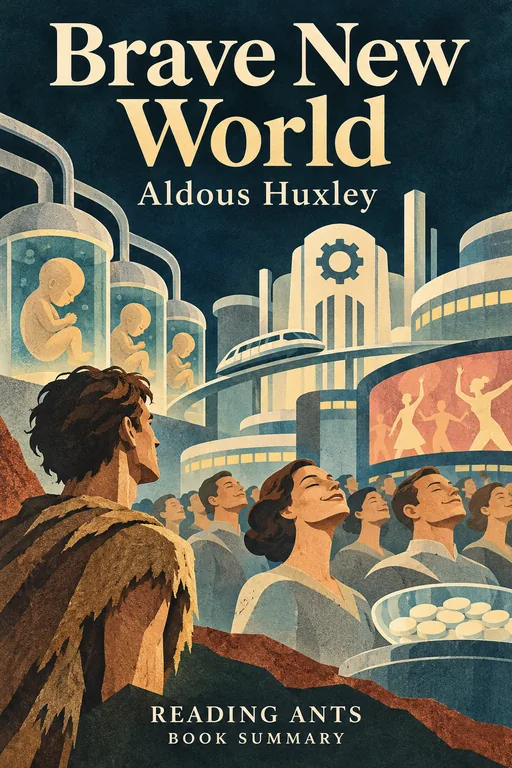
Brave New World
Aldous Huxley
In a future world where people are made in factories, programmed for their roles and kept happy with drugs and entertainment, a man raised outside the system discovers that this perfect comfort comes at the cost of everything that makes us human.
📜 Classics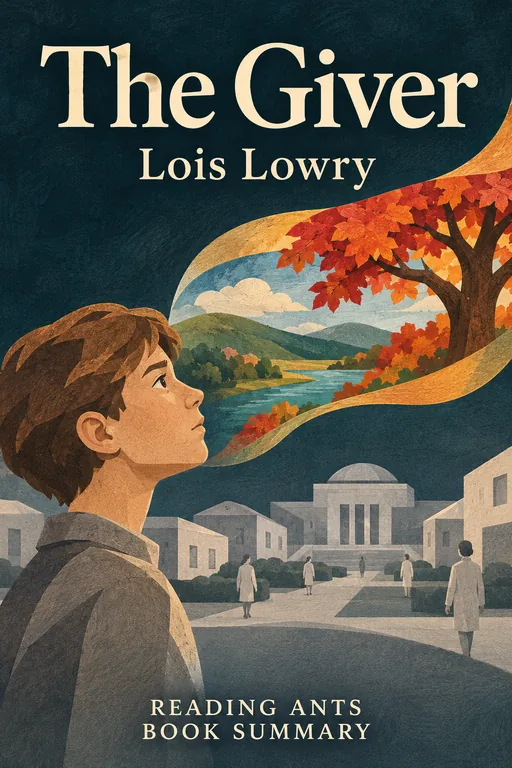
The Giver
Lois Lowry
In a perfectly controlled community with no pain, choice or color, a boy about to turn twelve is chosen to hold the memories of the past, and discovers the terrible price his people pay for their safety.
🎒 Young Adult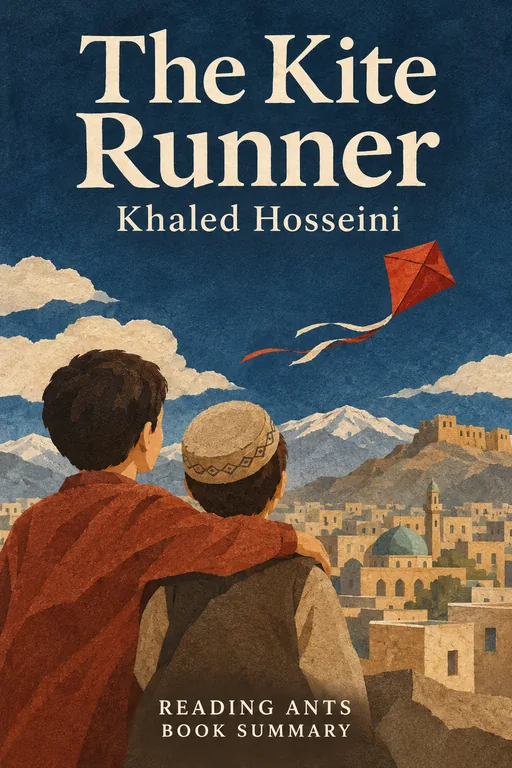
The Kite Runner
Khaled Hosseini
A wealthy boy in Kabul betrays his loyal best friend on the day of a kite tournament, and decades later, after fleeing to America, he returns to a Taliban-ruled Afghanistan to try to make things right.
✨ Modern FictionWant something different?
Pick another topic and we will show you three books to start with.