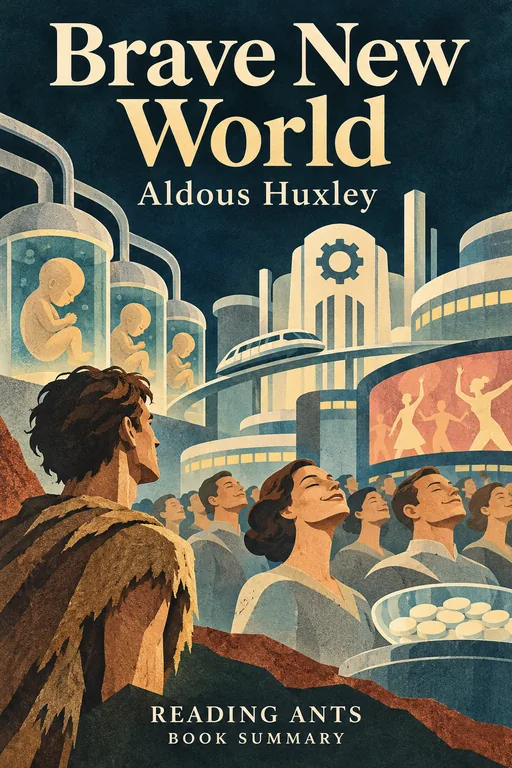
Brave New World
In a future world where people are made in factories, programmed for their roles and kept happy with drugs and entertainment, a man raised outside the system discovers that this perfect comfort comes at the cost of everything that makes us human.
Overview
Brave New World is a famous dystopian novel by the English writer Aldous Huxley, published in 1932. It is set in the “World State,” about six hundred years in the future. War, poverty and disease have been eliminated. Babies are no longer born but grown in bottles and conditioned from birth to accept their place in a rigid caste system. Everyone takes a drug called soma to stay calm and content, enjoys casual relationships and endless entertainment, and worships Henry Ford, the industrialist associated with the moving assembly line, as a kind of god. Bernard Marx, an unhappy citizen, and John, a “Savage” raised on a reservation outside the World State, both struggle against a society that has traded freedom and truth for stability and happiness.
Main Characters
- Bernard Marx: an Alpha-Plus psychologist who feels like an outsider.
- Lenina Crowne: a beautiful, conventional worker at the Hatchery.
- John (“the Savage”): a young man raised on a reservation, who loves Shakespeare.
- Linda: John’s mother, a World State citizen stranded on the reservation.
- Helmholtz Watson: Bernard’s brilliant friend, a writer frustrated by empty work.
- Mustapha Mond: one of the ten World Controllers.
- The Director of Hatcheries and Conditioning: Bernard’s boss.
Full Summary
The Hatchery
The novel opens at the Central London Hatchery and Conditioning Centre, where the Director shows a group of students how humans are made. Eggs are fertilized in laboratories and grown in bottles. Embryos are sorted into five castes: Alphas and Betas, the intelligent ruling classes, and Gammas, Deltas and Epsilons, who are deliberately deprived of oxygen and treated with alcohol to make them suited for simple, repetitive work. Lower-caste embryos are cloned into dozens of identical twins.
Children are then conditioned. Baby Deltas are given electric shocks when they touch books and flowers, so they will grow up to dislike them. While children sleep, recordings repeat messages, teaching them to love their caste and their roles. Family, parents and the words “mother” and “father” are considered disgusting. The World Controller, Mustapha Mond, explains that history and art have been abolished because they cause unhappiness.
Bernard and Lenina
Bernard Marx is an Alpha-Plus but shorter than most Alphas, rumored to be the result of a mistake in his bottle. He feels lonely and resents the shallow society around him, where everyone is expected to take soma, attend group activities and avoid deep feelings. He is attracted to Lenina Crowne, who is popular and follows the rules.
Bernard takes Lenina on a holiday to a Savage Reservation in New Mexico, where people still live in the old ways, with families, religion and aging. Lenina is horrified by the dirt, sickness and old people she sees.
John the Savage
On the reservation, they meet John, a young man with fair hair who is clearly not native to the village. His mother, Linda, was once a World State citizen who got lost on the reservation while visiting with the Director years ago and was left behind, pregnant. Rejected by the villagers, John grew up lonely, learning to read from an old copy of Shakespeare’s plays, which shaped his ideas about love, honor and beauty.
Bernard realizes that the Director is John’s father, which would be a huge scandal. He brings John and Linda back to London.
The Savage in London
In London, the Director, who had planned to exile Bernard, is humiliated in public when John calls him “father” and Linda appears, aged and overweight. The Director resigns. John becomes a celebrity, and Bernard enjoys his new popularity as John’s guardian.
John, however, is disgusted by the World State. He sees identical twins working in factories, the emptiness of the entertainment, and the way people use soma to avoid all pain. He falls in love with Lenina, but when she offers herself to him casually, he is horrified, because he wants love as described in Shakespeare. Linda, meanwhile, lives in a permanent soma haze and dies in a hospital, where children being conditioned to accept death treat her passing as nothing. John, in grief and rage, throws away the workers’ soma rations, causing a riot. Bernard and Helmholtz are arrested with him.
The Controller’s Argument
The three are brought before Mustapha Mond. Mond, who once was a scientist himself, explains openly why the World State exists. People could have art, science, truth and religion, he says, but these bring instability and suffering. The World State has chosen happiness and stability instead. Great art requires suffering; real science threatens the order; God is incompatible with machines and comfort.
John argues that he wants the right to be unhappy: to have real danger, freedom, goodness and sin, even if that means pain. Mond accepts this but will not let him change the society. Bernard and Helmholtz are sent to islands where independent thinkers are exiled, and Helmholtz is glad to go.
The Lighthouse
John moves to an abandoned lighthouse in the countryside to live alone and punish himself for the temptations of the World State. But reporters discover him, and crowds gather to watch him whip himself, treating him like a spectacle. When Lenina arrives among the crowds, John is overwhelmed by his desire and his disgust, and an orgy breaks out. The next morning, horrified by what he has done, John hangs himself.
Why It Matters
Brave New World is one of the most influential dystopian novels ever written, often compared with George Orwell’s Nineteen Eighty-Four. While Orwell imagined control through fear and surveillance, Huxley imagined control through pleasure, comfort and distraction. Many readers believe Huxley’s vision has proved more accurate, as modern societies struggle with consumerism, entertainment overload and attempts to escape discomfort.
The novel raises enduring questions about genetic engineering, drugs, mass production and the meaning of happiness. Terms like “brave new world” and “soma” are used widely in debates about technology and society. The book has frequently been banned and challenged for its sexual content and its criticism of religion and social norms, and it remains a staple of high school and university reading lists.
Key Takeaways
- Comfort can be a kind of control. People who are always entertained rarely question authority.
- Happiness isn’t everything. A life without pain also lacks depth, art and love.
- Freedom includes the right to suffer. John chooses truth and struggle over empty pleasure.
- Technology can dehumanize. Science used only for stability turns people into products.
- Individuality is precious. The World State erases what makes each person unique.
What We Can Learn
The novel encourages us to think about how we use comfort and distraction. Constant entertainment, scrolling or shopping can make it easy to avoid difficult feelings and important questions. Making time for real conversations, art, nature and reflection keeps us thoughtful.
It also reminds us that difficult emotions have value. Sadness, struggle and longing help us grow and connect with others. Avoiding all discomfort can make life shallow.
Finally, it invites us to think carefully about new technologies, such as genetic engineering and mood-altering drugs, and to ask who controls them and what we might lose.
Criticism and Counterpoints
Some critics find the characters thin and the plot secondary to Huxley’s ideas, especially in the long debate with Mustapha Mond. Others find John’s extreme reactions, including his self-punishment and violent outbursts, hard to sympathize with, and the novel’s ending bleak and disturbing.
The book’s portrayal of the Native Americans on the reservation has been criticized as stereotyped and dismissive. Some readers also note that Huxley offers no real alternative between the shallow World State and the harsh reservation, a point Huxley himself acknowledged and later explored in his novel Island.
Who Should Read It
This book suits older teens and adults interested in technology, society and big philosophical questions. Its sexual themes and drug use make it more suitable for mature readers. Fans of Nineteen Eighty-Four will find it a fascinating companion.
Want the whole book?
A summary is a taste, not the meal. Here is where to find the full book.
You reached the end 🎉
Nicely done. Mark this one as read, and we will suggest what to read next.
Read this next
Nineteen Eighty-Four
George Orwell
In a future Britain ruled by an all-seeing Party, one man secretly rebels by keeping a diary and falling in love, and discovers just how completely a totalitarian state can crush the human mind.
📜 Classics
Fahrenheit 451
Ray Bradbury
In a future America where books are illegal and firemen start fires instead of putting them out, one fireman begins to read the books he is supposed to burn, and discovers what his society has lost.
🚀 Sci-Fi & Fantasy
We
Yevgeny Zamyatin
In a glass city where everyone lives by a strict timetable and has a number instead of a name, a loyal engineer begins to feel love and doubt, and discovers what it costs to be free.
🌍 World Literature
The Handmaid's Tale
Margaret Atwood
In a near-future United States taken over by a religious dictatorship that strips women of their rights, a woman forced to bear children for a powerful couple secretly remembers her old life and searches for a way to survive.
✨ Modern Fiction
The Giver
Lois Lowry
In a perfectly controlled community with no pain, choice or color, a boy about to turn twelve is chosen to hold the memories of the past, and discovers the terrible price his people pay for their safety.
🎒 Young Adult
Pride and Prejudice
Jane Austen
Quick-witted Elizabeth Bennet and the proud, wealthy Mr. Darcy badly misjudge each other, and only by facing their own faults do they find their way to love.
📜 ClassicsWant something different?
Pick another topic and we will show you three books to start with.