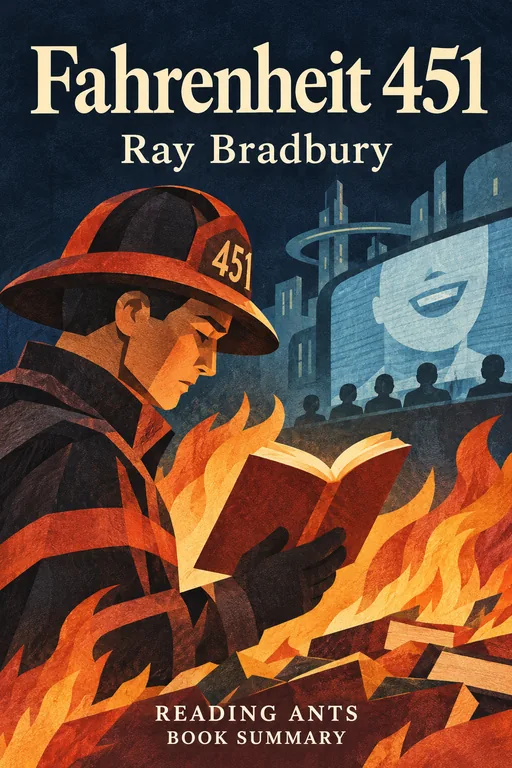
Fahrenheit 451
In a future America where books are illegal and firemen start fires instead of putting them out, one fireman begins to read the books he is supposed to burn, and discovers what his society has lost.
Overview
Fahrenheit 451, by Ray Bradbury, was published in 1953. Its title comes from the temperature at which, Bradbury believed, book paper catches fire and burns. The story takes place in a future American city where houses are fireproof, people spend their time watching giant wall-sized screens, and books are banned because they make people unhappy and different. Guy Montag is a fireman whose job is to burn houses where books are hidden. After a chance meeting with a curious teenage neighbor, Clarisse, and a shocking incident, Montag begins to question everything. Bradbury wrote the novel as a warning against a society that gives up reading, thinking and conversation for entertainment.
Main Characters
- Guy Montag: a fireman who begins to doubt his job.
- Mildred Montag: his wife, addicted to television and sleeping pills.
- Clarisse McClellan: a free-spirited seventeen-year-old who makes Montag think.
- Captain Beatty: Montag’s intelligent, cynical fire chief.
- Faber: a retired English professor who helps Montag.
- Granger: the leader of a group of wandering book-memorizers.
- Mrs. Phelps and Mrs. Bowles: Mildred’s friends.
Full Summary
The Hearth and the Salamander
Guy Montag loves his work. As a fireman in a future America, he uses kerosene to burn books and the houses that hide them, and he takes pleasure in the beauty of flames. One evening, on his way home, he meets his new neighbor, Clarisse, a teenager who asks him if he is happy, and who notices things like dew and the smell of old leaves. Her questions disturb him.
At home, Montag finds his wife, Mildred, unconscious from an overdose of sleeping pills. Medics come with machines, pump her stomach, and leave, treating it as a routine matter. The next day, Mildred has no memory of it. She spends most of her time in a room with three walls of giant television screens, her “family,” and wears small radio “seashells” in her ears.
The Burning
Montag is sent with his crew to burn a house where an old woman has hidden many books. The woman refuses to leave, and when the firemen start the fire, she strikes a match and burns herself alive with her books. Montag, shaken, secretly takes one of the books and hides it under his pillow.
He falls ill and stays at home. Captain Beatty, the fire chief, visits and explains the history of the firemen. According to him, books weren’t banned by government order but because people wanted them gone: minorities objected to offensive content, and people wanted shorter, easier entertainment. Eventually, no one could stand books, since they made people feel stupid or unhappy.
The Professor
Montag, who has stolen a number of books, finds that Mildred hates them and that Clarisse has disappeared; he learns she was killed by a speeding car. He remembers meeting an old man, Faber, a retired English professor, in the park. He goes to Faber and shows him a Bible. Faber explains that books are valuable not for themselves but because they contain quality information, leisure to digest it and the right to act on what we learn.
Faber gives Montag a small radio earpiece so they can talk as he continues to work, and hopes to start a plan to print new books.
Mildred’s Friends
At home, Montag, desperate to reach his wife, reads a poem aloud to Mildred and her friends, women who talk about politics in shallow terms. They are upset. Mildred, ashamed and angry, tries to pass it off as a firemen’s prank, but one of the women, Mrs. Phelps, bursts into tears, and the two women hurry away. Mildred and her friends later report him to the firemen.
The Chase
Montag reports to the fire station and rides out with the crew to an alarm. Beatty, aware that Montag has been reading, taunts him on the way, quoting many different books to demonstrate how they contradict each other. The truck stops at the address: Montag’s own house. Montag is ordered to burn it, and when Beatty continues to mock him, Montag turns the flamethrower on his captain and kills him.
The Mechanical Hound, a robotic killer dog, wounds Montag’s leg before he destroys it, and he flees along the river after a manhunt broadcast on live television, pursued by a second Hound. A false suspect is killed instead, to make the audience believe the chase is over.
The Book People
Montag floats down the river and meets a group of former intellectuals living as hobos, led by Granger. Each of them has memorized a book, so that when the time comes, the books can be written down again. Montag recalls parts of Ecclesiastes and Revelation, and takes on Ecclesiastes as his book.
War breaks out, and enemy jets bomb the city, destroying it in an instant. Mildred is killed. Montag and the group watch the city destroyed from a distance. The group begins walking toward the ruins, intending to help rebuild civilization. Montag recalls a passage from the Bible about a tree of life with leaves for healing the nations, a symbol of hope as the novel ends.
Why It Matters
Fahrenheit 451 is a classic of dystopian fiction, often taught in schools alongside 1984 and Brave New World. Published in the midst of the Cold War and the McCarthy era, it was a response to book burning in Nazi Germany and to the growing influence of television. Bradbury wrote the first version in the basement of the library at UCLA, renting a typewriter by the hour.
The novel is often described as a story about censorship, but Bradbury insisted that its real subject was television and how it distracts people from reading and thinking. Many of its predictions, such as wall-sized screens, earphones that block out the world and people who prefer entertainment to ideas, resemble modern life. It has been adapted into a 1966 film by François Truffaut and a 2018 TV movie.
Key Takeaways
- A society can lose books without being forced. People give up reading by choice.
- Entertainment can distract from thought. Constant screens numb people.
- Knowledge needs time and conversation. Quality information, leisure and action are all needed.
- Individuals can make a difference. Montag chooses to resist.
- Ideas survive through memory. The book people keep literature alive.
What We Can Learn
The novel encourages us to protect our attention and our ability to think. Reading, talking with others and having quiet time are essential. It may help to ask how much time we spend on screens, and how much time we spend learning.
It also shows that censorship doesn’t always come from governments. Sometimes it comes from the desire to avoid offense, or from our own wish for comfort. Being open to different, even challenging, ideas keeps a society free.
Finally, it reminds us that books and stories are carried by people. We can all help keep ideas alive by sharing them.
Criticism and Counterpoints
Some critics find the novel’s picture of a nation of shallow, TV-addicted people too simplistic, and its women characters, such as Mildred and her friends, are rather shallow and stereotyped. Others argue that the plot’s rapid ending, with an atomic war that destroys the city, is too convenient.
The novel’s attitudes to popular culture have also been questioned, since it suggests that television has no value. Bradbury himself later said that he was not against all new media, but against letting it replace thought. Many readers find its central message more relevant than ever.
Who Should Read It
This short novel suits readers from about 13 upward who enjoy science fiction and ideas. It is a good introduction to dystopian fiction. It contains some violence, but is not graphic.
Want the whole book?
A summary is a taste, not the meal. Here is where to find the full book.
You reached the end 🎉
Nicely done. Mark this one as read, and we will suggest what to read next.
Read this next
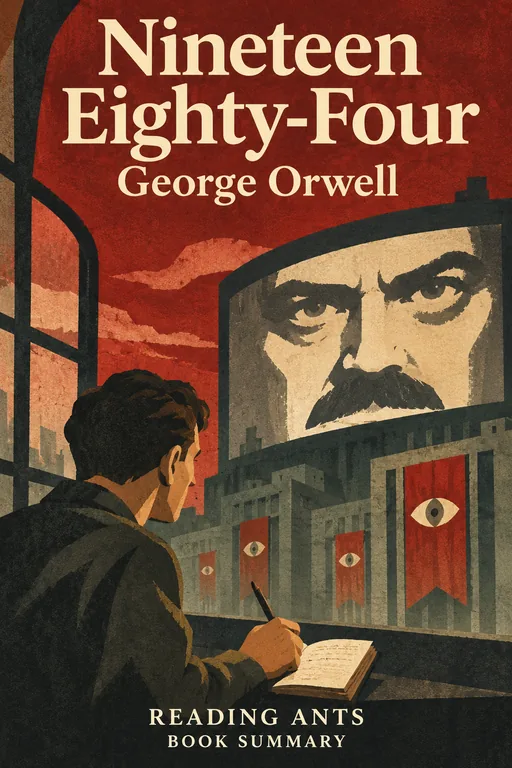
Nineteen Eighty-Four
George Orwell
In a future Britain ruled by an all-seeing Party, one man secretly rebels by keeping a diary and falling in love, and discovers just how completely a totalitarian state can crush the human mind.
📜 Classics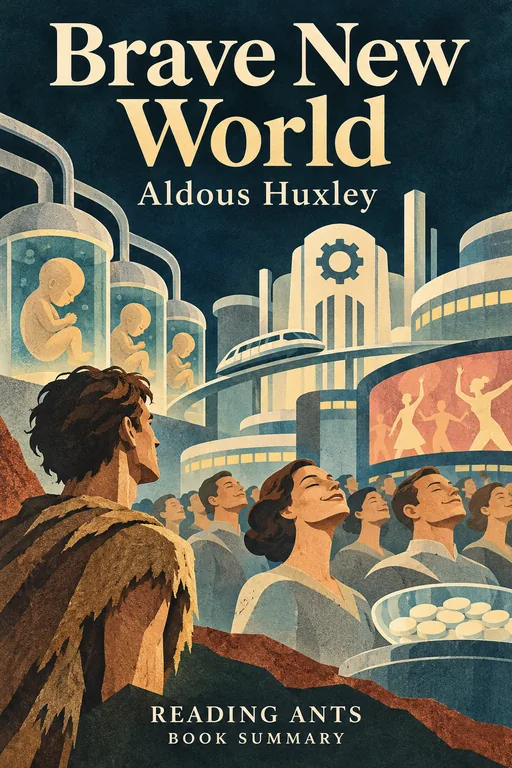
Brave New World
Aldous Huxley
In a future world where people are made in factories, programmed for their roles and kept happy with drugs and entertainment, a man raised outside the system discovers that this perfect comfort comes at the cost of everything that makes us human.
📜 Classics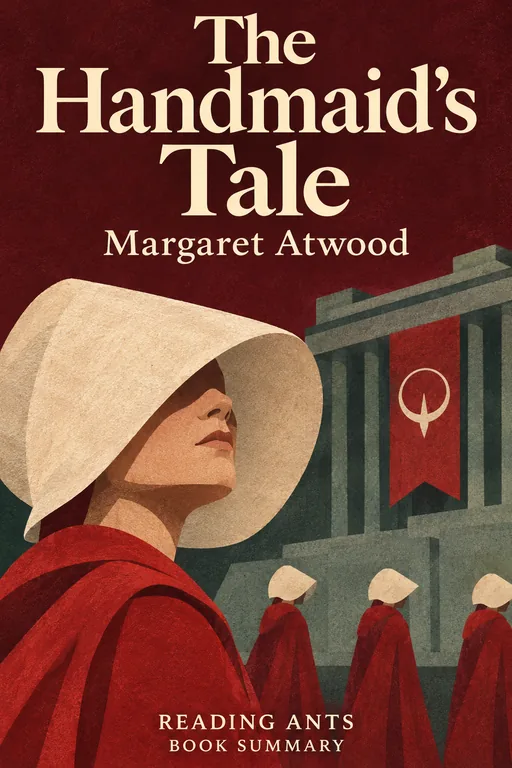
The Handmaid's Tale
Margaret Atwood
In a near-future United States taken over by a religious dictatorship that strips women of their rights, a woman forced to bear children for a powerful couple secretly remembers her old life and searches for a way to survive.
✨ Modern Fiction
We
Yevgeny Zamyatin
In a glass city where everyone lives by a strict timetable and has a number instead of a name, a loyal engineer begins to feel love and doubt, and discovers what it costs to be free.
🌍 World Literature
The Giver
Lois Lowry
In a perfectly controlled community with no pain, choice or color, a boy about to turn twelve is chosen to hold the memories of the past, and discovers the terrible price his people pay for their safety.
🎒 Young Adult
Frankenstein
Mary Shelley
A young scientist creates a living being from dead body parts, then abandons it in horror, and his rejected creation, longing for love, turns to revenge.
🚀 Sci-Fi & FantasyWant something different?
Pick another topic and we will show you three books to start with.