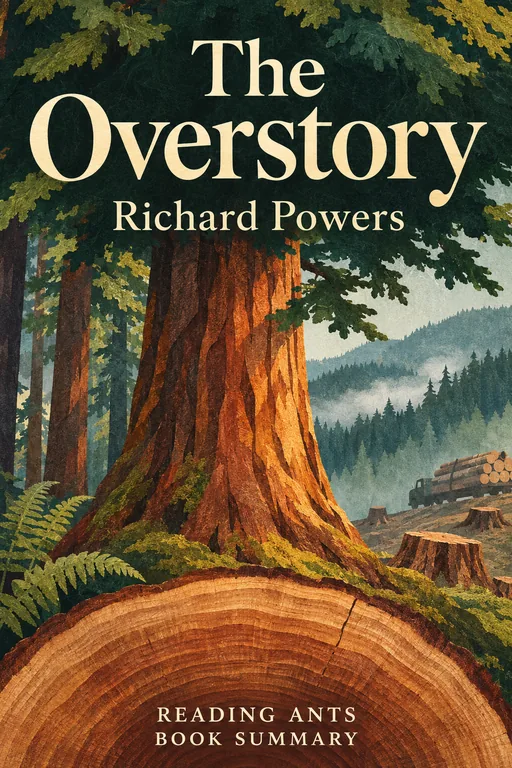
The Overstory
Nine strangers, each changed by an encounter with trees, are drawn together to defend America's old-growth forests, in a novel that treats trees as characters and invites us to see human life as one small part of a much longer one.
Overview
The Overstory is a novel by Richard Powers, published in 2018, which won the Pulitzer Prize for Fiction in 2019. It is made up of four parts, named after the parts of a tree: Roots, Trunk, Crown and Seeds. In the first part, nine characters are introduced in short stories, each tied to a tree or to nature. In later parts, their lives intersect, in the context of the logging wars on the American West Coast. The novel mixes science, history and fiction, and suggests that trees communicate and cooperate. It is a long, ambitious book that asks readers to look at the nonhuman world with new respect.
Main Characters
- Nicholas Hoel: an artist whose family has photographed a chestnut tree for generations.
- Mimi Ma: an engineer whose father plants a mulberry tree in her honor.
- Adam Appich: a psychology student who studies how people respond to environmental threats.
- Patricia Westerford: a botanist who discovers that trees communicate and is mocked.
- Douglas Pavlicek: a Vietnam veteran saved by a banyan tree.
- Olivia Vandergriff: a college student revived after electrocution, who hears a message.
- Neelay Mehta: a paralyzed software designer who creates virtual worlds.
- Ray Brinkman and Dorothy Cazaly: a married couple, a lawyer and a stenographer.
Full Summary
Roots
The novel opens with stories of nine characters. Nicholas Hoel’s family has photographed a chestnut tree each month for generations, and he paints and photographs. Mimi’s father, an immigrant engineer who later takes his own life, plants a mulberry tree, and she studies engineering. Douglas, an airman in Vietnam, survives a plane crash when he falls into a banyan tree. Patricia learns about trees as a child, and as an adult, she shows that trees defend themselves against insects by chemical signals, and they speak to each other. Her research is dismissed.
Each character’s story is a small masterpiece of its own, and takes place in different settings: a farm in Iowa, a suburb in California, a jungle in Vietnam, a university lab. The effect is to show that the lives of strangers, like the roots of trees, are linked under the surface.
Trunk
In the second section, the characters’ paths cross. Olivia Vandergriff, who is electrocuted and revived, is told by voices in her head to save the trees. Nicholas, Mimi, Adam and Douglas meet, with Olivia, on the West Coast, where old-growth redwoods are being cut. Adam Appich, a psychology student, and others begin to take action. They stage protests, living in trees, and chain themselves to logging machines.
Their reasons for joining are varied: grief, anger, faith, a sense of calling. They are not a united movement but a group of individuals who find, in the redwoods, a place where their different griefs meet.
The Tree Sit
Nick and Olivia, the long-term tree sitters, camp in a giant redwood, which they try to defend from loggers, with others joining at times. The protesters live for months on platforms high above the forest floor. They endure cold, hunger and harassment. The sit becomes a symbol of resistance, but there is danger, and the loggers find ways to intimidate them. The sit does not stop the logging, and the group is left discouraged.
Crown
As the movement fails to stop the logging, some of the activists escalate to sabotage, an act which they regard as justifiable, but which turns out to be disastrous. Olivia dies in an arson accident, and the others scatter, hunted by the authorities. Some are arrested and given long prison sentences, while others hide. The group’s belief in the cause is tested by guilt, fear and betrayal under pressure.
Aftermath
The characters face the consequences. Some go to prison, and the strain of what they have done marks them for life. Patricia Westerford, who has achieved fame after her work was recognized, publishes a book about trees and works on a seed bank. In despair at the loss of forests, she nearly takes her own life onstage at a conference.
Seeds
In the final section, the survivors’ stories close. Neelay Mehta, a software designer, uses his skills to create an immersive game and, later, learning and observing artificial intelligence agents. Patricia’s strand is the seed archive. Ray Brinkman’s brain aneurysm, after which he and Dorothy find new meaning in their marriage and in nature, is among the quieter strands. The tale ends with a vision of how artificial intelligence and nature might connect, and with the idea that humans are brief and trees are long. Mimi, who has survived, makes peace with her role. The book closes with Nick’s giant fallen-wood word, STILL, seen from above, a closing image of hope and patience.
Why It Matters
The Overstory won the Pulitzer Prize and brought the issue of forest conservation into the literary mainstream. It sold widely, and has been praised for its scale and its poetic prose. It is often mentioned alongside nonfiction works such as The Hidden Life of Trees and Braiding Sweetgrass in discussions about reconnecting with nature.
The novel has been credited with inspiring readers to learn about trees and to take part in environmental causes, and is frequently recommended in conversations about climate fiction.
The novel also brought many readers to books on forests, and some universities and book clubs have organized tree plantings in response, a sign of its unusual effect for a work of fiction.
Key Takeaways
- Trees are living, communicating beings. The novel invites reverence.
- Humans are short-lived. Trees live for centuries.
- Activism has costs. Protest leads to loss and violence.
- Science can be doubted. Patricia’s work is first dismissed.
- Connection between species matters. The book sees life as a network.
What We Can Learn
The novel invites us to see trees and forests with new eyes, and to understand how much we depend on them. This may prompt us to learn more about our local trees.
It also shows how hard it is to change a society that is built on consumption, and encourages us to think about what actions are effective.
Finally, it reminds us that time is long, and that our short lives are part of a much longer story.
It also reminds us that change often begins with individuals paying attention to something that others overlook.
Criticism and Counterpoints
Some critics find the novel’s human characters thin and its plot loosely connected, with the trees being the real characters. Others say that it is too didactic, and that its message about environmentalism overwhelms the story. Some readers find the second half bleak, and the portrayal of eco-activists simplistic.
A few scientists note that some of the book’s claims about tree communication are popularized beyond the evidence. Still, many readers are inspired.
Who Should Read It
This book suits mature teenagers and adults. It is long, with several threads, and some tragic events. It is a good choice for readers who care about the environment and enjoy ambitious fiction.
Want the whole book?
A summary is a taste, not the meal. Here is where to find the full book.
You reached the end 🎉
Nicely done. Mark this one as read, and we will suggest what to read next.
Read this next
The Hidden Life of Trees
Peter Wohlleben
Forester Peter Wohlleben describes how trees communicate, share resources and care for one another in forests, and argues that we should treat them as living beings with social lives.
🔬 Science
Braiding Sweetgrass
Robin Wall Kimmerer
Botanist and Potawatomi writer Robin Wall Kimmerer weaves together Indigenous wisdom, plant science and personal stories to show that people and the Earth can live in a relationship of gratitude and reciprocity.
🔬 Science
Silent Spring
Rachel Carson
The careless spraying of powerful chemical pesticides like DDT was poisoning birds, fish, soil, water and people, and humans must learn to live with nature instead of waging war on it.
🔬 Science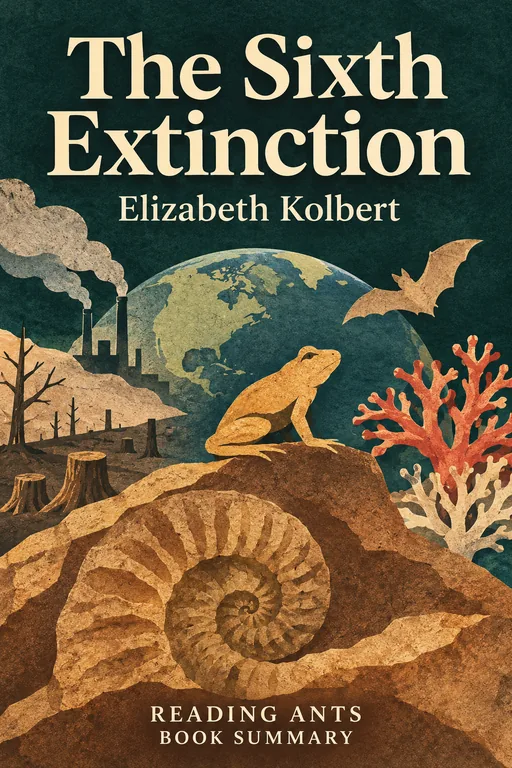
The Sixth Extinction
Elizabeth Kolbert
Elizabeth Kolbert travels the world to show that humans are causing a new mass extinction, the sixth major mass extinction in Earth's history (after the five widely recognized ones), by changing the climate, the oceans and habitats faster than species can adapt.
🔬 Science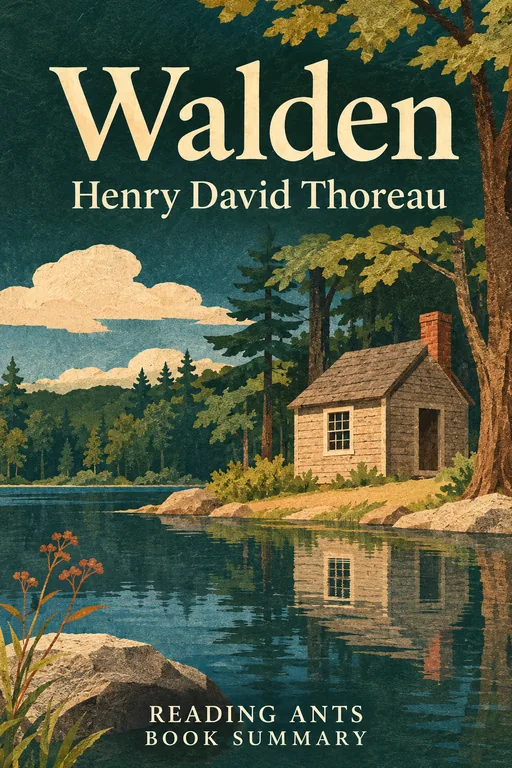
Walden
Henry David Thoreau
Henry David Thoreau describes the two years he spent living simply in a small cabin by Walden Pond in Massachusetts, and argues that people should simplify their lives, spend time in nature and think for themselves.
🕊️ Philosophy & Religion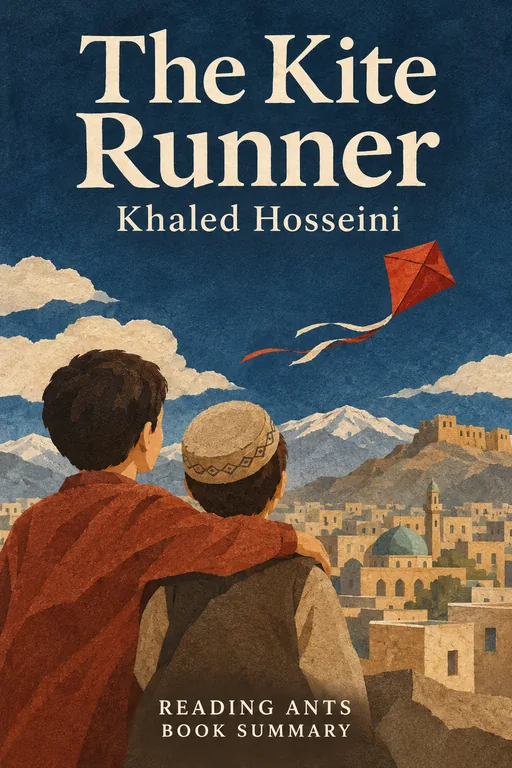
The Kite Runner
Khaled Hosseini
A wealthy boy in Kabul betrays his loyal best friend on the day of a kite tournament, and decades later, after fleeing to America, he returns to a Taliban-ruled Afghanistan to try to make things right.
✨ Modern FictionWant something different?
Pick another topic and we will show you three books to start with.