 Reading Ants
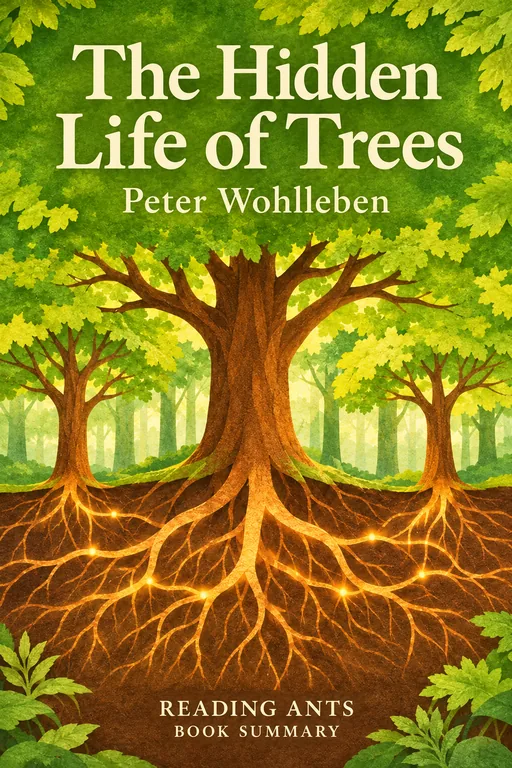
The Hidden Life of Trees
Original title: Das geheime Leben der Bäume
Forester Peter Wohlleben describes how trees communicate, share resources and care for one another in forests, and argues that we should treat them as living beings with social lives.
Overview
The Hidden Life of Trees: What They Feel, How They Communicate was written by the German forester Peter Wohlleben, who manages a forest in the Eifel region of Germany. It was published in German in 2015 and in English in 2016, and became a surprising international bestseller. Wohlleben draws on his decades of work in the forest, on scientific research and on a gift for storytelling. He uses human words, such as friendship, parenting and pain, to describe the lives of trees, which makes his writing vivid, though sometimes controversial. The book consists of short chapters that can be read in any order, each focusing on a different aspect of tree life.
Full Summary
1. Friendship and the wood wide web
The idea: Wohlleben begins with an old mossy stump in the forest that, though it seems dead, is still alive after hundreds of years. He explains that the neighboring trees feed it with sugar through their roots, as if nursing it. He describes how trees in a forest are connected by networks of fungi around their roots, known as mycorrhizal networks, through which they share nutrients and information. This underground network, nicknamed the “wood wide web,” lets stronger trees support weaker ones.
In real life: Next time you walk in a forest, think of the invisible threads of fungi connecting the roots beneath your feet.
2. Warning signals and communication
The idea: Trees can also communicate through the air and through their roots. When an animal such as a giraffe or an antelope nibbles on a tree’s leaves, the tree may release chemicals into the air that signal neighbors to produce substances that make their leaves taste bad. Wohlleben also cites studies of trees responding to insect attacks by releasing scents that attract predators of the pests. These signals suggest that trees warn each other and defend themselves collectively.
In real life: Researchers studying African acacia trees browsed by animals such as giraffes and antelope have reported this kind of chemical warning in the wild.
3. Mother trees and the raising of young
The idea: In a dense forest, young trees grow slowly in the shade of their elders, which Wohlleben compares to a family. Old trees, he suggests, support seedlings through root connections and by shaping the environment, and they slow down the growth of the young, which helps them develop strong, dense wood. This slow growth lets them live much longer than trees that grow too fast in the open. He calls the large old trees “mother trees.”
In real life: Trees that grow slowly under a canopy can become stronger and healthier than those in full sun.
4. Seasons, water and survival
The idea: The book explains how trees handle the challenges of the seasons. In autumn, leaves change color as trees withdraw valuable substances, and in winter they enter a rest period. Trees also transport water from roots to leaves by pressure and evaporation, over tens of meters, in ways scientists are still studying. Wohlleben describes how trees survive storms, drought and pests, and why forests influence weather by releasing moisture and cooling the air.
In real life: Walking in a forest on a hot day feels cooler because trees release water vapor through their leaves.
5. Forests and human management
The idea: Wohlleben criticizes commercial forestry that plants rows of the same species and harvests them young, with heavy machines that compact the soil. He argues that such forests are less healthy, more prone to pests and storms and lack the social structure of natural forests. In his own forest, he has stopped using machinery in some areas, allowed trees to grow old and worked more gently, finding that this can still produce timber while protecting the ecosystem.
In real life: A forest with many species and ages is generally more resilient to disease than a field of identical trees.
6. A call for respect
The idea: The final sections invite readers to look at forests with fresh eyes. Wohlleben suggests that trees may feel pain in some basic way, a claim that goes beyond what scientists can prove, and that humans should reflect on how to live with forests, not only use them. He hopes that learning about trees will lead people to protect old forests and appreciate them. He ends with the thought that getting to know trees can bring a sense of wonder and humility.
In real life: Spending time in a forest, even a small one, can lower stress and invite curiosity about nature.
Why It Matters
The book sold millions of copies in dozens of languages and prompted widespread public interest in forests, and in the “wood wide web.” It inspired documentaries, children’s books and discussions about how we manage woodlands, and encouraged people to look at trees in a new way.
It helped popularize research on tree communication and cooperation, such as the work of the Canadian ecologist Suzanne Simard, and encouraged a more careful approach to forestry in some places.
The book also reached readers who rarely read about science, because it uses stories and warm language, and many report that it changed how they feel on a walk in the woods.
Key Takeaways
- Trees are connected. Roots and fungi link them in networks.
- Trees can warn each other. Chemical signals spread danger alerts.
- Old trees support young ones. Forests have a kind of family structure.
- Diverse forests are healthier. Natural woods are more resilient.
- Wonder inspires care. Knowing trees can encourage protection.
What We Can Learn
The book invites us to slow down and notice the natural world. Spending time near trees, observing their shapes and seasonal changes, can reveal much that is usually overlooked.
It also reminds us that cooperation is common in nature. Although we often think of competition, forests show that sharing and support can help many individuals survive.
Finally, it encourages us to think about the effects of our choices on living systems, from how we manage forests to what wood and paper we buy.
Criticism and Counterpoints
Many scientists have criticized the book for using human language and for stating some speculative claims as facts. For example, the idea that trees “feel pain” or “love” and the claim that mother trees deliberately nurture their young are not supported by clear evidence. Researchers also dispute how widely and how much trees really share resources through fungal networks, and some have argued that popular accounts overstate the findings.
Other critics point out that Wohlleben, a forester who runs a forest academy, sometimes oversimplifies forestry practices in general. Some readers find the anthropomorphic tone charming; others find it misleading. It is best treated as an invitation to curiosity and then checked against scientific sources.
Who Should Read It
This book suits readers from about age ten up to adults. The chapters are short and easy to enjoy, and it is a good gift for nature lovers. Readers should be aware that some of its claims are controversial among scientists.
Want the whole book?
A summary is a taste, not the meal. Here is where to find the full book.
You reached the end 🎉
Nicely done. Mark this one as read, and we will suggest what to read next.
Read this next
Braiding Sweetgrass
Robin Wall Kimmerer
Botanist and Potawatomi writer Robin Wall Kimmerer weaves together Indigenous wisdom, plant science and personal stories to show that people and the Earth can live in a relationship of gratitude and reciprocity.
🔬 Science
The Sixth Extinction
Elizabeth Kolbert
Elizabeth Kolbert travels the world to show that humans are causing a new mass extinction, the sixth major mass extinction in Earth's history (after the five widely recognized ones), by changing the climate, the oceans and habitats faster than species can adapt.
🔬 Science
Walden
Henry David Thoreau
Henry David Thoreau describes the two years he spent living simply in a small cabin by Walden Pond in Massachusetts, and argues that people should simplify their lives, spend time in nature and think for themselves.
🕊️ Philosophy & Religion
The Omnivore's Dilemma
Michael Pollan
By following four meals from the soil to the plate, Michael Pollan shows how modern food is produced, and asks what we should eat when we can choose almost anything.
⚖️ Politics & Society
A Brief History of Time
Stephen Hawking
One of the world's greatest physicists explains, with almost no math, what we know about the origin, structure and fate of the universe, from the Big Bang to black holes and the nature of time itself.
🔬 Science
On the Origin of Species
Charles Darwin
All living things are related and have slowly changed over immense periods of time, shaped by natural selection, the process by which individuals better suited to their environment survive and pass on their traits.
🔬 ScienceWant something different?
Pick another topic and we will show you three books to start with.