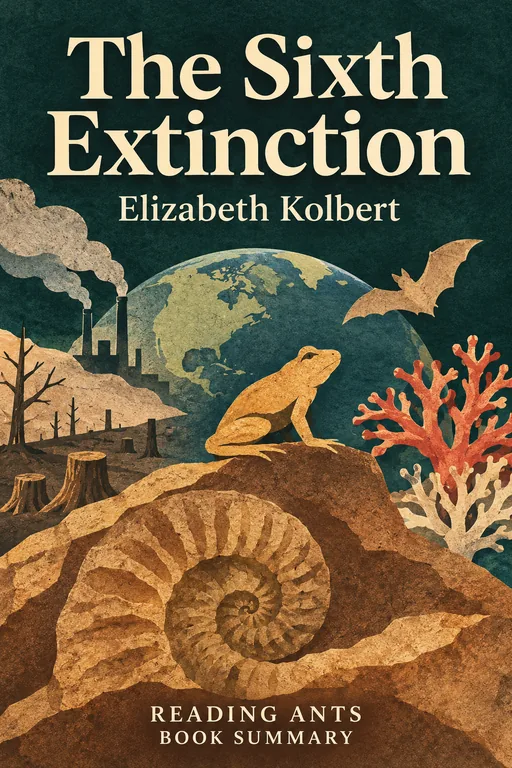
The Sixth Extinction
Elizabeth Kolbert travels the world to show that humans are causing a new mass extinction, the sixth major mass extinction in Earth's history (after the five widely recognized ones), by changing the climate, the oceans and habitats faster than species can adapt.
Overview
The Sixth Extinction: An Unnatural History was written by Elizabeth Kolbert, a staff writer at The New Yorker, and published in 2014. It won the Pulitzer Prize for General Nonfiction in 2015. Kolbert, who had written about climate change, set out to investigate the idea that Earth is entering a new period of mass extinction, caused by people. She visited places ranging from the Panamanian rain forest to the Great Barrier Reef, and spoke with scientists studying frogs, bats, coral, trees and fossils. Each chapter tells the story of one species and one idea, from the discovery of extinction as a concept to the modern threats of climate change, habitat loss and invasive species.
Full Summary
1. The idea of extinction
The idea: Kolbert begins in Panama, where scientists are trying to save golden frogs, which are vanishing because of a fungus called chytrid. She then goes back in time to the 1790s and early 1800s, when the French naturalist Georges Cuvier showed, through fossil bones such as those of mammoths and mastodons, that species can disappear forever, an idea that was radical at the time. Together, these stories introduce the central question of the book: are we in the midst of a mass extinction?
In real life: Learning that a whole species can vanish makes the loss of a single frog or bird seem like part of a larger pattern.
2. Catastrophes of the past
The idea: The book recounts the five previous mass extinctions in Earth’s history, the most famous being the one that killed the dinosaurs about sixty-six million years ago, which scientists now link to an asteroid impact, as proposed by Luis and Walter Alvarez. Kolbert explains the evidence, such as a thin layer of iridium-rich clay found in rocks around the world. Other mass extinctions were caused by volcanic eruptions and changes in climate and ocean chemistry, showing that massive change can lead to mass death.
In real life: A layer of rock with unusual chemicals can be a clue to a global event that happened millions of years ago.
3. The acid oceans
The idea: Kolbert travels to the Bay of Naples and to the Great Barrier Reef to study ocean acidification. As the oceans absorb carbon dioxide from the air, their water becomes more acidic, which makes it harder for corals, mollusks and some plankton to build shells and skeletons. Coral reefs, home to a quarter of marine species, are also threatened by warming water. She shows that changes in ocean chemistry have played a role in earlier extinctions.
In real life: Scientists have found that shells of some sea creatures grow thinner in more acidic water.
4. Forests, islands and invaders
The idea: Kolbert visits a long-running study in the Amazon rain forest, where scientists have studied how breaking forests into small patches reduces the number of species. She also discusses how people move species around the world, intentionally or accidentally. Some of these invaders do great harm: the fungus that causes white-nose syndrome, for example, has killed millions of bats in North America. Habitat loss and invasive species often work together to push native species to the brink.
In real life: A small patch of forest cut off from other forests cannot support as many different animals and plants as a large one.
5. Lost giants and ourselves
The idea: The book also looks at how humans have affected animals for tens of thousands of years. Kolbert discusses the disappearance of the great auk, a flightless seabird hunted to extinction in the 1800s, and of many large mammals in different parts of the world, and the possibility that early humans contributed to the loss of those mammals. She visits a laboratory studying Neanderthal DNA and explains that modern humans interbred with Neanderthals and replaced them, raising the question of whether humans were a cause of that vanishing too.
In real life: The arrival of people in Australia and the Americas is linked in time with the loss of many large animals, though scientists debate why.
6. The age of humans
The idea: In the final chapters, Kolbert argues that we live in the Anthropocene, an age in which human activity is the main force shaping the planet. She stresses that the current rate of extinction is far higher than the natural background rate, and that it is likely to accelerate as the climate continues to change. She meets people working to save endangered species, such as the Sumatran rhino, and concludes that humans may be the first species to understand that they are causing a mass extinction, and thus the first with the chance to act.
In real life: Conservation programs, such as breeding endangered animals in captivity, can give some species a chance but cannot replace healthy habitats.
Why It Matters
The Sixth Extinction brought the idea of a human-caused mass extinction to a wide audience, and helped shape public understanding of biodiversity loss. It was widely praised for its clear, vivid reporting and became a staple in environmental science classes and book clubs.
The book contributed to growing attention to biodiversity and to the connections between climate change, ocean chemistry, habitat destruction and species loss. It appeared alongside scientific assessments and reports that have since confirmed the high rate of species decline.
The book also gave readers a way to feel the scale of a slow-moving crisis, by showing individual animals and the researchers who care for them, which is a technique that many later environmental writers have copied.
Key Takeaways
- Extinction is real and permanent. Once a species is gone, it cannot return.
- We may be in a mass extinction. Rates are far above natural levels.
- Many pressures act together. Climate change, habitat loss and invasive species combine.
- Oceans are changing. Acidification threatens corals and shellfish.
- Humans have the power to act. Understanding the problem is a step toward solving it.
What We Can Learn
The book teaches us to pay attention to the living world around us. Learning the names and stories of species in our own neighborhoods can make their loss feel real and encourage protection.
It also shows how connected environmental problems are. Burning fossil fuels affects the climate and the oceans, which in turn affect plants and animals, so solutions need to address multiple causes.
Finally, it invites us to combine sadness with hope. Kolbert’s reporting shows both loss and the dedication of people working to save species, a reminder that effort can matter.
Criticism and Counterpoints
Some scientists point out that the term “mass extinction” involves very precise definitions, and that current extinction rates are difficult to measure, since many species are poorly known. Estimates vary widely, and not everyone agrees that the present can be called a sixth extinction yet, though most agree the trend is very serious.
Other readers find the book discouraging, with little discussion of solutions or policy. Some also note that it focuses on a handful of dramatic examples and that it sometimes simplifies debates about the causes of past extinctions, such as the role of humans in the loss of large mammals. Still, many appreciate its clear storytelling.
Who Should Read It
This book suits teenagers and adults. It is written in an engaging, sometimes humorous style, but its subject is sobering. It is a good introduction to biodiversity and climate change for general readers.
Want the whole book?
A summary is a taste, not the meal. Here is where to find the full book.
You reached the end 🎉
Nicely done. Mark this one as read, and we will suggest what to read next.
Read this next
Silent Spring
Rachel Carson
The careless spraying of powerful chemical pesticides like DDT was poisoning birds, fish, soil, water and people, and humans must learn to live with nature instead of waging war on it.
🔬 Science
The Omnivore's Dilemma
Michael Pollan
By following four meals from the soil to the plate, Michael Pollan shows how modern food is produced, and asks what we should eat when we can choose almost anything.
⚖️ Politics & Society
A Short History of Nearly Everything
Bill Bryson
Bill Bryson sets out to understand how we know what we know about the universe, the Earth and life, and tells the story through the odd, brilliant and sometimes unlucky people who figured it out.
🏛️ History
Braiding Sweetgrass
Robin Wall Kimmerer
Botanist and Potawatomi writer Robin Wall Kimmerer weaves together Indigenous wisdom, plant science and personal stories to show that people and the Earth can live in a relationship of gratitude and reciprocity.
🔬 Science
The Hidden Life of Trees
Peter Wohlleben
Forester Peter Wohlleben describes how trees communicate, share resources and care for one another in forests, and argues that we should treat them as living beings with social lives.
🔬 Science
A Brief History of Time
Stephen Hawking
One of the world's greatest physicists explains, with almost no math, what we know about the origin, structure and fate of the universe, from the Big Bang to black holes and the nature of time itself.
🔬 ScienceWant something different?
Pick another topic and we will show you three books to start with.