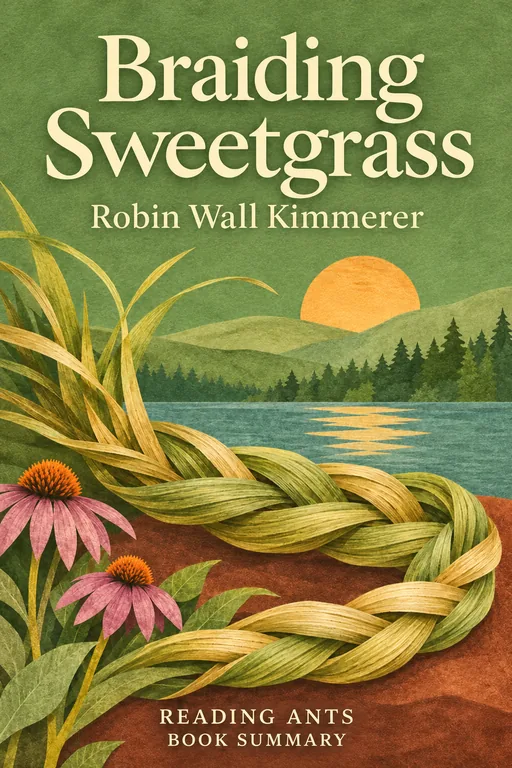
Braiding Sweetgrass
Botanist and Potawatomi writer Robin Wall Kimmerer weaves together Indigenous wisdom, plant science and personal stories to show that people and the Earth can live in a relationship of gratitude and reciprocity.
Overview
Braiding Sweetgrass: Indigenous Wisdom, Scientific Knowledge, and the Teachings of Plants is a collection of essays by Robin Wall Kimmerer, a professor of environmental biology at the State University of New York and a member of the Citizen Potawatomi Nation. It was published in 2013 and rose slowly to become a bestseller years later. Sweetgrass is a fragrant plant, sacred to many Native peoples, which is braided in ceremonies as a sign of care. Kimmerer’s own work combines scientific methods with traditional Native knowledge. The book is arranged in five sections: Planting Sweetgrass, Tending Sweetgrass, Picking Sweetgrass, Braiding Sweetgrass and Burning Sweetgrass, which follow the cycle of gathering and care.
Full Summary
1. Skywoman and the gift of the world
The idea: Kimmerer begins with the story of Skywoman, from an Indigenous creation tradition of the Northeast and Great Lakes region. Skywoman falls from the Sky World and is caught by geese, then lands on the back of a turtle, where animals bring up mud from the sea floor to form land. She scatters seeds she carried with her and the Earth turns green. Kimmerer contrasts this story of a woman who arrives as a guest and is cared for by the Earth, and who in turn cares for it, with the story of Eve, who was cast out of a garden. The first story, she says, shapes a culture of gratitude.
In real life: The stories we tell about our place in the world influence how we treat it.
2. The gift economy of plants
The idea: Throughout the book, Kimmerer shows that the natural world operates on reciprocity. She tells about a patch of wild strawberries, which she receives as a gift, not a possession, and how that attitude changes the way she harvests. She contrasts the “market economy,” where goods are bought and sold, with a “gift economy,” in which gifts create relationships and responsibilities. She suggests that when we treat the land as a gift, we feel an obligation to give back.
In real life: Picking berries in someone’s field with permission and thanks is different from simply taking.
3. The Honorable Harvest
The idea: Kimmerer describes a set of principles known as the Honorable Harvest, which many Indigenous cultures practice. They include asking permission before taking, never taking the first or the last of something, taking only what you need, using everything you take, giving thanks and sharing, and giving something back. She illustrates these with stories of harvesting wild leeks, which are slow to regrow, and sweetgrass, which actually grows better when it is carefully picked than when it is left alone.
In real life: Following simple rules like taking only what you need and sharing can make using resources more sustainable.
4. Science and Native knowledge together
The idea: Kimmerer trained in botany at a time when science tended to dismiss Indigenous knowledge. She tells how her studies of mosses and sweetgrass helped her see the value of combining the two ways of knowing. Western science, she says, excels at measuring and analyzing, while Indigenous knowledge adds relationships, meaning and responsibility. She tells about studies showing that harvesting sweetgrass in a respectful way increases its abundance, which confirms what traditional gatherers had long known.
In real life: Land managers today sometimes work with Indigenous communities to learn about controlled burning and other long-practiced methods.
5. Language and grammar of animacy
The idea: Kimmerer writes about learning the Potawatomi language, which is endangered. She notes that in Potawatomi, most words are verbs, and that living beings, such as trees, rivers and rocks, are referred to with animate grammar, as persons, not as objects labeled “it.” She suggests that this grammar shapes how people relate to the world. She proposes using a new word in English, “ki,” to refer to nonhuman beings, as a way of including them in our moral community.
In real life: Saying “who” instead of “what” for an animal or tree is a small change that can shift how we think about it.
6. Restoration and reciprocity
The idea: In the later essays, Kimmerer discusses damaged landscapes and the need for restoration, not just conservation. She tells the story of the Windigo, a greedy, cannibalistic monster of Anishinaabe tales, as a warning against overconsumption. She also shares examples of communities restoring ponds, planting trees and reviving old practices. She argues that humans can be good members of the ecosystem, giving back as well as taking, and she ends with a hopeful call for gratitude and action.
In real life: Planting native species or cleaning a stream are practical ways to give something back to the land.
Why It Matters
Braiding Sweetgrass became one of the most beloved books in nature writing and environmental thought, selling over a million copies, largely through word of mouth. It brought Indigenous perspectives to a wide readership, and has been widely read in schools and universities, and in conservation circles.
The book gives readers a language for hope in a time of ecological crisis, one based not on guilt but on gratitude and relationship. It has influenced scientists, teachers, gardeners and activists, and has helped open conversations about the value of traditional ecological knowledge.
It also showed that a book can be both rigorous and tender: Kimmerer’s essays combine careful observation of plants with stories, memory and humor, which is why many readers return to it again and again.
Key Takeaways
- The land is a gift. Gratitude shapes how we treat it.
- Reciprocity matters. Take with care and give back.
- Two ways of knowing. Science and Indigenous knowledge complement each other.
- Language shapes thought. How we speak about nature affects how we treat it.
- Hope is active. Restoration is something we can do.
What We Can Learn
The book invites us to rethink our relationship with nature, from a relationship of use to one of respect and care. A simple practice of giving thanks for food or water can remind us that we depend on living systems.
It also demonstrates the value of listening to different traditions. Indigenous communities have centuries of experience living in particular places, and their insights can enrich modern science and policy.
Finally, it encourages us to take small actions. Planting a tree, caring for a patch of land or learning the names of local plants are ways of practicing reciprocity.
Criticism and Counterpoints
Some readers feel that the book romanticizes Native peoples and traditional ways of living, and that it understates the diversity of Indigenous cultures or the fact that they also change the environment. Others, including some scientists, say that parts of the book rely more on personal reflection than on evidence, and that the blend of science and spirituality does not satisfy everyone.
A few critics argue that suggestions such as new pronouns or a gift economy are impractical in a modern society. Others note that the book’s gentle tone avoids discussing political conflicts over land and resources. Still, most readers find it moving and inspiring.
Who Should Read It
This book suits readers from about age ten up to adults. The essays are short, lyrical and can be read in any order, though some contain advanced science words. It is a good book for reading slowly, outdoors if possible.
Want the whole book?
A summary is a taste, not the meal. Here is where to find the full book.
You reached the end 🎉
Nicely done. Mark this one as read, and we will suggest what to read next.
Read this next
The Hidden Life of Trees
Peter Wohlleben
Forester Peter Wohlleben describes how trees communicate, share resources and care for one another in forests, and argues that we should treat them as living beings with social lives.
🔬 Science
Walden
Henry David Thoreau
Henry David Thoreau describes the two years he spent living simply in a small cabin by Walden Pond in Massachusetts, and argues that people should simplify their lives, spend time in nature and think for themselves.
🕊️ Philosophy & Religion
The Sixth Extinction
Elizabeth Kolbert
Elizabeth Kolbert travels the world to show that humans are causing a new mass extinction, the sixth major mass extinction in Earth's history (after the five widely recognized ones), by changing the climate, the oceans and habitats faster than species can adapt.
🔬 Science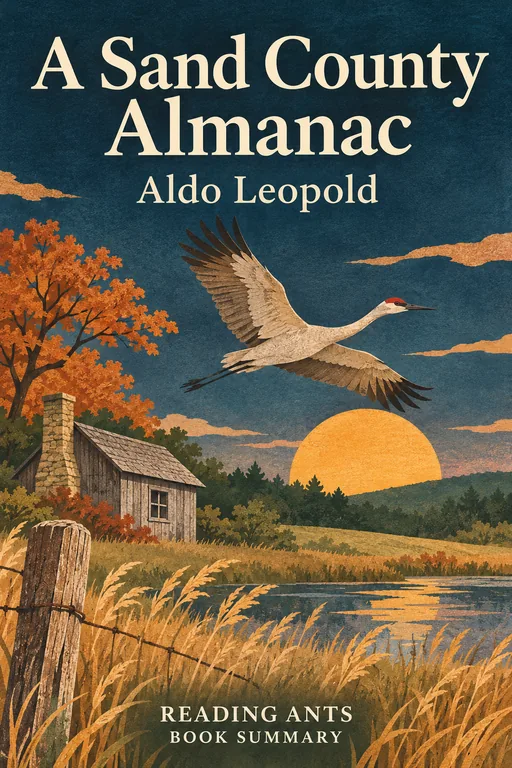
A Sand County Almanac
Aldo Leopold
Forester and ecologist Aldo Leopold describes a year on a worn-out Wisconsin farm and his travels, and argues for a "land ethic," a view in which humans are members of the community of the land, with a duty to care for it.
🔬 Science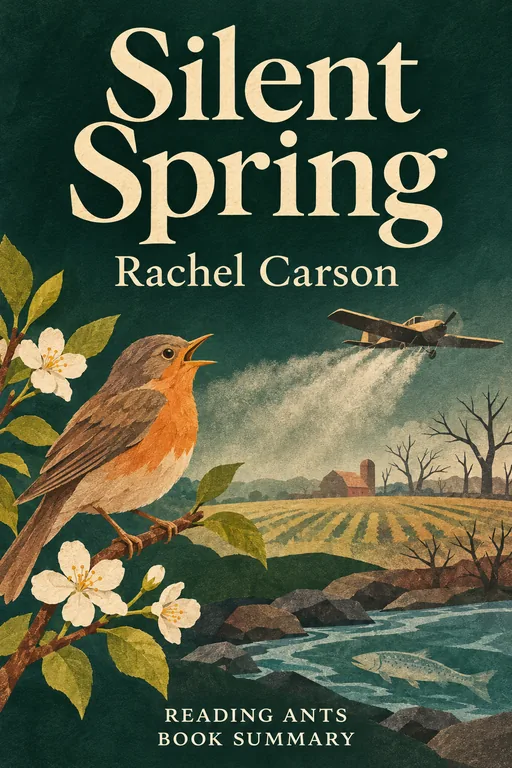
Silent Spring
Rachel Carson
The careless spraying of powerful chemical pesticides like DDT was poisoning birds, fish, soil, water and people, and humans must learn to live with nature instead of waging war on it.
🔬 Science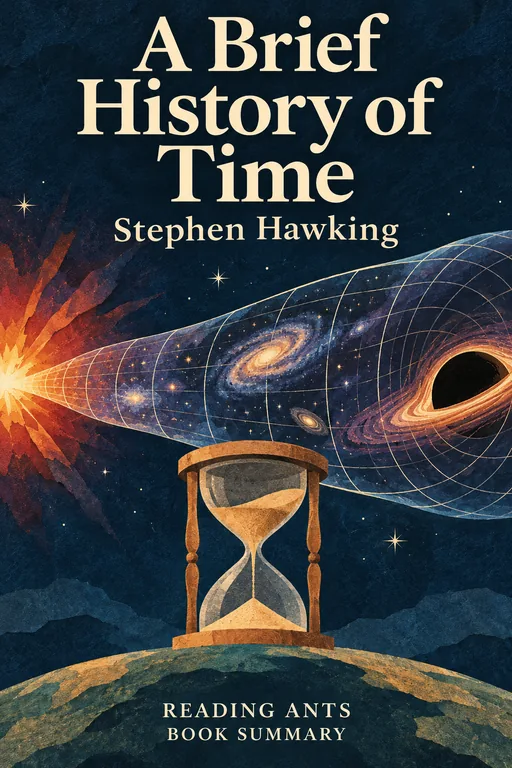
A Brief History of Time
Stephen Hawking
One of the world's greatest physicists explains, with almost no math, what we know about the origin, structure and fate of the universe, from the Big Bang to black holes and the nature of time itself.
🔬 ScienceWant something different?
Pick another topic and we will show you three books to start with.