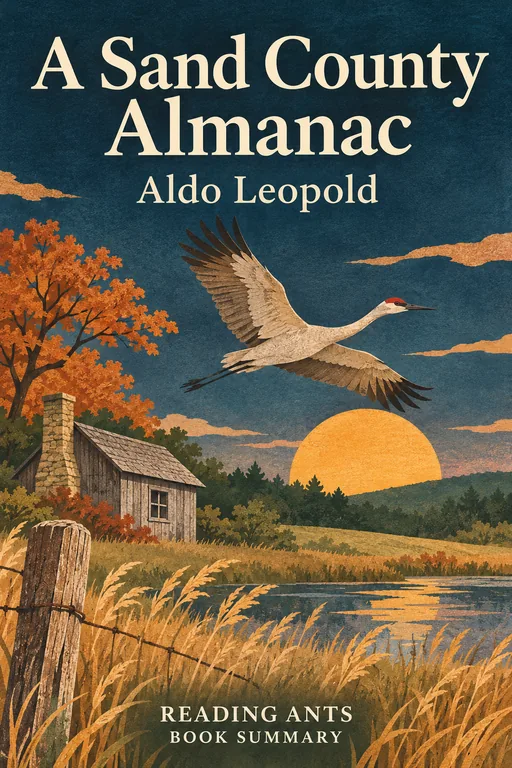
A Sand County Almanac
Forester and ecologist Aldo Leopold describes a year on a worn-out Wisconsin farm and his travels, and argues for a "land ethic," a view in which humans are members of the community of the land, with a duty to care for it.
Overview
A Sand County Almanac, and Sketches Here and There was published in 1949, the year after the death of Aldo Leopold, a professor of wildlife management at the University of Wisconsin and a pioneer of conservation. In the 1930s, he and his family began restoring a worn-out farm on sandy soil in central Wisconsin, with a weathered shack, and they spent much of their free time there. The book has three parts: a month-by-month almanac of the farm, a set of sketches from places where he had lived and worked, and a series of essays on conservation, ending with “The Land Ethic.” It is a classic of nature writing.
Full Summary
1. A year on the shack farm
The idea: In the first part, Leopold describes the seasons at the farm, in short essays that follow the months. In January, he follows a mouse and a thaw, and in April, the courtship flight of the woodcock at dusk. He writes of the geese returning and of pines that he planted. Each observation shows the connections among soil, plants, animals and weather, and his joy in the details of nature.
In real life: Noticing which birds arrive each spring shows how the seasons are linked.
2. Thinking like a mountain
The idea: One of the best-known essays recounts an episode from his younger days as a forester in the Southwest, when he shot a wolf and watched “a fierce green fire” die in her eyes. He realized that he and others had believed that fewer wolves meant more deer, and that this meant hunter’s paradise. But, after wolves were removed, the deer multiplied until they stripped the mountain of vegetation. He concludes that only the mountain itself has the long view, and that we must think like it.
In real life: Removing one animal from a system can cause unforeseen problems for the rest.
3. The sketches: lessons from many places
The idea: The second part, “Sketches Here and There,” collects writings from various landscapes, in Canada, Mexico and the United States, including Wisconsin, Iowa and the Southwest. In one, he describes a trip to a river delta in Mexico, which was wild and rich, and he mourns the loss of such places. These sketches show his sense of history and his love of wild places.
In real life: The rings of a tree trunk can tell you about droughts and wet years long ago.
4. The shortcomings of conservation and the value of wilderness
The idea: In the third part, Leopold discusses conservation, and says that an approach based only on economics fails, since most species and places have no commercial value, but are essential to the health of ecosystems. He values wilderness as a place of recreation and as a reminder of the origins of our culture. He criticizes the idea that nature exists only to be used, and says that hunters and farmers should be stewards, not just takers.
In real life: A wetland may not produce money, but it cleans water and shelters wildlife.
5. The land ethic
The idea: The final essay sets out his main idea. Ethics, Leopold says, have expanded over time, from rules among individuals to the relation between the individual and society. The next step is a land ethic, which enlarges the boundaries of the community to include soils, waters, plants and animals, or collectively, the land. A person with a land ethic stops acting as the land’s master and instead sees himself as one citizen among the others, respecting his fellow members and the community as a whole.
In real life: Treating a river as a neighbor and not as a trash dump is a land ethic in practice.
6. A thing is right when it preserves integrity
The idea: Leopold gives a simple test for his ethic, which is that an action is right if it helps to keep the living community whole, steady and beautiful, and wrong if it does the opposite. He also says that a land ethic cannot be created by law alone, but requires a change in our inner views, in love, respect and admiration. He accepts that this is a slow process, and calls for education and a change in how we see our relationship to land.
In real life: Choosing to protect a local wood because you love it is stronger than a rule that you resent.
Why It Matters
A Sand County Almanac is a landmark of environmental literature, and one of the founding texts of the modern conservation movement. The idea of the land ethic has influenced ecologists, philosophers and policy makers, and has shaped how many people think about the relation between humans and nature. The book has sold more than two million copies and remains in print. Its prose, simple and moving, makes it a pleasure to read, and its message that we belong to a community with other living things has resonated with generations. It prepared the ground for Rachel Carson’s Silent Spring and later environmental writing.
Key Takeaways
- We are part of the land community. Humans are members, not owners.
- Ecosystems are interconnected. Removing one piece affects the others.
- Economics alone is not enough. Many valuable things have no price.
- Ethics can expand. The circle of concern can include soils, water and wildlife.
- Love and respect drive change. Laws need a change of heart.
What We Can Learn
You can start by paying attention to the nature near you, such as the birds, plants and weather, and keep a simple journal of the seasons. Learn about the original ecology of your area. Take part in restoring a local park or planting native species. Think about the effects of your choices on other living things. And apply the test of Leopold in daily choices: does this help or harm the health of the community of life? Spending time outdoors is a good way to begin.
Criticism and Counterpoints
Some philosophers say that the land ethic is vague, and that it is not clear how to balance the interests of individuals and the whole, and that its emphasis on the community may seem to give less weight to individual animals, which animal rights thinkers criticize. Others note that Leopold, as a hunter and forester, accepted the killing of animals for management, and that ecological science has since changed, as the idea of a stable balance has given way to dynamic views. Some critics say that his writing is romantic. Still, it remains a respected classic.
Who Should Read It
This book is for readers who love nature and good writing, including older children. The essays are short and can be read in any order. Those who want a scientific guide to ecology should read it alongside modern texts.
Want the whole book?
A summary is a taste, not the meal. Here is where to find the full book.
You reached the end 🎉
Nicely done. Mark this one as read, and we will suggest what to read next.
Read this next
Silent Spring
Rachel Carson
The careless spraying of powerful chemical pesticides like DDT was poisoning birds, fish, soil, water and people, and humans must learn to live with nature instead of waging war on it.
🔬 Science
Walden
Henry David Thoreau
Henry David Thoreau describes the two years he spent living simply in a small cabin by Walden Pond in Massachusetts, and argues that people should simplify their lives, spend time in nature and think for themselves.
🕊️ Philosophy & Religion
The Voyage of the Beagle
Charles Darwin
Charles Darwin's lively journal of his five-year voyage around the world on HMS Beagle records the animals, plants, rocks and peoples that he saw, and the observations that led him toward the theory of evolution.
🔬 Science
In the Shadow of Man
Jane Goodall
Jane Goodall tells how, as a young woman with no scientific degree, she went to Tanzania and learned to know wild chimpanzees as individuals, discovering that they make tools, have emotions and lead complex social lives.
🔬 Science
Entangled Life
Merlin Sheldrake
Biologist Merlin Sheldrake takes readers into the hidden world of fungi, showing how these strange organisms, which are neither plants nor animals, shape ecosystems, forge partnerships with plants, and may help to solve human problems.
🔬 Science
A Brief History of Time
Stephen Hawking
One of the world's greatest physicists explains, with almost no math, what we know about the origin, structure and fate of the universe, from the Big Bang to black holes and the nature of time itself.
🔬 ScienceWant something different?
Pick another topic and we will show you three books to start with.