 Reading Ants
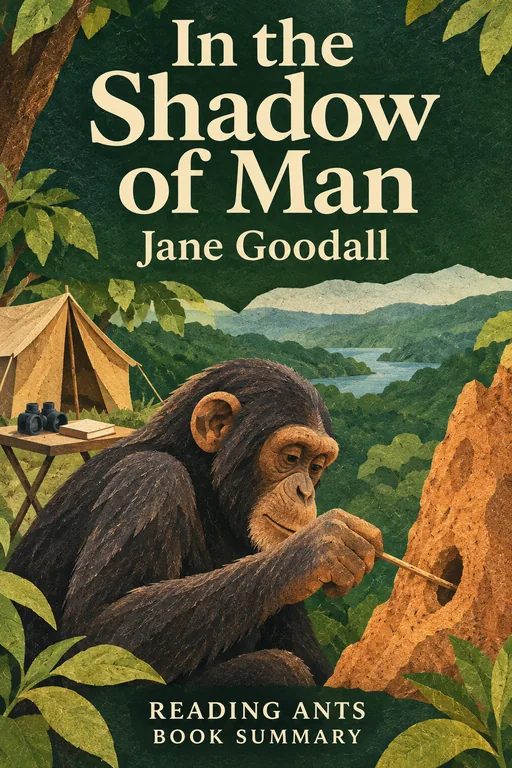
In the Shadow of Man
Jane Goodall tells how, as a young woman with no scientific degree, she went to Tanzania and learned to know wild chimpanzees as individuals, discovering that they make tools, have emotions and lead complex social lives.
Overview
In the Shadow of Man was published in 1971 by Jane Goodall, an English primatologist, who began her study of chimpanzees in 1960, at Gombe Stream in what is now Tanzania, at the invitation of the anthropologist Louis Leakey. She was in her twenties. The book is an account of her first decade in the forest, written in a lively and personal style, with photographs. It records her observations of the chimpanzees’ behavior, and the difficulties and joys of living in the bush. Her work changed science’s view of chimpanzees, and of what separates humans from other animals.
Full Summary
1. Beginnings: a dream and a camp by the lake
The idea: Goodall tells how, as a girl, she dreamed of living with animals in Africa. She saved for a trip to Kenya, where she met Leakey, who took her on as his secretary and assistant and later sent her to study chimpanzees. She and her mother, who came with her at first, set up camp by Lake Tanganyika, and she spent months tracking the elusive chimpanzees through the hills, with little success at first.
In real life: Patience and persistence can win the trust of shy creatures.
2. Gaining their trust
The idea: Over time, the chimpanzees began to accept her, as she watched them patiently from a distance. One of the first she got to know was a gray-chinned male she named David Greybeard, who let her come close. She used names instead of numbers for the animals, which was unusual in science at the time, and noted their distinct personalities. She also began to feed them bananas at camp, which helped her to observe them, though it later caused some problems.
In real life: Giving a name to an animal makes you see it as an individual.
3. Tool-making and meat-eating
The idea: A key discovery came when she saw David Greybeard use a grass stalk to fish termites from a mound, and later saw him and another male strip the leaves from twigs to make them work better. Until then, scientists believed that only humans made tools. Goodall sent news to Leakey, who replied that we must redefine tool, redefine man or accept chimpanzees as humans. She also found that chimpanzees hunt and eat meat, including young pigs and monkeys, and not only fruit, which surprised many scientists, who had assumed that they were vegetarians.
In real life: A single careful observation can overturn an accepted belief.
4. Family and social life
The idea: The author describes the social lives of chimpanzees, with its dominance among males, grooming, and strong bonds between mothers and children. She follows the family of a female she called Flo, who was an affectionate, playful and tolerant mother, and her offspring, including Fifi, Figan and the infant Flint, and records how the young learn. She also tells how a low-ranking male, Mike, rose to the top of the hierarchy by banging empty kerosene cans during his charging displays, and how he took the place of the former leader, Goliath. She notes emotional displays, such as play, grief, and comfort through touching and embracing. These parallels led her to stress how much humans and chimpanzees share, though she also points to real differences, such as speech.
In real life: A child learns from watching and being close to its mother, as chimpanzees do.
5. Dark sides and illness
The idea: Goodall also records difficult events. An outbreak of polio killed or crippled several chimpanzees in the 1960s, and she describes the sad fate of a paralyzed male, Mr. McGregor, whom the other chimpanzees avoided and who did not survive. She also shows aggression and the strength of the male hierarchy. The violent conflict between neighboring chimpanzee groups that she reported later is not part of this 1971 book.
In real life: Learning about the darker side of a species you love can be painful.
6. Life in the forest, and the future
The idea: In the later chapters, Goodall reflects on her own life at Gombe: the beauty and the hardships of the forest, her marriage to the photographer Hugo van Lawick, who came to film the chimpanzees, and the birth of their son, Grub. She describes how the research grew, with assistants, a research center and tighter control of feeding, and the beginnings of a long-term study that is now among the longest running of any wild animal. She also expresses concern about threats to chimpanzees, such as capture, the loss of habitat and poor conditions in captivity, and notes some signs of hope, including growing protection by governments. She ends with the view that long-term study of chimpanzees will help us to understand ourselves.
In real life: A long study of one place can reveal changes that are not seen in a short visit.
Why It Matters
In the Shadow of Man is a classic of nature writing and primatology. Goodall’s observations changed the scientific understanding of animals, by showing that chimpanzees make tools, hunt, have complex social relationships and display emotions, and by challenging the sharp line between humans and other animals. Her use of names and her focus on individuals influenced how scientists study behavior. The study at Gombe continues, and she became a global advocate for conservation, with the Jane Goodall Institute and the Roots & Shoots program for young people. The book has inspired many people to pursue science.
Key Takeaways
- Patience gives insight. Quiet observation revealed secrets.
- Animals are individuals. Chimpanzees have personalities and emotions.
- Humans are not entirely unique. Tool use and culture appear in other species.
- Long-term study matters. Years of watching show patterns.
- Conservation is urgent. Wild populations and their forest homes face serious threats.
What We Can Learn
You can try watching an animal, such as a bird or squirrel, for fifteen minutes in silence, and writing down what it does. Notice the personalities of pets. Be open to evidence that changes a belief, as in the discovery of tool use. Support conservation projects, and the protection of habitats. If you are curious about science but think that you do not have the right background, remember that Goodall began with curiosity and persistence. Treat animals with respect and kindness.
Criticism and Counterpoints
Some scientists criticized Goodall’s early methods, such as naming animals and describing their emotions, as unscientific and anthropomorphic, though this is now more accepted. Others argued that feeding the chimpanzees bananas altered their behavior and increased aggression, a risk she herself discusses in the book. Some of her interpretations of chimpanzee behavior have been revised by later research, and some of the group conflict she later reported has been debated. However, her contribution to science is widely recognized.
Who Should Read It
This book is for readers of all ages who love animals, nature and adventure. It is warmly written and easy to follow. Those who want a scientific overview of primate research can read more recent works, and may wish to see Goodall’s own later books.
Want the whole book?
A summary is a taste, not the meal. Here is where to find the full book.
You reached the end 🎉
Nicely done. Mark this one as read, and we will suggest what to read next.
Read this next
My Family and Other Animals
Gerald Durrell
Gerald Durrell recalls his boyhood on the Greek island of Corfu in the 1930s, where he collected animals of every kind, while his eccentric English family tried to cope with life in the sun.
👤 Real Lives
An Immense World
Ed Yong
Science journalist Ed Yong explores the astonishing range of ways that animals sense the world, from bats that see with sound to fish that feel electric fields, and shows that every species lives in its own private sensory bubble.
🔬 Science
The Voyage of the Beagle
Charles Darwin
Charles Darwin's lively journal of his five-year voyage around the world on HMS Beagle records the animals, plants, rocks and peoples that he saw, and the observations that led him toward the theory of evolution.
🔬 Science
A Sand County Almanac
Aldo Leopold
Forester and ecologist Aldo Leopold describes a year on a worn-out Wisconsin farm and his travels, and argues for a "land ethic," a view in which humans are members of the community of the land, with a duty to care for it.
🔬 Science
Walden
Henry David Thoreau
Henry David Thoreau describes the two years he spent living simply in a small cabin by Walden Pond in Massachusetts, and argues that people should simplify their lives, spend time in nature and think for themselves.
🕊️ Philosophy & Religion
A Brief History of Time
Stephen Hawking
One of the world's greatest physicists explains, with almost no math, what we know about the origin, structure and fate of the universe, from the Big Bang to black holes and the nature of time itself.
🔬 ScienceWant something different?
Pick another topic and we will show you three books to start with.