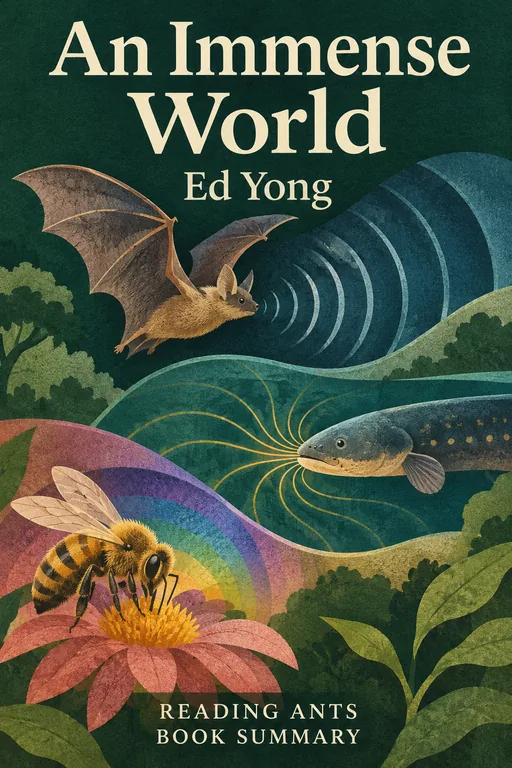
An Immense World
Science journalist Ed Yong explores the astonishing range of ways that animals sense the world, from bats that see with sound to fish that feel electric fields, and shows that every species lives in its own private sensory bubble.
Overview
An Immense World: How Animal Senses Reveal the Hidden Realms Around Us was published in 2022 by Ed Yong, a science journalist who won a Pulitzer Prize in 2021 for his reporting on the COVID-19 pandemic, while a staff writer at The Atlantic. The book is built on a concept from the zoologist Jakob von Uexkull, the umwelt, the part of the world that an animal can perceive and that matters to it. Yong goes through the senses one by one, and shows how different the worlds of different animals are. He visits laboratories and fields, and talks to many scientists. The result is a book of wonder and humility.
Full Summary
1. The idea of the umwelt
The idea: Yong opens by asking you to imagine a school gym that holds an elephant, a mouse, a robin, an owl, a bat, a rattlesnake, a spider, a mosquito, a bumblebee and a person, and to think about how differently each of them would sense the very same room. He then introduces the umwelt, a word popularized by the zoologist Jakob von Uexkull in 1909 for the part of the surroundings that an animal can actually sense and experience. A tick searching for a mammal, for example, cares about body heat, the touch of hair and the smell of butyric acid, and the rest of the world simply does not exist for it. Humans are limited too, and we easily mistake what we perceive for everything there is to perceive. Yong says plainly that this is not a book that ranks animals by how sharp their senses are, and he warns that forgetting other umwelten is a quiet form of anthropomorphism. Understanding animals takes curiosity and imagination.
In real life: A dog that stops to sniff a fire hydrant is reading who has passed by, a message you cannot sense.
2. Smell and taste
The idea: The first chapter covers the chemical senses, which Yong calls the most ancient and universal of all. Dogs have far more smelling hardware than people, including many more neurons in the nose and a nose that keeps odors flowing steadily, and they can do feats such as telling identical twins apart by scent. Yong also warns that comparing the smell of different animals is often meaningless, and he argues that human noses are better than textbooks claim. Seabirds called tubenoses, a group that includes albatrosses and shearwaters, follow the smell of a gas called dimethyl sulfide to find rich feeding waters over the open ocean. Ants run their societies with chemical signals called pheromones, and snakes smell with their forked tongues. Taste works differently: many insects taste with their feet, and catfish have taste buds all over their bodies. Because we are such visual creatures, Yong notes, smell is easy to overlook.
In real life: Letting a dog take a slow, sniffy walk gives it a chance to use its main sense.
3. Sight and light
The idea: Vision varies greatly across the animal kingdom. Jumping spiders use large central eyes to see sharply and smaller side eyes to detect movement, and scallops have dozens of eyes, up to around 200 in some species, though they may not see whole scenes the way we do. Most animals that can see color can also see ultraviolet light. Flowers such as sunflowers have ultraviolet bullseyes at the base of their petals that bees can see, while to us they look plain. Mantis shrimps have 12 classes of color receptors, yet experiments showed that they are poor at telling similar colors apart. In the deep ocean, sunlight fades to blue and then to darkness, many animals make their own light, and the giant squid has enormous eyes that probably help it spot the glow that sperm whales stir up.
In real life: A flower that looks plain to you may have a bright landing target for bees.
4. Pain and heat
The idea: Yong shows that even pain and temperature are tuned to each animal’s life. Naked mole-rats, which live in crowded underground nests where carbon dioxide builds up, do not feel pain from acids or from the chemical that makes chili peppers burn, although they still dislike pinches and burns. Thirteen-lined ground squirrels do not mind low temperatures that would feel painfully cold to a mouse, which lets them hibernate. Rattlesnakes have two pits on the snout that sense the infrared heat of warm prey, so they can effectively see heat.
In real life: A chili pepper burns because it triggers a sensor that normally detects painful heat.
5. Touch, vibration and sound
The idea: The next chapters deal with touch, flow, surface vibrations and hearing. The star-nosed mole explores its tunnels with a star-shaped nose, and harbor seals use their whiskers to follow the wakes left by fish. Wood crickets sense the air pushed ahead of an attacking spider with tiny hairs. Many insects, including treehoppers, communicate with vibrations that travel through plants, and spiders feel through the silk of their webs. Elephants make deep infrasound rumbles in the air that people cannot hear, and they can also pick up signals through the ground. Male crickets sing to attract females, and a parasitic fly has learned to find them by listening in. Many moths have ears that can hear bats, and the clicks of tiger moths and the long tails of luna moths help to confuse the bats.
In real life: A treehopper on a leaf is sending songs that you can hear only with the help of a device.
6. Echolocation
The idea: Bats and dolphins use sonar, sending out sounds and reading the echoes to build a picture of what lies ahead. A bat can find a spider in its web and pluck it away in the dark, and Yong follows researchers who study how bats track moths and how moths fight back. The book stresses that this sense, though impressive, can still be tricked.
In real life: A bat catching an insect in the dark is using sound as you use sight.
7. Electricity and magnetism
The idea: Some animals have senses that humans lack. Knifefishes and other electric fish make electric fields and sense distortions in them, which they use to find their way and to communicate in murky rivers. Sharks and rays can detect the faint electric signals of buried prey. Many animals can sense the Earth’s magnetic field and use it as a compass, including migrating songbirds such as European robins, sea turtles, big brown bats and mole-rats. Yong explains that scientists are still working out how this sense works, and several explanations are still being tested.
In real life: A baby sea turtle swimming out into the open ocean is guided by a built-in magnetic compass.
8. Protecting the senses we share
The idea: In the last chapters, Yong considers how animals combine information from their senses, and then how human activity is disrupting their sensory worlds. Artificial light at night pulls migrating songbirds toward bright city lights and lures newly hatched sea turtles away from the sea. Noise from ships makes humpback whales stop singing and stresses other animals, and pesticides can weaken the sense of smell that guides salmon back to their home streams. He argues that sensory pollution is a form of environmental harm. The good news is that light and noise stop as soon as they are turned down, so they are among the easiest problems to fix. He ends by urging humility, and by saying that humans are the only animals that can try to imagine what the others sense.
In real life: Turning off unneeded outdoor lights can help migrating birds.
Why It Matters
An Immense World was widely praised as a work of science writing. It introduced the concept of the umwelt to a general audience, and brought the research of many scientists to the page. The book encourages readers to be curious about the creatures around them, and to imagine other ways of perceiving. It also highlights environmental issues, such as light and noise pollution, that are less discussed. It invites readers to see a walk with a dog in a new way, and it reminds us that our own perception is only one small slice of the world.
Key Takeaways
- Each animal has its own sensory world. The umwelt is what matters to a creature.
- Senses vary widely. Animals see, hear and feel things that we cannot.
- Hidden senses exist. Electricity and magnetism guide some species.
- Human activity disrupts senses. Light, noise and chemicals can harm animals.
- Humility and wonder are appropriate. Our perception is limited.
What We Can Learn
You can use the book to look at pets, birds and insects with curiosity, and to ask what the world is like for them. Spend a few minutes watching an animal and think about what it might sense. Reduce light and noise pollution where you can, such as by closing curtains at night or avoiding unnecessary lights, and let a dog sniff on its walks. Learn about local wildlife. And remember that our own senses are limited, so we should be modest in our claims about what is real. This is also a good reason to protect other species.
Criticism and Counterpoints
Some scientists point out that senses such as magnetoreception are not yet well understood, so findings in those areas are tentative. Others note that it is hard to know what animals actually experience, and that language about their “worlds” involves guesswork. The book is long, and some readers may find that the survey of many species can feel like a list. Some of the experiments described raise ethical questions about the treatment of animals. Still, the book is widely praised.
Who Should Read It
This book is for readers of all ages who love animals and nature, and who like learning surprising facts. It is easy to read and full of vivid examples. Those who want a technical review of sensory biology can consult scientific textbooks.
Want the whole book?
A summary is a taste, not the meal. Here is where to find the full book.
You reached the end 🎉
Nicely done. Mark this one as read, and we will suggest what to read next.
Read this next
Entangled Life
Merlin Sheldrake
Biologist Merlin Sheldrake takes readers into the hidden world of fungi, showing how these strange organisms, which are neither plants nor animals, shape ecosystems, forge partnerships with plants, and may help to solve human problems.
🔬 Science
In the Shadow of Man
Jane Goodall
Jane Goodall tells how, as a young woman with no scientific degree, she went to Tanzania and learned to know wild chimpanzees as individuals, discovering that they make tools, have emotions and lead complex social lives.
🔬 Science
Your Inner Fish
Neil Shubin
Paleontologist Neil Shubin shows, through the discovery of a fossil fish with the beginnings of limbs, that the human body carries traces of its ancient ancestors, so that our hands, heads and even hiccups can be explained by evolution.
🔬 Science
The Body: A Guide for Occupants
Bill Bryson
Bill Bryson takes a funny and amazed tour of the human body, from the skin to the brain, and the history of those who have studied it, to show how remarkable, complicated and fragile our bodies are.
🔬 Science
A Sand County Almanac
Aldo Leopold
Forester and ecologist Aldo Leopold describes a year on a worn-out Wisconsin farm and his travels, and argues for a "land ethic," a view in which humans are members of the community of the land, with a duty to care for it.
🔬 Science
A Brief History of Time
Stephen Hawking
One of the world's greatest physicists explains, with almost no math, what we know about the origin, structure and fate of the universe, from the Big Bang to black holes and the nature of time itself.
🔬 ScienceWant something different?
Pick another topic and we will show you three books to start with.