 Reading Ants
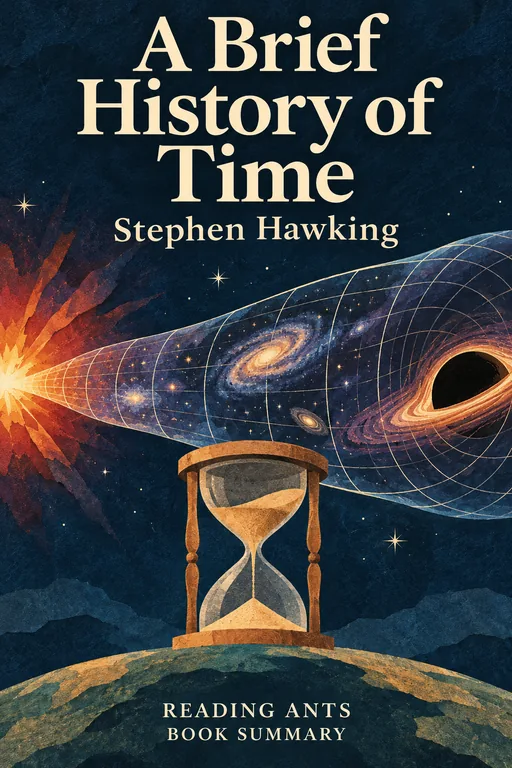
One of the world's greatest physicists explains, with almost no math, what we know about the origin, structure and fate of the universe, from the Big Bang to black holes and the nature of time itself.
Overview
A Brief History of Time is Stephen Hawking’s attempt to explain the biggest questions in science to ordinary readers: Where did the universe come from? Did it have a beginning, and will it have an end? What are black holes? Why does time move forward and not backward? Hawking, a Cambridge physicist who lived for decades with the motor neuron disease ALS, takes readers on a tour from ancient ideas about the cosmos through Newton and Einstein to the frontier of modern physics, including his own discoveries. By his own account, he includes only one equation, Einstein’s famous E = mc², and relies on clear explanations and diagrams instead. The book became one of the best-selling science books ever.
Full Summary
1. How our picture of the universe changed
The idea: People once believed the Earth was the center of everything. Over centuries, thinkers such as Copernicus, Galileo and Kepler showed that the Earth orbits the Sun, and Isaac Newton explained the movement of the planets with his law of gravity. Hawking explains that a scientific theory is a model that describes observations and makes predictions that can be tested. A theory can never be proven completely, but it can be disproven by a single observation that contradicts it.
From the book: Hawking opens with a story about a scientist giving a public lecture on astronomy. Afterward an elderly woman insists that the world is really a flat plate resting on the back of a giant tortoise. Asked what the tortoise stands on, she replies that it is tortoises all the way down. Hawking uses the story to ask what makes our own modern picture better.
In real life: Weather forecasts are models, too. They aren’t perfect, but they improve as scientists test them against what actually happens.
2. Space and time are linked
The idea: Einstein’s theory of relativity changed our understanding of space and time. The speed of light in a vacuum is the same for observers moving at constant speeds relative to one another, which means time can run at different speeds for people moving relative to each other. Space and time are woven together into “spacetime,” and massive objects like the Sun bend it, which is what we feel as gravity. Light passing near a star follows this curve.
In real life: The GPS satellites that guide phone maps must correct for relativity. Their clocks tick at slightly different rates from clocks on Earth, and without corrections, the maps would quickly become inaccurate.
3. The universe is expanding
The idea: In the 1920s, the astronomer Edwin Hubble discovered that distant galaxies are moving away from us, and the farther they are, the faster they move. This means the universe is expanding. Running the film backward, everything must once have been packed together in an extremely hot, dense state: the Big Bang. Hawking and Roger Penrose showed mathematically that, if Einstein’s theory is correct, the universe must have begun with a “singularity,” a point where the laws of physics break down.
In real life: Imagine dots drawn on a balloon. As you blow it up, every dot moves away from every other dot, and no dot is at the center. That’s a simple picture of how galaxies spread apart.
4. The strange world of quantum physics
The idea: At the scale of atoms and particles, nature behaves very differently. The uncertainty principle says we can never know both the exact position and the exact speed of a particle at the same time. Particles also behave like waves. Hawking explains the four basic forces of nature: gravity, electromagnetism and the strong and weak nuclear forces. Physicists have tried to combine these forces into a single theory, but uniting gravity with quantum physics remains the greatest unsolved problem.
In real life: Quantum physics sounds abstract, but it is the basis for computer chips, lasers and the screens on our phones.
5. Black holes aren’t completely black
The idea: When a very massive star collapses, it can form a black hole, a region where gravity is so strong that nothing, not even light, can escape. Its boundary is called the event horizon. Hawking’s most famous discovery was that, because of quantum effects, black holes should slowly give off radiation, now called Hawking radiation. This means black holes can gradually lose energy and, over enormous periods of time, may eventually evaporate.
In real life: Black holes are no longer just theory. In 2019, astronomers released the first image of the shadow of a black hole, captured by a network of telescopes around the world.
6. Why time moves forward
The idea: The laws of physics mostly work the same forward and backward in time, so why do we remember the past and not the future? Hawking describes three “arrows of time”: the direction in which disorder increases, the direction in which we remember, and the direction in which the universe expands. He argues that they all point the same way, and that this is connected to the conditions in which intelligent life can exist.
In real life: A broken cup never jumps back together on its own. Things tend to move from order to disorder, which is why your bedroom gets messy unless you tidy it.
7. The search for a theory of everything
The idea: Hawking describes his own “no-boundary” idea, developed with James Hartle: the universe may be finite in time yet have no edge or starting point, just as the surface of the Earth is finite but has no edge. In the updated edition he also discusses wormholes and the possibility of time travel, alongside string theory, and ends with the hope of finding a complete theory that explains everything. If we found it, he writes, it would be the ultimate triumph of human reason, allowing everyone to take part in discussing why the universe exists.
In real life: Scientists at huge experiments, like the Large Hadron Collider near Geneva, are still searching for clues to the theory Hawking hoped for.
Why It Matters
A Brief History of Time became a publishing phenomenon. It stayed on bestseller lists for years, sold millions of copies and was translated into dozens of languages. It made cosmology and black holes topics of popular conversation, and it turned Hawking into one of the most famous scientists in the world, a symbol of curiosity and determination despite severe disability.
The book inspired a wave of popular science writing and encouraged many young people to study physics. It showed that difficult science could be shared with the public, and it helped make ideas like the Big Bang, black holes and the search for a “theory of everything” part of general culture. Hawking later wrote simpler versions, including A Briefer History of Time.
Key Takeaways
- The universe began in a hot, dense state. Evidence points to a Big Bang and expansion from that early state, while Hawking asks whether time itself needs a sharp starting edge.
- Space and time are flexible. Gravity is the bending of spacetime by mass and energy.
- Black holes radiate. Quantum effects let them slowly lose energy.
- Physics is incomplete. Combining gravity and quantum theory remains an open challenge.
- Science is a human adventure. Theories are models we keep testing and improving.
What We Can Learn
Hawking’s book encourages us to keep asking big questions. Wondering where everything came from isn’t only for scientists; curiosity is something every person can practice, whether by reading, stargazing or visiting a science museum.
It also teaches how science works: ideas are tested, and good scientists change their minds when the evidence demands it. Hawking himself revised some of his views over his career. In our own lives, being willing to update our beliefs when we learn something new is a sign of strength, not weakness.
Finally, Hawking’s life shows that obstacles need not stop us from contributing to the world. He continued working and communicating for decades, using a speech computer.
Criticism and Counterpoints
The book is famous for being bought by many people who never finished it. Despite Hawking’s efforts, later chapters on quantum physics, imaginary time and the no-boundary proposal are difficult for general readers. Some reviewers felt that explanations were too brief for such complex ideas.
Parts of the science have also aged. Since 1988, discoveries such as the accelerating expansion of the universe and dark energy have changed cosmology, and Hawking’s own views on topics like black hole information evolved. Some readers also found the closing references to knowing “the mind of God” confusing, since Hawking later made clear he did not believe in a creator. Updated editions and his later books address some of these points.
Who Should Read It
This book is ideal for curious teens and adults who want to understand modern physics without equations. Readers new to science may find it challenging in places and might start with A Briefer History of Time or Astrophysics for People in a Hurry. Physics enthusiasts will enjoy hearing the ideas from one of the scientists who shaped them.
Want the whole book?
A summary is a taste, not the meal. Here is where to find the full book.
You reached the end 🎉
Nicely done. Mark this one as read, and we will suggest what to read next.
Read this next
Cosmos
Carl Sagan
Carl Sagan takes readers on a journey from the Earth to the edge of the universe, blending astronomy, history and philosophy to show how humanity came to understand the cosmos and our place in it.
🔬 Science
The Elegant Universe
Brian Greene
Physicist Brian Greene explains in plain language how string theory tries to unite Einstein's relativity and quantum mechanics by picturing the smallest things in nature as tiny vibrating strings in a universe with extra dimensions.
🔬 Science
Brief Answers to the Big Questions
Stephen Hawking
Physicist Stephen Hawking, in a posthumous book drawn from his lectures and writing, gives short answers to ten of the biggest questions that people ask, from the origin of the universe to the future of humanity.
🔬 Science
Seven Brief Lessons on Physics
Carlo Rovelli
Italian physicist Carlo Rovelli gives seven short, poetic lessons on the biggest ideas in modern physics, from Einstein's relativity to quantum theory, the structure of the cosmos, particles, gravity, heat and time, and our place in it all.
🔬 Science
Astrophysics for People in a Hurry
Neil deGrasse Tyson
Astrophysicist Neil deGrasse Tyson gives a fast, friendly tour of the biggest ideas in modern astronomy, from the Big Bang to dark matter and the search for other worlds, in a short book you can read in a few hours.
🔬 Science
On the Origin of Species
Charles Darwin
All living things are related and have slowly changed over immense periods of time, shaped by natural selection, the process by which individuals better suited to their environment survive and pass on their traits.
🔬 ScienceWant something different?
Pick another topic and we will show you three books to start with.