 Reading Ants
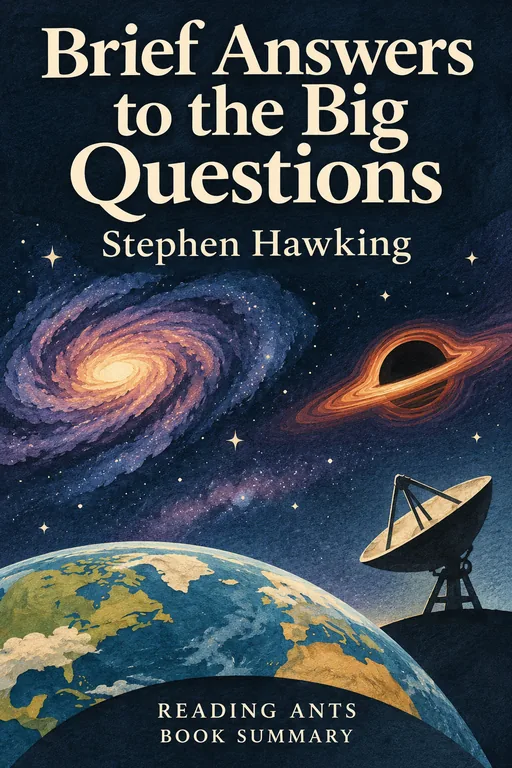
Brief Answers to the Big Questions
Physicist Stephen Hawking, in a posthumous book drawn from his lectures and writing, gives short answers to ten of the biggest questions that people ask, from the origin of the universe to the future of humanity.
Overview
Brief Answers to the Big Questions was published in 2018, a few months after the death of Stephen Hawking, the English theoretical physicist known for his work on black holes and for his bestselling A Brief History of Time. He had been paralyzed by motor neuron disease and communicated through a speech device. Over the years, Hawking was asked many questions by the public, and he had been collecting his answers. The book, with a foreword by the actor Eddie Redmayne, an introduction by the physicist Kip Thorne and an afterword by his daughter Lucy, is structured around ten questions, each answered in a short chapter, in his clear and humorous style.
Full Summary
The book has ten chapters, one per question. This summary treats the first five separately and groups the last five (survival, space, artificial intelligence and the future) in section 6.
1. Is there a God?
The idea: Hawking says that science can explain how the universe began without needing a creator, and that he believes that the laws of physics are enough. He argues that the universe could have appeared from nothing under the laws of quantum physics, that the positive energy of matter is balanced by the negative energy of space, and that time itself began at the Big Bang, so there was no earlier time in which a creator could act. He says the simplest explanation is that there is no God, though he adds that he has no wish to offend people of faith, and that if people want to call the laws of science “God,” it would not be a personal God.
In real life: People often disagree about whether science and religion answer different questions.
2. How did it all begin?
The idea: The author explains the Big Bang theory, that the universe was once very small, hot and dense, and has been expanding for about 13.8 billion years. He says that space and time exist only within the universe, so asking what came before the Big Bang may not make sense, like asking for a point south of the South Pole. He describes how quantum fluctuations in the early universe were the seeds for structures such as galaxies, and how the laws of physics lead from this to the structure we see.
In real life: Asking what is south of the South Pole shows how a question can lose meaning.
3. Is there other intelligent life in the universe?
The idea: Hawking considers the chance that there is life elsewhere, and why the galaxy does not seem to be full of it. Life may be very unlikely to start, intelligence may be an unlikely result of evolution, a collision with an asteroid or comet may wipe out life, or intelligent civilizations may destroy themselves. He discusses the Breakthrough Listen project, which searches for signals, but advises caution about answering back until we have developed further, and compares meeting a more advanced civilization to the original inhabitants of America meeting Columbus.
In real life: A smaller group meeting a stronger one may be at risk.
4. Can we predict the future?
The idea: The book discusses whether the universe is determined. Hawking says that the laws of science, in principle, allow prediction, but in practice, the world is too complex, and quantum mechanics puts a limit on certainty. He also discusses free will, since we cannot predict what people will do. He tells how Laplace imagined a universe fully determined by the laws of science, and how that idea is limited by the uncertainty principle and by chaos.
In real life: Even weather cannot be forecast far in advance because small changes matter.
5. What is inside a black hole?
The idea: In a chapter about his own field, Hawking explains black holes, regions of space where gravity is so strong that nothing, not even light, can escape. He explains that black holes are not completely black but emit a faint radiation, now called Hawking radiation, and so can slowly lose mass and eventually vanish. This raised the “information paradox,” the question of what happens to information that falls in, which he worked on for years.
In real life: Imagine a hole that slowly leaks, so that nothing in the universe is truly permanent.
6. Is time travel possible, and what are the threats ahead?
The idea: Hawking considers time travel, and says that travel to the future is possible by moving close to the speed of light, while travel to the past cannot be ruled out by our present understanding but would cause logical problems. He suggests that the laws of physics may conspire to prevent it, an idea he calls the Chronology Protection Conjecture. In later chapters he discusses the threats that humanity faces, including nuclear war, climate change, asteroid impacts and artificial intelligence, and urges that we spread to other planets, and support science and education, to ensure our survival.
In real life: A traveler moving very fast would age more slowly than those at home.
Why It Matters
Brief Answers to the Big Questions was a bestseller, and was Hawking’s last message to the public. It gathers his views on questions that interest many people, and in a short and accessible form, and shows his sense of humor and optimism. The book reflects his belief that science should be shared, and that curiosity is vital. His calls for caution about artificial intelligence and for climate action have been widely noted. For many readers, it is an introduction to modern physics and a tribute to a remarkable scientist whose life showed how far curiosity can reach, even when the body is severely limited.
Key Takeaways
- The universe has a beginning. Time itself started with the Big Bang.
- Science can explain a great deal. The laws of nature may suffice for creation.
- Black holes are not entirely black. They emit radiation and can evaporate.
- Humanity faces serious risks. We must act to preserve our future.
- Curiosity is essential. Keep asking questions and looking up.
What We Can Learn
You can use the book as a start to learn more about physics and cosmology, and to ask your own big questions. Hawking’s life shows that physical limits need not stop curiosity and achievement. Pay attention to the large risks that humanity faces, and support education and research. Keep an open mind about topics, such as religion and life elsewhere, where there are different views. And try to explain complex ideas in plain language, as he did. Looking at the night sky is a good place to begin.
Criticism and Counterpoints
Some critics say that the book is a collection of short answers that simplify complex topics, and that some views, such as those on God and artificial intelligence, are brief and speculative. Others note that parts repeat material from his earlier books, and that it was compiled posthumously from various sources, so that it is uneven. Religious readers have challenged his claim that science removes the need for a creator, saying that it addresses different questions. Some reviewers also note that he favors speculative ideas such as string theory and the multiverse, and that some of his predictions, such as those about gene editing and artificial intelligence, are ones that some experts may not share. Still, the book is widely appreciated.
Who Should Read It
This book is for readers who are curious about science and big ideas, including young people. It is short and clear. Those who want a more detailed explanation of physics would benefit from reading A Brief History of Time and other works.
Want the whole book?
A summary is a taste, not the meal. Here is where to find the full book.
You reached the end 🎉
Nicely done. Mark this one as read, and we will suggest what to read next.
Read this next
A Brief History of Time
Stephen Hawking
One of the world's greatest physicists explains, with almost no math, what we know about the origin, structure and fate of the universe, from the Big Bang to black holes and the nature of time itself.
🔬 Science
Pale Blue Dot
Carl Sagan
Carl Sagan reflects on a photograph of Earth taken from far out in space, in which our planet is a tiny speck, to argue that humanity should be humble, care for our fragile world and aim to explore the solar system and beyond.
🔬 Science
The Elegant Universe
Brian Greene
Physicist Brian Greene explains in plain language how string theory tries to unite Einstein's relativity and quantum mechanics by picturing the smallest things in nature as tiny vibrating strings in a universe with extra dimensions.
🔬 Science
Seven Brief Lessons on Physics
Carlo Rovelli
Italian physicist Carlo Rovelli gives seven short, poetic lessons on the biggest ideas in modern physics, from Einstein's relativity to quantum theory, the structure of the cosmos, particles, gravity, heat and time, and our place in it all.
🔬 Science
Life 3.0
Max Tegmark
Physicist Max Tegmark explores what happens when artificial intelligence matches and then surpasses human intelligence, lays out a range of possible futures, and argues that we should think carefully, now, about which one we want.
🔬 Science
On the Origin of Species
Charles Darwin
All living things are related and have slowly changed over immense periods of time, shaped by natural selection, the process by which individuals better suited to their environment survive and pass on their traits.
🔬 ScienceWant something different?
Pick another topic and we will show you three books to start with.