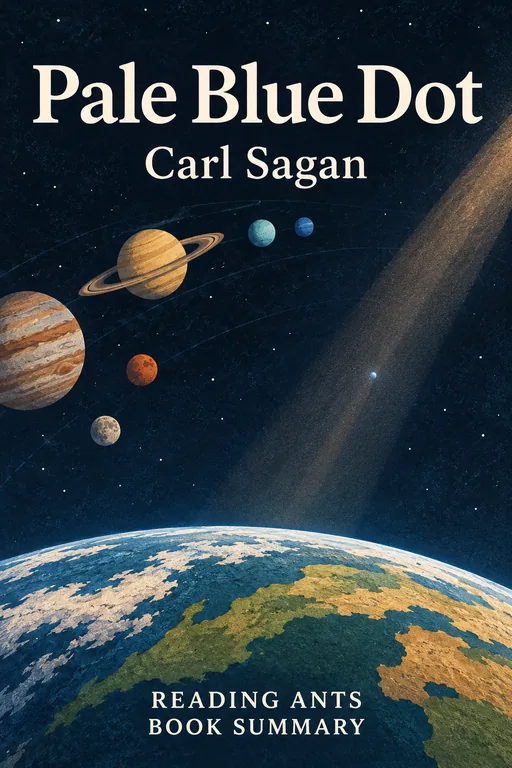
Carl Sagan reflects on a photograph of Earth taken from far out in space, in which our planet is a tiny speck, to argue that humanity should be humble, care for our fragile world and aim to explore the solar system and beyond.
Overview
Pale Blue Dot: A Vision of the Human Future in Space was published in 1994 by Carl Sagan, an astronomer and popular science writer, who had hosted the television series Cosmos. The title comes from a famous image taken in 1990 by the space probe Voyager 1, at Sagan’s suggestion, when it was about six billion kilometers away. In it, Earth appears as a pale blue speck in a beam of sunlight. The book combines a tour of the solar system, which draws on the discoveries of the space probes, with a philosophical argument for the future of humans in space.
Full Summary
1. The pale blue dot and our place in the cosmos
The idea: Sagan opens with the picture of the tiny Earth, and writes a famous passage describing all of human history, every king and peasant, every hope and war, as having taken place on that speck. He says that it shows the folly of human conceits, and the illusion that we are important in the universe. For Sagan, the image underlines our responsibility to treat one another more kindly, and to preserve the only home we know.
In real life: Seeing your town from a plane makes everyday arguments seem small.
2. The Copernican revolution and human pride
The idea: The author traces how the discovery that Earth is not the center of the universe, made by Copernicus and others, dethroned human beings, and how each step, from the planets to galaxies, has made the universe larger and our place smaller. He argues that this knowledge, though humbling, is also a source of wonder. He criticizes the tendency of humans to cling to the idea of a special status, and to put one’s own group at the center of the social universe.
In real life: Learning that the Sun is one of billions of stars changes how we picture our world.
3. A tour of the planets
The idea: A large part of the book is a lively account of the worlds of the solar system, as revealed by space probes, in whose missions Sagan took part. He describes the volcanic landscapes of Venus, the volcanoes, dust storms and ancient riverbeds of Mars, the rings of Saturn and the moons of the outer planets, such as Titan, with its thick, hazy atmosphere. He emphasizes that these places are strange and beautiful, and that comparing them helps us to understand Earth.
In real life: Studying other planets helps scientists to understand climate on our own.
4. Lessons from other worlds
The idea: Sagan shows how planetary science teaches about the risks to Earth. Venus has a massive greenhouse effect, which he describes as a runaway one, and Mars may have gone through a runaway cooling. These examples, he says, show how easily a planetary environment can be pushed off balance, and he links them to human effects on Earth such as greenhouse warming and ozone depletion. He argues that studying other worlds helps us to see how fragile a habitable planet is, and to appreciate our own.
In real life: A neighbor’s house that has burned down reminds you to check your smoke detectors.
5. Why go to space?
The idea: The author argues for a long-term human presence in space. He gives practical reasons, such as the need to protect Earth from asteroids and comets, and to use the resources of other worlds, and larger ones, such as the survival of our species. He imagines international crews, cooperating on missions such as a trip to Mars, and notes that a species with all its eggs in one basket is vulnerable to catastrophe. He emphasizes that space exploration should serve, not distract from, the improvement of life on Earth.
In real life: Exploration often brings benefits that no one expected.
6. A vision of the future
The idea: In the last chapters, Sagan imagines humans spreading to other worlds over centuries, and the questions of pride and responsibility that altering other worlds raises, such as the risks of terraforming. He reflects that our current choices will shape the destiny of our descendants, and that we have become powerful without becoming equally wise. He ends by arguing that peopling other worlds would unify nations and generations, and requires us to be both smart and wise.
In real life: Decisions made today about the environment affect people not yet born.
Why It Matters
Pale Blue Dot is one of Sagan’s best-loved works, and the image and words about it have become famous, inspiring many to think about the place of humanity in the universe and the need for stewardship of Earth. The passage is often quoted and read in tributes. The book contributed to public interest in planetary science and space exploration, and its argument that we should protect the planet and look to the future continues to influence scientists and educators. It also reflects Sagan’s gift for linking science to human values.
Key Takeaways
- Earth is a tiny, fragile world. Seen from far away, it is a speck.
- Humility is wise. Human importance in the cosmos is modest.
- Other planets teach us about ours. They show how climates can change.
- Exploration is part of being human. Curiosity drives discovery.
- We have a duty to our future. Choices now affect later generations.
What We Can Learn
When you feel caught up in conflict or worry, you can think of the pale blue dot and gain some perspective. Learn about the planets and about space exploration, and share your interest with others. Take care of the environment, which is our only home. Support curiosity and science education. And remember that cooperation among nations is needed for big projects. Looking at the night sky, or visiting a planetarium, can be a good way to feel a sense of wonder.
Criticism and Counterpoints
Some critics say that the book is partly outdated, since many discoveries have been made about planets, moons and exoplanets since 1994. Others argue that the case for human settlement in space is optimistic, and that the money would be better used to solve problems on Earth, or that robotic exploration is more efficient. Some find the tone of humility and the philosophical sections sentimental. Others note that the discussion of space politics, such as joint US and Russian projects, reflects the early 1990s. Still, the central message has lasting appeal.
Who Should Read It
This book is for readers of all ages who love astronomy and who enjoy reflective writing. It is accessible and beautifully written. Those who want the latest planetary data should consult recent sources, but many read it for the vision.
Want the whole book?
A summary is a taste, not the meal. Here is where to find the full book.
You reached the end 🎉
Nicely done. Mark this one as read, and we will suggest what to read next.
Read this next
The Demon-Haunted World
Carl Sagan
Carl Sagan defends science as a candle in the dark against superstition and pseudoscience, and offers a "baloney detection kit" of tools for thinking critically and for testing claims.
🔬 Science
Brief Answers to the Big Questions
Stephen Hawking
Physicist Stephen Hawking, in a posthumous book drawn from his lectures and writing, gives short answers to ten of the biggest questions that people ask, from the origin of the universe to the future of humanity.
🔬 Science
A Brief History of Time
Stephen Hawking
One of the world's greatest physicists explains, with almost no math, what we know about the origin, structure and fate of the universe, from the Big Bang to black holes and the nature of time itself.
🔬 Science
Seven Brief Lessons on Physics
Carlo Rovelli
Italian physicist Carlo Rovelli gives seven short, poetic lessons on the biggest ideas in modern physics, from Einstein's relativity to quantum theory, the structure of the cosmos, particles, gravity, heat and time, and our place in it all.
🔬 Science
The Elegant Universe
Brian Greene
Physicist Brian Greene explains in plain language how string theory tries to unite Einstein's relativity and quantum mechanics by picturing the smallest things in nature as tiny vibrating strings in a universe with extra dimensions.
🔬 Science
On the Origin of Species
Charles Darwin
All living things are related and have slowly changed over immense periods of time, shaped by natural selection, the process by which individuals better suited to their environment survive and pass on their traits.
🔬 ScienceWant something different?
Pick another topic and we will show you three books to start with.