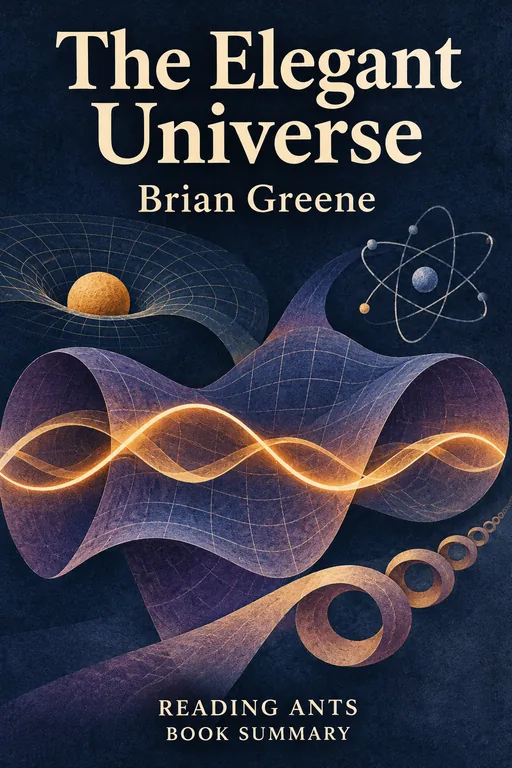
Physicist Brian Greene explains in plain language how string theory tries to unite Einstein's relativity and quantum mechanics by picturing the smallest things in nature as tiny vibrating strings in a universe with extra dimensions.
Overview
The Elegant Universe: Superstrings, Hidden Dimensions, and the Quest for the Ultimate Theory was published in 1999 by Brian Greene, a professor of physics and mathematics at Columbia University, and a researcher in string theory. It was a finalist for the Pulitzer Prize, and was adapted in 2003 as a three-part program on the American television series NOVA. The book first explains the two great pillars of twentieth-century physics, general relativity and quantum mechanics, which describe the very large and the very small, and which seem to be in conflict. Then it introduces string theory as a possible solution, using analogies and everyday images to explain hard concepts.
Full Summary
1. Two great theories in conflict
The idea: Greene begins with the problem. Einstein’s general theory of relativity explains gravity, and the behavior of planets, stars and galaxies. Quantum mechanics explains atoms and particles. Each works extremely well in its domain, but when we try to combine them, for example to describe a black hole or the beginning of the universe, the equations break down. A theory of everything would have to unite them.
In real life: Two maps may each be accurate for their own regions, but disagree where they overlap.
2. Relativity: space, time and gravity
The idea: The author explains Einstein’s special relativity, in which the speed of light is constant, and time and space are linked, so that moving clocks run slow. Then he explains general relativity, in which gravity is the curvature of space-time caused by mass, as a heavy ball bends a rubber sheet. These ideas, which were confirmed by many tests, changed our understanding of space and time. He uses everyday images, such as moving clocks, to make the ideas concrete.
In real life: GPS satellites must correct their clocks because of the effects of relativity.
3. Quantum mechanics: the world of the very small
The idea: In the next chapters, Greene describes quantum theory, with its strange features: particles can behave like waves, they do not have definite positions until measured, and the uncertainty principle of Heisenberg places limits on what we can know. At tiny scales, the universe is a frenzy of random fluctuations, which clash with the smooth space of relativity. He explains the standard model of particle physics, with its particles and forces.
In real life: It is impossible to know exactly where an electron is and how fast it is moving at the same time.
4. Strings: a new picture
The idea: String theory proposes that the fundamental ingredients of nature are not point-like particles, but tiny one-dimensional strings, so small that they look like points. Different vibrations of a string correspond to different particles, as different notes come from a violin string. One vibration pattern looks like the graviton, the particle that would carry gravity, so that gravity is built into the theory. This offers a way to combine quantum mechanics and relativity.
In real life: A single guitar string can make many notes, depending on how it vibrates.
5. Extra dimensions and the five theories
The idea: For the mathematics to work, string theory needs more than the three dimensions of space and one of time: it needs ten dimensions, or eleven in a later version. The extra dimensions, Greene says, would be curled up very small, so that we do not notice them, like the circular dimension of a garden hose seen from far away. He describes how the five versions of string theory came to be seen as possible facets of a single deeper theory, called M-theory, in the mid-1990s, and how the shapes of the extra dimensions, known as Calabi-Yau spaces, may determine the properties of particles.
In real life: A hose looks like a line from a distance, but up close has a circular surface.
6. Black holes, the beginning and testing the theory
The idea: Greene describes his own work on how strings could allow tears in the fabric of space, and explains how string theory may help to resolve mysteries of black holes, such as their entropy and radiation, and to ask whether the universe began with a singularity. He also acknowledges the great challenge: the strings are so small that testing the theory directly is extremely difficult, and, as of the book’s writing, there was no experimental confirmation. He suggests possible indirect tests, such as signs of supersymmetric particles in accelerators, and ends with optimism about a final theory.
In real life: A theory that cannot be tested remains an attractive idea, but not yet proven.
Why It Matters
The Elegant Universe was a national bestseller, and introduced string theory to a wide audience. It showed that difficult ideas can be explained with clear analogies, and inspired many readers to take an interest in physics. The book also contributed to public debate about the nature of scientific theories, as string theory has been controversial. Greene has written several other popular books, and in 2008 co-founded the World Science Festival. The book remains a widely read introduction to the subject. The string theorist John Schwarz said that its description of the state of the theory was reliable, and the physicist Steven Weinberg included it in a list of the best science books for general readers. It also won the Royal Society Prize for Science Books.
Key Takeaways
- Physics has two great theories. Relativity and quantum mechanics describe different scales.
- They conflict. A unifying theory is needed.
- String theory proposes vibrating strings. Particles are different notes.
- Extra dimensions are required. They are said to be curled up small.
- Testing remains the challenge. Without evidence, the theory is unproven.
What We Can Learn
You can use the book to learn about modern physics, and to see how scientists use analogies to understand what they cannot see. Notice the difference between a theory that is mathematically beautiful and one that has been confirmed. Try explaining a difficult idea, such as relativity, to a friend, using an everyday image. Keep an open mind about where science may lead, and remember that science progresses by testing ideas. And enjoy the sense of wonder that such questions can bring.
Criticism and Counterpoints
Some physicists have criticized string theory itself, saying that after decades it has made no testable predictions and has not been confirmed, and that it has absorbed too many resources. Books such as Not Even Wrong and The Trouble with Physics challenge it. Others say that popular accounts, including this one, present the theory with more confidence than is justified, and that analogies can mislead. The theory also allows a vast number of possible universes, which makes it hard to test. Supporters point to its mathematical results and its role in other areas of physics.
Who Should Read It
This book is for readers who are curious about physics and the universe, and who are willing to follow some difficult ideas. It is clear and lively, though long. Those who want a shorter introduction might begin with a smaller book on physics, and then come back to this one.
Want the whole book?
A summary is a taste, not the meal. Here is where to find the full book.
You reached the end 🎉
Nicely done. Mark this one as read, and we will suggest what to read next.
Read this next
A Brief History of Time
Stephen Hawking
One of the world's greatest physicists explains, with almost no math, what we know about the origin, structure and fate of the universe, from the Big Bang to black holes and the nature of time itself.
🔬 Science
Brief Answers to the Big Questions
Stephen Hawking
Physicist Stephen Hawking, in a posthumous book drawn from his lectures and writing, gives short answers to ten of the biggest questions that people ask, from the origin of the universe to the future of humanity.
🔬 Science
Seven Brief Lessons on Physics
Carlo Rovelli
Italian physicist Carlo Rovelli gives seven short, poetic lessons on the biggest ideas in modern physics, from Einstein's relativity to quantum theory, the structure of the cosmos, particles, gravity, heat and time, and our place in it all.
🔬 Science
Relativity: The Special and the General Theory
Albert Einstein
Albert Einstein himself explains, for readers without advanced mathematics, how his special and general theories of relativity change our understanding of space, time, motion and gravity.
🔬 Science
Pale Blue Dot
Carl Sagan
Carl Sagan reflects on a photograph of Earth taken from far out in space, in which our planet is a tiny speck, to argue that humanity should be humble, care for our fragile world and aim to explore the solar system and beyond.
🔬 Science
On the Origin of Species
Charles Darwin
All living things are related and have slowly changed over immense periods of time, shaped by natural selection, the process by which individuals better suited to their environment survive and pass on their traits.
🔬 ScienceWant something different?
Pick another topic and we will show you three books to start with.