 Reading Ants
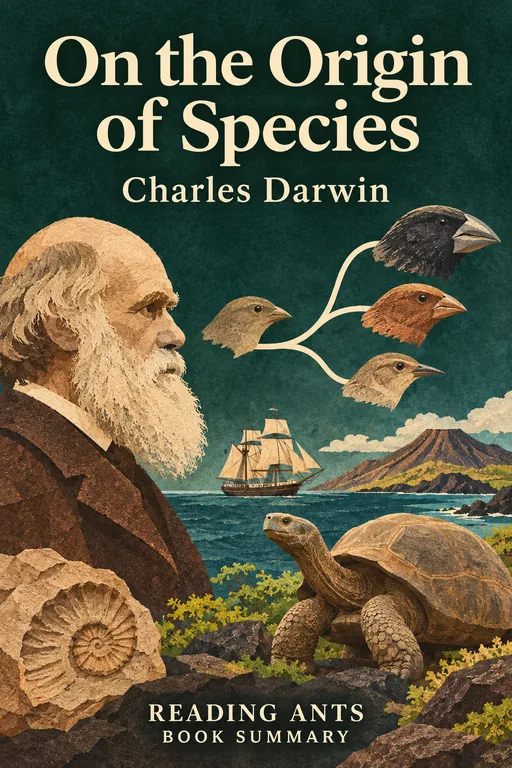
All living things are related and have slowly changed over immense periods of time, shaped by natural selection, the process by which individuals better suited to their environment survive and pass on their traits.
Overview
On the Origin of Species is one of the most important books in the history of science. Charles Darwin, an English naturalist, spent five years in the 1830s sailing around the world on the ship HMS Beagle, collecting plants, animals and fossils. Over the following two decades, he developed a theory to explain the astonishing variety of life: species are not fixed and separately created, but evolve from earlier forms. When the naturalist Alfred Russel Wallace independently reached a similar idea, Darwin rushed to publish. His book, which appeared in 1859, gathered an enormous amount of evidence, from pigeon breeding to fossils and island animals, into a single powerful argument. It transformed biology and changed how humans understand their place in nature.
Full Summary
1. Living things vary
The idea: Darwin begins with something familiar: domesticated animals and plants. Breeders have created very different varieties of pigeons, dogs and crops by choosing which individuals to breed. This “artificial selection” works because individuals naturally vary, and many of those differences are passed down to offspring. Darwin then shows that wild species also vary, so much that naturalists often disagree about where one species ends and another begins.
From the book: Darwin bred pigeons himself and describes how the many fancy breeds, some with puffed-up chests, fan-shaped tails or unusual beaks, all descend from the wild rock pigeon.
In real life: All dog breeds, from tiny Chihuahuas to huge Great Danes, descend from wolves. Humans created this variety over many thousands of years by choosing which dogs to breed.
2. The struggle for existence
The idea: Inspired by the economist Thomas Malthus, Darwin points out that living things produce far more offspring than can survive. A single plant may produce thousands of seeds, and a pair of animals could fill the world if all their young lived. Food, space and predators limit populations, so there is a constant “struggle for existence,” not only fighting, but competing for resources and surviving harsh conditions.
In real life: A tree may drop thousands of seeds each year, but only a handful will grow into new trees. Most are eaten, land in the wrong place or are shaded out by others.
3. Natural selection
The idea: Combine variation and the struggle for existence, and the result is natural selection. Individuals with traits that help them survive and reproduce in their environment are more likely to pass those traits on. Over many generations, small advantages accumulate, and populations gradually change. Darwin also describes sexual selection, in which traits like a peacock’s tail spread because they help individuals attract mates.
In real life: When bacteria are exposed to antibiotics, a few may have a mutation that helps them survive. They multiply, and soon the antibiotic no longer works. This is natural selection happening today.
4. The tree of life
The idea: Over vast periods, natural selection causes populations to split and diverge into new species. Darwin pictures life as a great branching tree, in which living species are the tips of branches, and their common ancestors lie deeper in the trunk. Many branches die out, leaving the fossils we sometimes find. The book’s only illustration is a diagram of this branching pattern.
In real life: A family tree shows how cousins share grandparents. In the same way, humans and chimpanzees share a common ancestor, and deeper down, all mammals share one too.
5. Answering the difficulties
The idea: Darwin openly addresses the biggest objections to his theory. How could a complex organ like the eye evolve? He shows that simpler light-sensitive organs exist in other animals, so a gradual path is possible. Why are there gaps in the fossil record? Because fossils form only rarely, the record is very incomplete. He also discusses instincts and why hybrids between species are often sterile.
In real life: Scientists today still follow Darwin’s habit of looking for the strongest arguments against their own ideas. Testing ideas against criticism is what makes science reliable.
6. Evidence from fossils and geography
The idea: Darwin shows that the fossil record, though incomplete, fits his theory: older rocks contain simpler and different life forms, and extinct species often resemble living ones in the same region. The distribution of animals around the world also makes sense. Islands like the Galápagos have species found nowhere else, which resemble those on the nearest mainland, just as you would expect if they descended from ancestors that arrived from there.
From the book: Darwin describes how the plants and animals of the Galápagos Islands, off South America, are clearly related to South American species, even though the islands’ climate is quite different from the mainland. Animals on the Cape Verde Islands, off Africa, resemble African species instead.
In real life: Australia’s unique kangaroos and koalas make sense once we know the continent was isolated for millions of years, letting its animals evolve separately.
7. Grandeur in this view of life
The idea: In his final chapter, Darwin summarizes his “one long argument” and points to further evidence: similar bone structures in a human hand, a bat’s wing and a whale’s flipper; useless “leftover” organs; and similarities between embryos of different animals. He only hints that his theory might shed light on human origins. He closes by describing the beauty of a tangled riverbank full of life, all produced by the same natural laws, and suggests there is grandeur in this view of life, in which endless beautiful forms have evolved from simple beginnings.
In real life: Your arm, a cat’s leg and a bird’s wing all contain the same basic arrangement of bones, a family resemblance pointing to a shared ancestor.
Why It Matters
On the Origin of Species is often called the most important book in biology. It provided the foundation for the theory of evolution, which explains the diversity of life and connects every field of biology, from genetics to ecology and medicine. The first printing sold out almost immediately, and the book sparked intense debate among scientists and religious leaders.
Darwin’s ideas changed how people see the world and humanity’s place within it, showing that humans are part of nature, related to every other living thing. Later discoveries in genetics and DNA, which Darwin knew nothing about, strongly confirmed and expanded his theory. Today, evolution helps scientists understand diseases, develop vaccines, fight antibiotic resistance and protect endangered species.
Key Takeaways
- Species change over time. Life is not fixed but constantly evolving.
- Natural selection drives evolution. Helpful traits spread because they aid survival and reproduction.
- All life is related. Every living thing shares common ancestors on a single tree of life.
- Small changes add up. Tiny differences over millions of years create new species.
- Evidence matters. Darwin built his case from careful observation and openly tested its weaknesses.
What We Can Learn
Darwin’s book is a model of patient, honest thinking. He spent more than twenty years collecting evidence before publishing, and he openly discussed the problems with his theory. When we form opinions, gathering evidence and considering the strongest objections makes our conclusions stronger.
It also teaches the power of small, gradual change. Just as small differences add up over many generations, small daily efforts can add up to large changes in our own lives.
Finally, evolution reminds us that we are connected to the rest of nature. Understanding how species depend on their environments helps us see why protecting habitats and biodiversity matters.
Criticism and Counterpoints
In Darwin’s time, critics raised serious scientific questions: no one knew how traits were inherited, and some physicists argued the Earth was too young for evolution to work. These problems were later solved by genetics and by evidence that the Earth is billions of years old. Darwin also made some mistakes, such as partly accepting the idea that traits acquired during an animal’s life could be inherited.
The theory has faced religious opposition from those who believe it conflicts with their faith, although many religious people accept evolution. Ideas loosely based on Darwin, such as “social Darwinism,” were later misused to justify racism and inequality, which Darwin’s science does not support. Modern readers may also find the book’s Victorian style slow and dense.
Who Should Read It
This book is for teens and adults curious about biology, science history or how life came to be. Its old-fashioned style can be challenging, so beginners may prefer a modern introduction such as Your Inner Fish or The Greatest Show on Earth. Science lovers will appreciate reading Darwin’s argument in his own words.
Want the whole book?
A summary is a taste, not the meal. Here is where to find the full book.
You reached the end 🎉
Nicely done. Mark this one as read, and we will suggest what to read next.
Read this next
The Voyage of the Beagle
Charles Darwin
Charles Darwin's lively journal of his five-year voyage around the world on HMS Beagle records the animals, plants, rocks and peoples that he saw, and the observations that led him toward the theory of evolution.
🔬 Science
The Selfish Gene
Richard Dawkins
Evolution is best understood from the point of view of genes, which act as if they were "selfish," using bodies as survival machines to make more copies of themselves, and this explains both competition and surprising acts of cooperation in nature.
🔬 Science
Your Inner Fish
Neil Shubin
Paleontologist Neil Shubin shows, through the discovery of a fossil fish with the beginnings of limbs, that the human body carries traces of its ancient ancestors, so that our hands, heads and even hiccups can be explained by evolution.
🔬 Science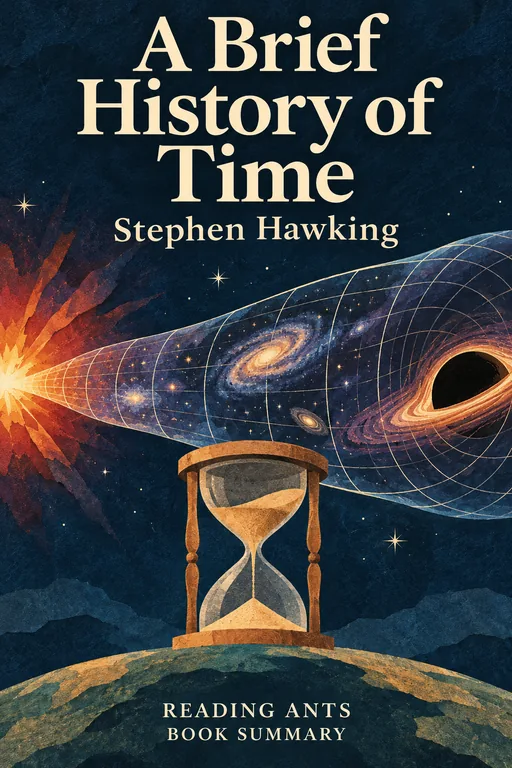
A Brief History of Time
Stephen Hawking
One of the world's greatest physicists explains, with almost no math, what we know about the origin, structure and fate of the universe, from the Big Bang to black holes and the nature of time itself.
🔬 Science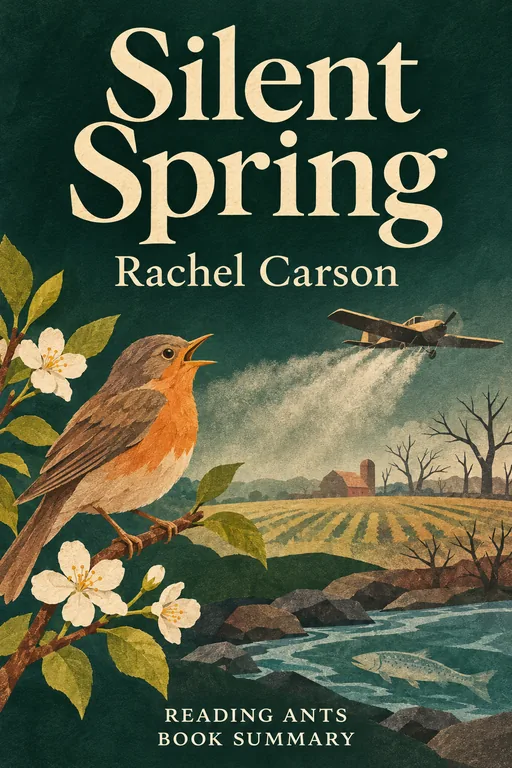
Silent Spring
Rachel Carson
The careless spraying of powerful chemical pesticides like DDT was poisoning birds, fish, soil, water and people, and humans must learn to live with nature instead of waging war on it.
🔬 Science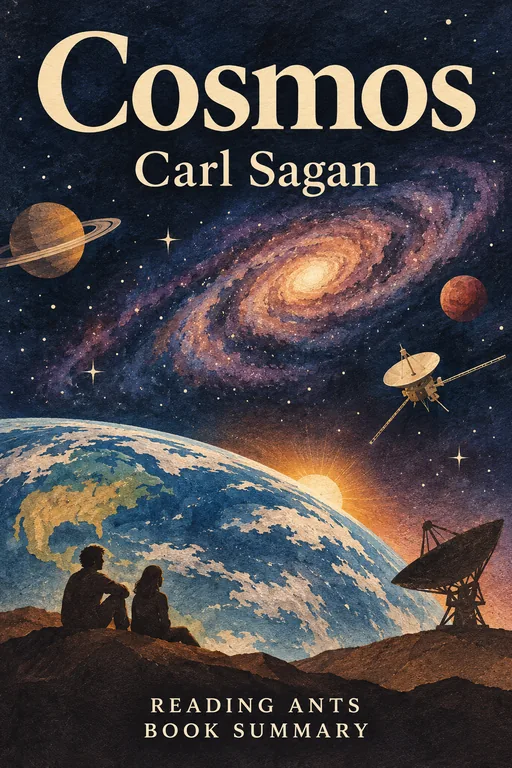
Cosmos
Carl Sagan
Carl Sagan takes readers on a journey from the Earth to the edge of the universe, blending astronomy, history and philosophy to show how humanity came to understand the cosmos and our place in it.
🔬 ScienceWant something different?
Pick another topic and we will show you three books to start with.