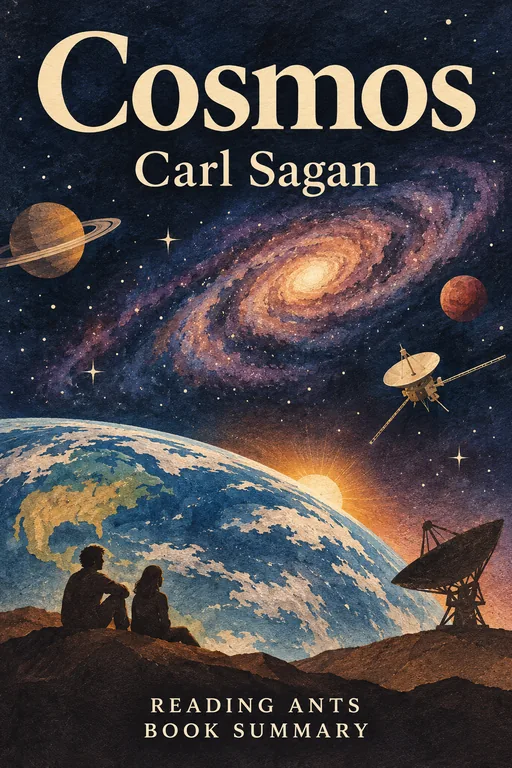
Cosmos
Carl Sagan takes readers on a journey from the Earth to the edge of the universe, blending astronomy, history and philosophy to show how humanity came to understand the cosmos and our place in it.
Overview
Cosmos is a book by the American astronomer and science communicator Carl Sagan, published in 1980 as a companion to his thirteen-part television series of the same name, which was one of the most-watched series in the history of American public television. Sagan was a professor at Cornell University, who had worked with NASA on missions to other planets, including the Voyager spacecraft, and he had a gift for explaining science with poetry. In thirteen chapters, which the Full Summary below groups into seven parts, the book covers the origins of the universe, the lives of stars, the history of astronomy, the search for life elsewhere and the dangers facing our world. It remains one of the best-selling science books ever published.
Full Summary
1. The shores of the cosmic ocean
The idea: Sagan opens by describing the cosmos as all that is, was or ever will be. He invites readers to imagine the universe through a Cosmic Calendar, which compresses the roughly fifteen billion years that were then estimated since the Big Bang (about 13.8 billion by today’s estimates) into one year: humans appear only in the last hours of December 31, and recorded history takes up the final seconds. This image shows how new and brief the human story is. He also says that we are made of “star stuff,” since the atoms in our bodies were formed in stars, and that in studying the cosmos, we are the universe understanding itself.
In real life: Picturing history as a single year can make everyday worries feel smaller and our existence feel more special.
2. Evolution, life and the voice of the cosmos
The idea: Sagan discusses the evolution of life on Earth, showing how natural selection explains the variety of species, and uses the story of a crab, the Heike crab in Japan, as a proposed example of artificial selection, in which fishermen’s choices over generations may have shaped crab patterns that resemble a human face. He also reflects on the astonishing chain of events that led to human intelligence, and on the genetic code as a language shared by all life on Earth.
In real life: Humans have changed other species too, as farmers and dog breeders have shaped plants and animals over many generations.
3. The harmony of the worlds
The idea: This part tells the story of how humans learned to read the heavens. Sagan describes early astronomers who believed that the planets moved in perfect circles, and focuses on Johannes Kepler, who struggled for years to fit the orbits of the planets to a pattern, finally discovering that they move in ellipses. Kepler’s life, full of hardship and a mother accused of witchcraft, shows how science and superstition once mixed. Sagan celebrates the courage of thinkers who followed evidence.
In real life: Kepler’s persistence reminds us that great discoveries often come from years of careful work and from willingness to change an idea.
4. Planets, travelers and the search for life
The idea: The book travels through the solar system. Sagan describes Venus, a world with a runaway greenhouse effect, and Mars, where he discusses the search for life and the speculation about canals made by Martians. He recounts the Voyager missions’ discoveries about Jupiter, Saturn and their moons, and imagines what life might be like on other worlds. Throughout, he stresses the value of exploring and comparing planets to understand our own.
In real life: Learning how Venus became so hot helps scientists understand how greenhouse gases affect Earth’s climate.
5. Stars, galaxies and the edge of forever
The idea: Sagan then explains how stars are born, live and die, and how they create the chemical elements needed for life. He describes supernovae, white dwarfs, black holes and galaxies, and the expanding universe. He considers whether the universe is finite or infinite, and whether it will expand forever or collapse. The huge distances and times involved are conveyed through vivid comparisons and images.
In real life: The carbon in a pencil and the iron in our blood were made in earlier generations of stars.
6. The library of Alexandria and the loss of knowledge
The idea: In an emotional chapter, Sagan tells about the great Library of Alexandria in ancient Egypt, a center of learning where scholars such as Eratosthenes measured the Earth’s circumference using shadows. He mourns its destruction and the loss of ancient knowledge, including the death of the mathematician Hypatia, and warns that societies that turn against free inquiry risk dark ages. He ties this to the need to protect science and education.
In real life: Libraries, archives and open access to information are modern ways of preserving what humans have learned.
7. Who speaks for Earth?
The idea: The final part considers the possibility of extraterrestrial intelligence, the Drake equation, which estimates the number of civilizations in our galaxy, and the golden records carried by the Voyager spacecraft with greetings and music from Earth. Sagan also warns of the dangers of nuclear weapons and environmental damage, and asks who speaks for Earth and the future. He concludes with a plea for a view of humanity as a single species with a shared home and a responsibility to take care of it.
In real life: Climate change and nuclear arms are issues that cross national borders and need cooperation.
Why It Matters
Cosmos inspired a generation of scientists, teachers and ordinary people. The television series reached hundreds of millions of viewers across many countries, and the book spent weeks on bestseller lists. Many astronomers and engineers cite Sagan as the reason they chose their career.
In 2014, a follow-up series, Cosmos: A Spacetime Odyssey, hosted by Neil deGrasse Tyson, was broadcast. The book helped make science part of popular culture and set a model for how to communicate wonder and rigor together. Sagan also helped plan the golden records carried by the Voyager spacecraft, so the book is tied to a real message that humanity sent into interstellar space, which is still traveling today.
Key Takeaways
- We are part of the cosmos. Our atoms were made in stars.
- Humans are newcomers. The Cosmic Calendar shows how recent we are.
- Science is a human adventure. Curiosity and persistence drive discovery.
- Free inquiry needs protection. Knowledge can be lost.
- We share one world. Cooperation is needed to care for it.
What We Can Learn
The book inspires awe and humility. Looking at the scale of space and time, we can appreciate how small and how precious our planet is, and how rare is life.
It also teaches the value of asking questions and checking evidence. Sagan celebrates scientists who changed their minds when facts demanded it, a habit that helps in daily life.
Finally, it encourages a sense of shared responsibility. If Earth is a fragile home in a vast universe, we are called to look after it and each other.
Criticism and Counterpoints
Since 1980, science has advanced, so some details are outdated, such as the information about Mars and other planets, estimates of the age and size of the universe and ideas about the likelihood of extraterrestrial life. Some scientists said that Sagan was too optimistic about finding alien civilizations, and that his popularization sometimes simplified complex ideas.
A few critics found his tone too poetic or his political views, especially about nuclear arms, unwelcome in a science book. Others noted that the history of science is told mostly from a European perspective. Even so, many consider the book a classic that still conveys wonder.
Who Should Read It
This book suits readers from about age ten up to adults. Its language is lyrical and fairly easy, though some chapters are long. Younger readers may enjoy it with the television series or a parent’s help.
Want the whole book?
A summary is a taste, not the meal. Here is where to find the full book.
You reached the end 🎉
Nicely done. Mark this one as read, and we will suggest what to read next.
Read this next
A Brief History of Time
Stephen Hawking
One of the world's greatest physicists explains, with almost no math, what we know about the origin, structure and fate of the universe, from the Big Bang to black holes and the nature of time itself.
🔬 Science
A Short History of Nearly Everything
Bill Bryson
Bill Bryson sets out to understand how we know what we know about the universe, the Earth and life, and tells the story through the odd, brilliant and sometimes unlucky people who figured it out.
🏛️ History
Astrophysics for People in a Hurry
Neil deGrasse Tyson
Astrophysicist Neil deGrasse Tyson gives a fast, friendly tour of the biggest ideas in modern astronomy, from the Big Bang to dark matter and the search for other worlds, in a short book you can read in a few hours.
🔬 Science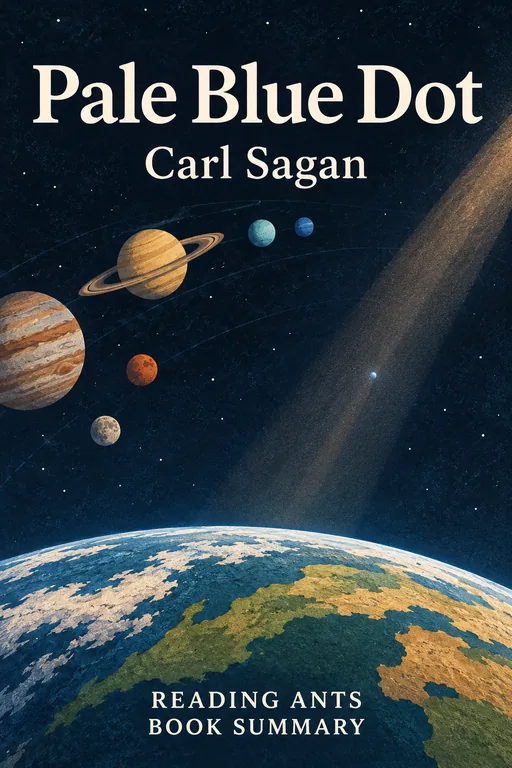
Pale Blue Dot
Carl Sagan
Carl Sagan reflects on a photograph of Earth taken from far out in space, in which our planet is a tiny speck, to argue that humanity should be humble, care for our fragile world and aim to explore the solar system and beyond.
🔬 Science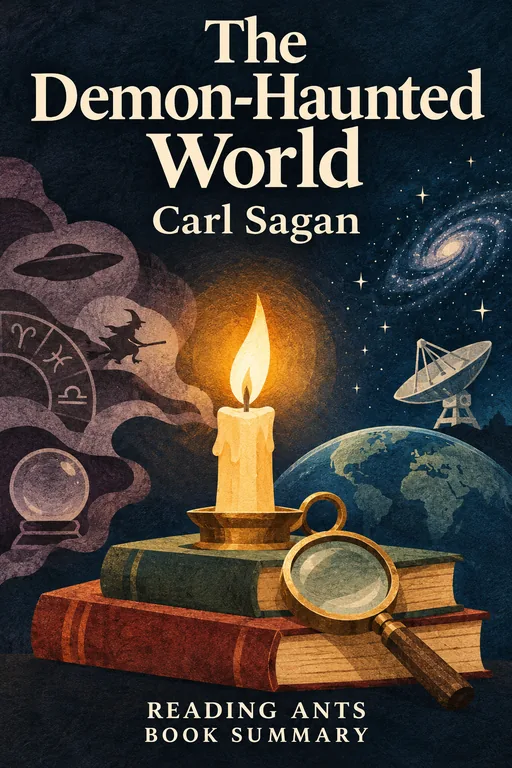
The Demon-Haunted World
Carl Sagan
Carl Sagan defends science as a candle in the dark against superstition and pseudoscience, and offers a "baloney detection kit" of tools for thinking critically and for testing claims.
🔬 Science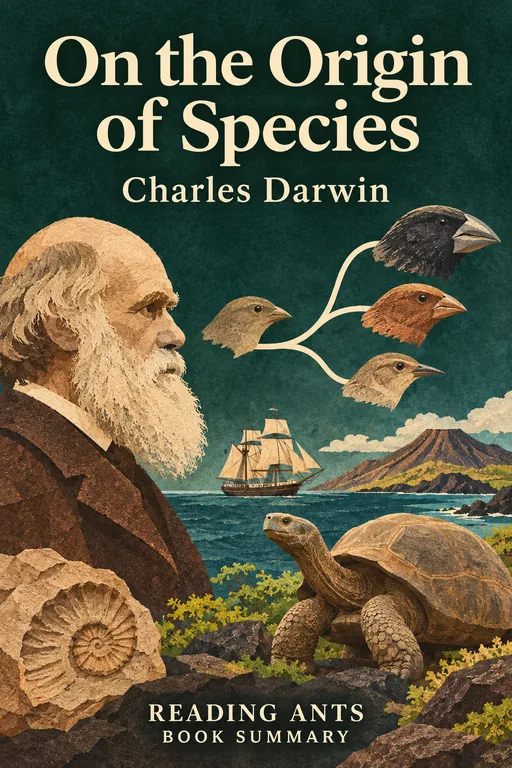
On the Origin of Species
Charles Darwin
All living things are related and have slowly changed over immense periods of time, shaped by natural selection, the process by which individuals better suited to their environment survive and pass on their traits.
🔬 ScienceWant something different?
Pick another topic and we will show you three books to start with.