 Reading Ants
Astrophysicist Neil deGrasse Tyson gives a fast, friendly tour of the biggest ideas in modern astronomy, from the Big Bang to dark matter and the search for other worlds, in a short book you can read in a few hours.
Overview
Astrophysics for People in a Hurry was written by Neil deGrasse Tyson, the director of the Hayden Planetarium in New York and a well-known science communicator, and published in 2017. It collects and expands a series of essays he wrote for a magazine and is only about two hundred pages. The book is designed for busy readers who want to understand the big picture of the universe without equations. Its twelve chapters, which the Full Summary below groups into six parts, cover how the universe began, what it is made of, how stars and planets form, the invisible forms of light and what our place in the cosmos means. It became a bestseller and made astrophysics approachable.
Full Summary
1. The greatest story ever told
The idea: Tyson begins with the beginning. Around 13.8 billion years ago, he explains, the entire observable universe, with all of its matter and energy, was squeezed into a region smaller than a pinhead, which rapidly expanded in the Big Bang. As the universe cooled, particles formed, then atoms of hydrogen and helium, and, much later, stars and galaxies. Tyson stresses that the laws of physics applied from the earliest moments, and that we can test our understanding by observing the faint glow left over from that time, the cosmic microwave background.
In real life: The leftover radiation from the Big Bang can be detected even today, a fossil light from the early universe.
2. Between the galaxies and the stuff of stars
The idea: The universe, he says, contains hundreds of billions of galaxies, each holding anywhere from millions to hundreds of billions of stars. Inside stars, atoms of light elements fuse into heavier ones, and when massive stars explode as supernovae, they spread carbon, oxygen, iron and other elements into space. These later become part of new stars, planets and living things. Tyson sums up that we are not only in the universe, but the universe is in us, since the atoms in our bodies were forged in stars.
In real life: The calcium in your teeth and the iron in your blood have an origin in ancient stellar explosions.
3. Dark matter and dark energy
The idea: Tyson reveals that ordinary matter, the stuff of stars, planets and people, is only about five percent of the universe. About twenty-seven percent is dark matter, an invisible substance known only through its gravity, which holds galaxies together. The rest, around sixty-eight percent, is dark energy, a mysterious force that seems to push the universe to expand faster. Astronomers don’t yet know what either is, which Tyson calls one of the greatest puzzles in science.
In real life: Astronomers noticed that stars in galaxies spin so fast that, without extra invisible mass, they would fly apart.
4. The cosmos on the table
The idea: In a fun chapter, Tyson looks at the periodic table and shows that the same elements found on Earth are found across the universe, as revealed by the light from distant stars. Hydrogen, helium, carbon and oxygen are among the most abundant. This universality means that the laws of chemistry and physics are the same everywhere, which allows us to understand faraway places by studying the light they send us.
In real life: Scientists can tell what a star is made of by splitting its light into a spectrum, like a rainbow with dark lines.
5. Planets, light and exoplanets
The idea: The next chapters discuss why planets are round, since gravity pulls matter into a sphere, and why small things like asteroids can be irregular. Tyson discusses the invisible kinds of light, such as radio waves, infrared, ultraviolet and X-rays, and how telescopes that see them reveal parts of the universe that our eyes cannot. He also discusses exoplanets, planets around other stars, thousands of which have been discovered, some in the “habitable zone,” where liquid water could exist.
In real life: Telescopes in space capture light that the atmosphere would block, giving us new views of the cosmos.
6. Between the planets and the cosmic perspective
The idea: Tyson considers the space between planets, which is not empty but contains dust, gas and tiny particles, and notes that Earth is hit by asteroids from time to time. In the last chapter, he reflects on the cosmic perspective, a view that comes from seeing ourselves as part of a vast universe. He argues that this view brings humility and a sense of connection, and can help us treat each other and the planet better.
In real life: Seeing photographs of Earth from space often changes how astronauts feel about borders and conflicts.
Why It Matters
The book was a long-running bestseller and brought modern physics to people who had never picked up a science book. It showed that astronomy’s biggest ideas could be explained in plain language, with humor and analogies. Tyson is a well-known television and podcast personality, and his work has helped many people take an interest in space.
The idea of the “cosmic perspective,” which appears in the book, has been widely quoted in discussions about science education and about our responsibility to our planet. Teachers often use the short chapters as warm-ups for science classes, since each one introduces a single big question that students can then explore further.
Key Takeaways
- The universe began 13.8 billion years ago. The Big Bang is the starting point.
- We are made of star stuff. Our elements came from stars.
- Most of the universe is unseen. Dark matter and energy remain mysteries.
- Physics is universal. The same laws apply everywhere.
- Perspective matters. Seeing our place in the cosmos can inspire humility.
What We Can Learn
The book invites us to wonder. Even a quick tour of the universe shows how much there is to learn and how remarkable it is that we can learn it.
It also teaches that science is a process. Tyson openly says what is unknown, such as the nature of dark matter, and shows that admitting ignorance is a normal part of science.
Finally, it reminds us that we share a common origin and a common home, which can encourage cooperation.
Criticism and Counterpoints
Because the book is so brief, it necessarily simplifies, and some physicists feel that important complexities are left out. Others have noted a few small errors or outdated figures. Some readers find that Tyson’s style is a bit self-assured or that the book jumps among topics without a deep explanation, and that those who want detail will need longer books.
Tyson has also faced controversy in his public career, which led some to be wary of his work, though the book’s science content remains standard. As a short introduction, most reviewers find it clear and enjoyable.
Who Should Read It
This book suits readers from about age ten up to adults. It is short and can be read in an afternoon. It is a good first book on astronomy before moving to longer works such as Cosmos.
Want the whole book?
A summary is a taste, not the meal. Here is where to find the full book.
You reached the end 🎉
Nicely done. Mark this one as read, and we will suggest what to read next.
Read this next
Cosmos
Carl Sagan
Carl Sagan takes readers on a journey from the Earth to the edge of the universe, blending astronomy, history and philosophy to show how humanity came to understand the cosmos and our place in it.
🔬 Science
A Brief History of Time
Stephen Hawking
One of the world's greatest physicists explains, with almost no math, what we know about the origin, structure and fate of the universe, from the Big Bang to black holes and the nature of time itself.
🔬 Science
A Short History of Nearly Everything
Bill Bryson
Bill Bryson sets out to understand how we know what we know about the universe, the Earth and life, and tells the story through the odd, brilliant and sometimes unlucky people who figured it out.
🏛️ History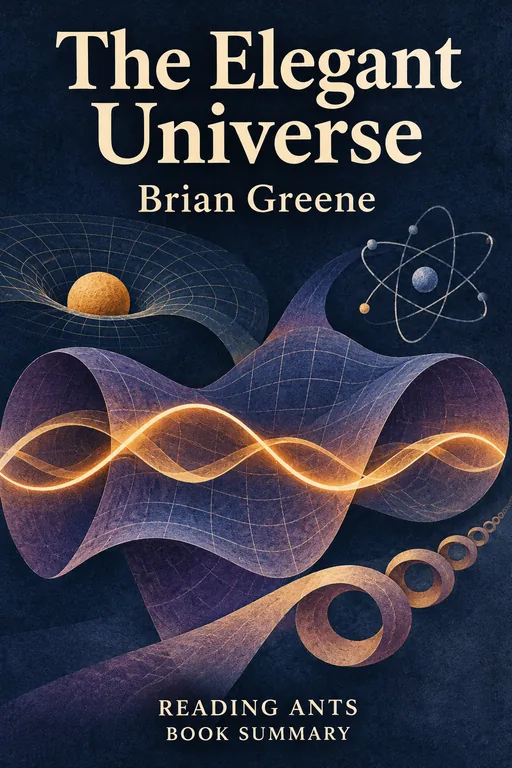
The Elegant Universe
Brian Greene
Physicist Brian Greene explains in plain language how string theory tries to unite Einstein's relativity and quantum mechanics by picturing the smallest things in nature as tiny vibrating strings in a universe with extra dimensions.
🔬 Science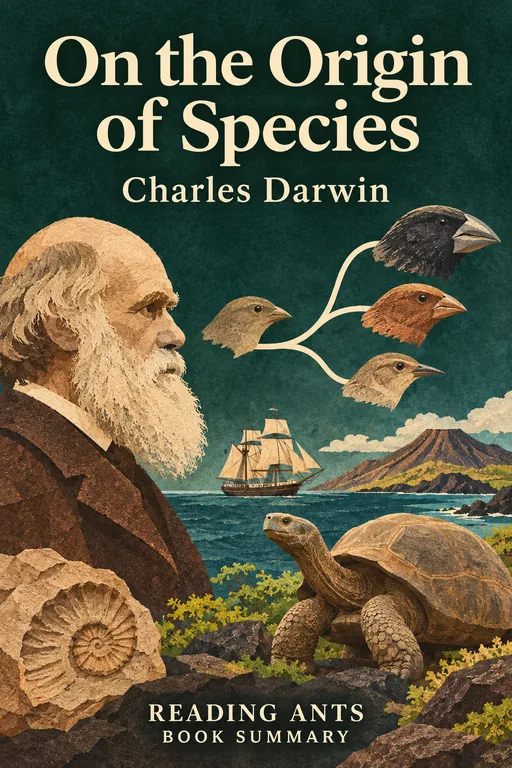
On the Origin of Species
Charles Darwin
All living things are related and have slowly changed over immense periods of time, shaped by natural selection, the process by which individuals better suited to their environment survive and pass on their traits.
🔬 Science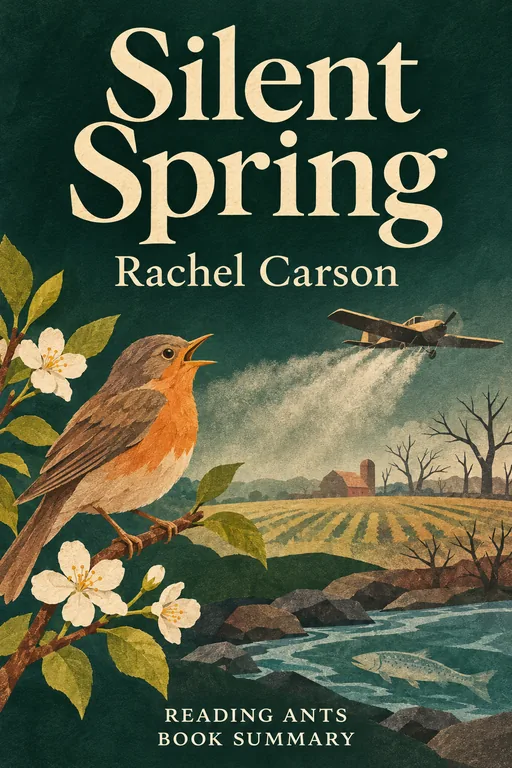
Silent Spring
Rachel Carson
The careless spraying of powerful chemical pesticides like DDT was poisoning birds, fish, soil, water and people, and humans must learn to live with nature instead of waging war on it.
🔬 ScienceWant something different?
Pick another topic and we will show you three books to start with.