 Reading Ants
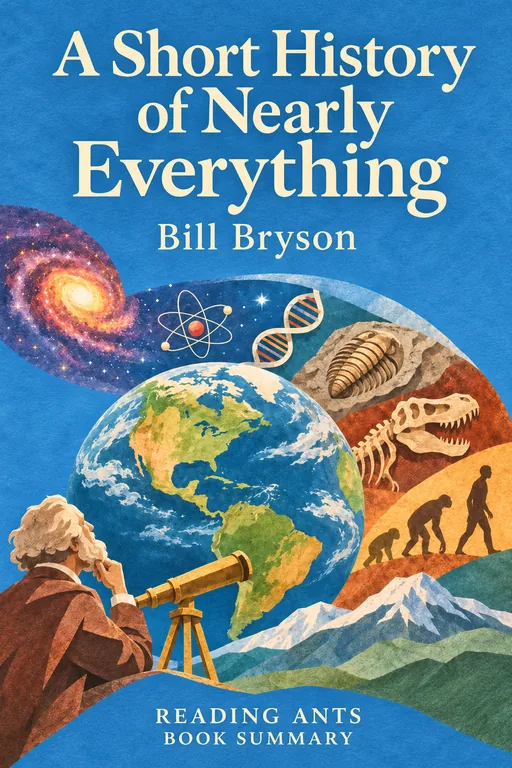
A Short History of Nearly Everything
Bill Bryson sets out to understand how we know what we know about the universe, the Earth and life, and tells the story through the odd, brilliant and sometimes unlucky people who figured it out.
Overview
A Short History of Nearly Everything was written by Bill Bryson, an American author who lived for many years in Britain and was best known for funny travel books. Published in 2003, it came from his curiosity: he realized, on a long flight, that he knew almost nothing about the planet he lived on, so he spent about three years reading and talking to scientists. The result is a lively tour of physics, chemistry, geology, biology and more, from the Big Bang to the rise of humans. It won several prizes and has been popular with readers who thought science would be dull.
Full Summary
1. How to build a universe and a planet
The idea: The book begins with the Big Bang, the event that scientists think started the universe. Bryson explains that the universe was once in an incredibly small, hot, dense state, then expanded outward, and that the first atoms formed in the early universe. He emphasizes how hard it is to grasp such vast scales of size, time and distance. He also describes how the solar system formed from a cloud of gas and dust, and how Earth, in particular, turned out to be well placed for life.
In real life: If you try to imagine the distances between planets, you quickly realize how small and isolated Earth is.
2. The size of the Earth
The idea: Bryson tells how scientists measured the Earth, weighed it and found its age. In the eighteenth and nineteenth centuries, people tried different methods, from studying mountains to examining layers of rock. He recounts that estimates of the age of the Earth changed many times, and that radioactivity, discovered around the end of the nineteenth century, finally gave a way to date rocks accurately. This led to the modern figure of about four and a half billion years.
From the book: He describes how the geochemist Clair Patterson, who measured lead in rock and meteorite samples, helped settle the age of the planet. In the course of that work he found widespread lead contamination, and he later campaigned against leaded gasoline, taking on powerful industries.
In real life: Dating rocks by radioactive decay rests on a similar idea to the radiocarbon dating that archaeologists use: a steady rate of decay works like a clock, though rock dating uses different elements and far longer timescales.
3. The new physics
The idea: Bryson explains how Einstein and others changed our understanding of space, time and matter. He tells about the discovery of the atom and its parts, and about the strange world of quantum physics where particles behave in ways that seem odd. He emphasizes that atoms are mostly empty space, yet everything is built from them, and that many of the atoms that make up our bodies were forged in stars long ago.
In real life: The calcium in your bones and the iron in your blood were made by nuclear reactions in stars, including stars that exploded long ago.
4. The dangerous planet
The idea: Earth is not a peaceful place, Bryson says. He describes earthquakes, volcanoes and asteroid impacts that have shaped the planet and threatened life. He explains how the study of rocks and fossils revealed that continents move slowly over millions of years, a theory called plate tectonics, which was resisted for decades before being accepted. He also describes the Yellowstone supervolcano as an example of a hidden danger.
In real life: The ground under your feet is slowly moving, which is why some regions have frequent earthquakes.
5. Life begins
The idea: Bryson turns to the story of life. He describes how scientists think that simple living things appeared early on Earth, and that for a very long time life stayed small and simple. He shares the strangeness of single cells, the number of microbes living on and in us, and the role of bacteria in making the world livable. He also tells how the many forms of life are connected, from ancient microorganisms to plants, animals and humans.
In real life: Your body contains more microbial cells than you might imagine, and many of them help you digest food.
6. The rise of animals and humans
The idea: The book follows the development of complex life, the great extinctions and the arrival of mammals. Bryson explains how the work of Charles Darwin and later scientists shaped our understanding of evolution, and how fossils help us see the past. He covers the appearance of humans and notes how recently, in geological terms, we arrived. He also reflects on how fragile species can be and how many have vanished.
In real life: Fossils show that most species that ever lived are now extinct, which gives context to modern worries about wildlife.
7. Our fragile place and the people who found it out
The idea: The last chapters reflect on humanity’s effect on the planet and on the unlikelihood of our existence. Bryson notes that we are the product of a long chain of lucky events, and that we are still in the early stages of understanding the world. Throughout the book, he highlights the people behind discoveries, many of whom were ignored, overlooked or treated unfairly, and he shows that science is a human effort full of rivalry, mistakes and wonder.
In real life: Reading about scientists who were doubted at first reminds us to judge ideas by evidence, not by who says them.
Why It Matters
A Short History of Nearly Everything showed that science writing can be funny, personal and gripping. It sold millions of copies, was translated into many languages and won major awards for science communication in Britain. Teachers, parents and general readers have used it as a doorway into subjects that can seem forbidding, and many people credit it with starting or reviving their interest in science.
Since its release, scientists have updated some details, such as the age estimates of the universe and discoveries in genetics and astronomy, but the book’s central picture and its focus on how knowledge was won remain valuable.
Key Takeaways
- We live on a rare, fragile planet. Many things had to go right for us to exist.
- Science is a human story. Discoveries came from curious, flawed people.
- Scale is hard to imagine. The universe is vast in time and space.
- Knowledge keeps changing. Today’s facts are refined by new evidence.
- Curiosity is worth cultivating. Asking simple questions can lead far.
What We Can Learn
The book teaches us to ask basic questions without embarrassment. Bryson began by admitting how little he knew, and that honesty led him to learn a great deal. We too can ask how things work, from the ground under our feet to the stars above.
It also reminds us that scientific knowledge was built slowly, with many wrong turns. Understanding that science is a process of testing and correcting ideas helps us handle news about new discoveries with patience instead of confusion.
Finally, it gives a sense of perspective. When we think about the age of the Earth and the long chain of events that led to us, everyday worries may feel smaller, and our shared home feels more precious.
Criticism and Counterpoints
Some scientists have noted errors and outdated statements, as the book is not written by a trained scientist and some details were later corrected or have changed with new research. The book also covers so much ground that some topics are treated lightly, and its focus is mainly on Western scientists and on the physical and life sciences, with less attention to other traditions.
A few readers find the humor and the many anecdotes distracting, or the length daunting. An illustrated edition and a version for younger readers exist for those who want an easier route. Even so, most reviewers praise the book for being accurate enough on the main points and for making readers want to learn more.
Who Should Read It
This book suits curious readers from about age ten and up, including adults who think they dislike science. It can be read in short stretches, one chapter at a time. Younger readers may prefer the illustrated edition made for them.
Want the whole book?
A summary is a taste, not the meal. Here is where to find the full book.
You reached the end 🎉
Nicely done. Mark this one as read, and we will suggest what to read next.
Read this next
Cosmos
Carl Sagan
Carl Sagan takes readers on a journey from the Earth to the edge of the universe, blending astronomy, history and philosophy to show how humanity came to understand the cosmos and our place in it.
🔬 Science
A Brief History of Time
Stephen Hawking
One of the world's greatest physicists explains, with almost no math, what we know about the origin, structure and fate of the universe, from the Big Bang to black holes and the nature of time itself.
🔬 Science
Sapiens: A Brief History of Humankind
Yuval Noah Harari
Humans came to rule the planet not because we are the strongest animals but because we can believe in shared stories (gods, nations, money, companies) that let millions of strangers cooperate.
🏛️ History
The Selfish Gene
Richard Dawkins
Evolution is best understood from the point of view of genes, which act as if they were "selfish," using bodies as survival machines to make more copies of themselves, and this explains both competition and surprising acts of cooperation in nature.
🔬 Science
Guns, Germs, and Steel
Jared Diamond
Some societies came to conquer others not because their people were smarter or better, but because geography gave them a head start in farming, animals, germs and technology.
🏛️ History
The Histories
Herodotus
Herodotus, often called the father of history, tells how the Greeks and the Persians came into conflict and fought the great wars of the early fifth century BCE, with long, colorful detours into the lands, customs and legends of the known world.
🏛️ HistoryWant something different?
Pick another topic and we will show you three books to start with.