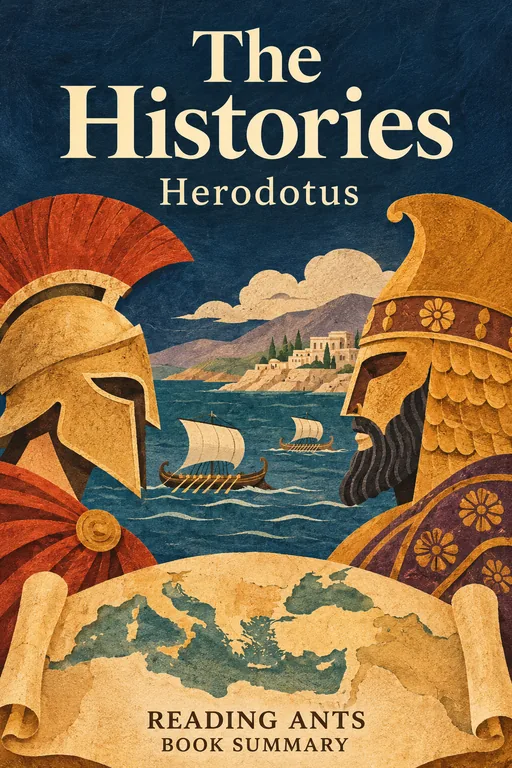
The Histories
Original title: Ιστορίαι
Herodotus, often called the father of history, tells how the Greeks and the Persians came into conflict and fought the great wars of the early fifth century BCE, with long, colorful detours into the lands, customs and legends of the known world.
Overview
The Histories is a long work in prose by Herodotus, who was born in the Greek city of Halicarnassus, on the coast of what is now Turkey, in the fifth century BCE. He traveled widely and collected stories from many peoples. His stated aim was to preserve the memory of great deeds, and to explain why Greeks and non-Greeks went to war. The book is later divided into nine parts. It combines military history with geography, folklore and anecdotes about kings. Herodotus did not know everything, and he often tells readers when he is reporting what others said, rather than what he believes.
Full Summary
1. Why people go to war
The idea: Herodotus begins with the question of why Greeks and Persians became enemies, and sets aside the old tales of kidnapped princesses, saying that he will not judge them. He prefers to say what he knows: that the king of Lydia, Croesus, was the first foreigner known to him to attack Greek cities in Asia, so the story starts there. He shows that history is the story of the rise and fall of kingdoms, and that fortune changes.
From the book: Croesus asks a famous oracle at Delphi whether he should attack Persia, and he is told that a great empire would fall. It is his own.
In real life: A message can be true and still mislead, if you hear what you want to hear.
2. The rise of Persia
The idea: The first books trace how Cyrus the Great conquered Lydia and Babylon and built a vast empire, and how his successors, Cambyses and Darius, expanded it. Herodotus includes stories of palace intrigue and of the struggles for the throne. He describes the structure of the empire, with its roads, governors and taxes, and says that it was powerful but grew proud.
In real life: A group that wins many victories in a row may start to believe that it cannot lose, and that belief can be its weakness.
3. Egypt, Scythia and the world of customs
The idea: In the early and middle books, Herodotus takes long detours into foreign lands. He describes Egypt, with its great river, its priests and its monuments, and the Scythian nomads of the north, with their burial customs and their way of war. He notes that each people believes its own customs are best, and he says that custom is king. Some of his reports are accurate, and some are exaggerated or mistaken.
In real life: Visiting a family with different habits at dinner can show you that your own routines are not the only normal ones.
4. The Ionian revolt and Marathon
The idea: The Greek cities of Asia Minor rebel against the Persians, with help from Athens. Darius resolves to punish Athens, and sends an army across the sea. In 490 BCE, a smaller Athenian force defeats the Persians at the plain of Marathon. Herodotus describes the battle and its aftermath, and the Athenians’ pride in their victory, which would shape their sense of themselves for generations.
In real life: A smaller team that is well prepared and motivated can beat a stronger one.
5. Xerxes invades
The idea: Darius dies, and his son Xerxes prepares a vast invasion of Greece, with a huge army and navy, building a bridge of boats over a strait and cutting a canal. Herodotus describes the gathering of forces from all over the empire, and gives a long list of peoples. Some Greek cities choose to cooperate with Persia, while others, led by Sparta and Athens, decide to resist. He portrays Xerxes as an overconfident ruler who ignores warnings.
In real life: Planning for years does not help if the leader refuses to listen to anyone who disagrees.
6. Thermopylae and Salamis
The idea: At a narrow pass called Thermopylae, a small Greek force, including a Spartan king, Leonidas, and his men, holds back the Persian army for days, until they are surrounded and die. Soon after, the Persians burn the Acropolis of Athens, which most Athenians have already left. At Salamis, the Athenian leader Themistocles secretly sends a false message to the Persians, which helps to lure their fleet into the narrow waters, where it is defeated. Herodotus tells of the courage of the Greeks and of the cleverness of some of their commanders.
In real life: Fighting where the ground favors you can matter more than having more people.
7. Plataea and the end
The idea: The next year, the combined Greek army wins a great land battle at Plataea, and the Persian forces withdraw from Greece. The work ends soon after, with some small stories about the Persians and a final lesson. In the last passage of the work, Herodotus reports that Cyrus, when his people proposed moving to a richer country, warned that soft lands tend to produce soft men. The Persians then chose to stay in their rugged land and rule, rather than farm an easy plain and be ruled by others.
In real life: Comfort can make people less ready for hard times.
Why It Matters
The Histories is the earliest large work of history in the Western tradition to survive. Herodotus was among the first to investigate the past by asking questions and comparing accounts, and the word “history” comes from the Greek word for inquiry, which he used. His work preserved the story of the Persian Wars, one of the turning points in European history, and it gives a valuable look at the many peoples of the ancient world. Some later writers called him a storyteller, because of his many tales, but modern historians and archaeologists have confirmed many of his details. The book also raises the questions that historians still ask: how to weigh sources, and how to understand other cultures.
Key Takeaways
- History is inquiry. Herodotus asked questions, and compared what people told him.
- Customs differ. Each people thinks that its own ways are best.
- Pride goes before a fall. Proud rulers, such as Croesus and Xerxes, are brought down.
- Freedom can inspire. The Greek cities fought hard to avoid being ruled by an emperor.
- Fortune turns. No state or person stays on top forever.
What We Can Learn
Herodotus teaches us to be curious about other peoples and to listen to their stories, and to be careful about which stories we believe. He also warns against overconfidence, and reminds us that power does not last. Reading his accounts, we can ask what evidence supports a claim, and who tells the story. His respect for the customs of others is a model for understanding people who are different from us. And his sense of humor and wonder shows that history can be exciting as well as serious.
Criticism and Counterpoints
Ancient and modern critics have accused Herodotus of being gullible, and some called him a liar or a teller of tall tales, because he included tales of marvels and reported numbers, such as the size of the Persian army, that are almost certainly too large. He also relied on oral stories that may have been shaped by local pride. Some historians say that he was too favorable to Athens, and that his picture of the Persians as despotic is one-sided. Others point out that he is open about his sources. Today, historians use him with care, combining him with archaeology and other texts.
Who Should Read It
This book is for readers of ancient history, travel stories and classic literature. It is long and winding, but many parts are exciting and funny, and it can be read in selections. Those who want a short, tidy account of the Persian Wars may prefer a modern summary, and then explore the original.
Want the whole book?
A summary is a taste, not the meal. Here is where to find the full book.
You reached the end 🎉
Nicely done. Mark this one as read, and we will suggest what to read next.
Read this next
History of the Peloponnesian War
Thucydides
Thucydides, an Athenian general turned historian, records the long war between Athens and Sparta in the fifth century BCE and uses it to study power, fear, politics and how human nature behaves in crisis.
🏛️ History
The Iliad
Homer
During the final year of the Trojan War, the great Greek warrior Achilles withdraws from battle in anger, and only the death of his dearest friend drives him back to fight, leading to terrible loss and a moment of shared human grief with his enemy.
🎭 Epics, Drama & Poetry
The Odyssey
Homer
After the Trojan War, the clever hero Odysseus struggles for ten years against monsters, gods and temptations to return home to his faithful wife and son, then must win back his house from the men trying to steal it.
🎭 Epics, Drama & Poetry
The Travels of Marco Polo
Marco Polo and Rustichello da Pisa
A Venetian merchant's account of his long journey to Asia and his years in the service of the Mongol emperor Kublai Khan, which opened the eyes of medieval Europeans to the wealth, cities and customs of the East.
🏛️ History
Sapiens: A Brief History of Humankind
Yuval Noah Harari
Humans came to rule the planet not because we are the strongest animals but because we can believe in shared stories (gods, nations, money, companies) that let millions of strangers cooperate.
🏛️ History
Guns, Germs, and Steel
Jared Diamond
Some societies came to conquer others not because their people were smarter or better, but because geography gave them a head start in farming, animals, germs and technology.
🏛️ HistoryWant something different?
Pick another topic and we will show you three books to start with.