 Reading Ants
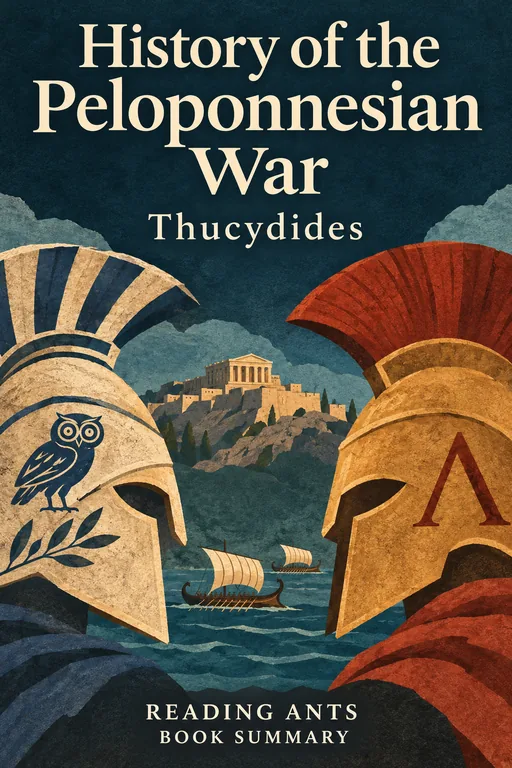
History of the Peloponnesian War
Original title: Ιστορία του Πελοποννησιακού Πολέμου
Thucydides, an Athenian general turned historian, records the long war between Athens and Sparta in the fifth century BCE and uses it to study power, fear, politics and how human nature behaves in crisis.
Overview
History of the Peloponnesian War was written by Thucydides, who lived in Athens in the fifth century BCE and who took part in the early part of the conflict. The war pitted Athens, a naval democracy with an empire, against Sparta, a land power, and their allies, and lasted for about twenty-seven years, from 431 BCE. Thucydides was exiled after a military failure, and used the time to gather information from both sides. His book is unfinished, ending in the middle of the war. It is known for its sober, analytical style, and for the speeches it contains, which show how people argued and reasoned. Thucydides says that the speeches stay close to the general sense of what was actually said, while giving each speaker what the occasion required, so they are neither transcripts nor free inventions.
Full Summary
1. Why the war happened
The idea: Thucydides says that although there were many disputes, the deepest cause of the war was the growth of Athenian power and the fear that this caused in Sparta. Athens had become wealthy and strong after leading the Greek allies in the Persian Wars, and turned its alliance into an empire. Sparta and its allies felt threatened. He argues that fear, honor and self-interest drive nations to conflict.
In real life: When a new student becomes very popular quickly, others may feel threatened, even if that student means no harm.
2. Pericles and the funeral speech
The idea: At the start of the war, the Athenian leader Pericles advised the city to avoid battle on land and to rely on its fleet and walls. At the end of the first year, at a public funeral for the war dead, Pericles gives a famous speech, which Thucydides records, honoring the fallen and describing the ideals of Athens: its open government, its respect for the law, its love of beauty and its citizens’ sense of duty. It is a portrait of what the city saw as its best self.
In real life: A leader who reminds people why their community is worth defending can inspire them in hard times.
3. The plague
The idea: In the second year, a terrible disease broke out in Athens, which was crowded with people who had fled the countryside. Thucydides describes the symptoms and the despair of the people, and how the plague killed very many. Pericles himself died about two and a half years after the war began, and Thucydides says that after his death Athens did the opposite of what he had urged. Fear of death led many to ignore laws and customs, since they thought that they might not live to be punished. He wrote the account so that others might recognize the illness.
In real life: In a crisis, a sense that rules no longer matter can spread quickly.
4. Debates about cruelty and justice
The idea: The war brought difficult choices. When the city of Mytilene revolted, the Athenian assembly first voted to kill all its men, and the next day argued again and called off the massacre of the city’s people, although the Athenians still put to death more than a thousand men they saw as the leaders of the revolt. Thucydides gives the speeches on both sides. At Corcyra, civil war turned into a bloody feud, and he says that the war made words lose their meaning and violence normal. He shows that wartime tends to make people harsher.
In real life: A group that is angry may act in ways it later regrets, which is why a cooling-off period can be valuable.
5. The Melian dialogue
The idea: In one of the most famous passages, Athenian envoys visit the small island of Melos, which wanted to remain neutral, and tell the Melians to submit, saying that the strong do what they can and the weak accept what they must. The Melians appeal to justice and hope, but refuse, and after a siege the Athenians take the island, killing the grown men and enslaving the women and children. Thucydides presents the scene as a lesson on power and the limits of moral argument.
In real life: A bully may say that “that’s just how things are,” and the question is how a community answers.
6. The Sicilian disaster
The idea: Encouraged by ambitious leaders, such as Alcibiades, Athens sent a great expedition to conquer Sicily. Alcibiades was soon recalled to face charges and went over to Sparta, and the venture, led by Nicias and later Demosthenes against a Spartan general, Gylippus, ended in 413 BCE with the destruction of the fleet and army. Thucydides tells the story with great detail and sadness. The failure shook Athens and gave its enemies hope, and their ally Persia began to help Sparta.
In real life: A grand project that is begun out of pride, without enough planning, can end in disaster.
7. Unfinished story
The idea: The book stops in the middle of the war, in 411 BCE, with Athens in turmoil and its government briefly overturned. Other writers later told the end, in which Athens was defeated in 404 BCE. Thucydides believed that human nature stays the same, so that the events he recorded would happen again in similar ways. His work was intended as a possession for all time, a tool to understand the future.
In real life: Studying how past conflicts started can help us to spot warning signs.
Why It Matters
Thucydides is often called the founder of scientific history and of political realism. His work is distinguished by his effort to be accurate, to explain events by human causes and not by the actions of gods, and to treat evidence critically. His analysis of power, fear and the way language and morality break down in war has been read by leaders and scholars for centuries. In modern times, the phrase “Thucydides trap” has been used for the risk of war when a rising power challenges an established one. The book is read in military academies and universities, and still offers insights into politics.
Key Takeaways
- Fear and power drive conflict. Rising strength can trigger dread and war.
- War corrupts. Violence erodes moral standards and language.
- Leaders matter. Wise or reckless leadership changes outcomes.
- Pride invites disaster. Overreach, as in Sicily, can ruin a state.
- Human nature repeats. Studying the past helps in recognizing patterns.
What We Can Learn
When you face a conflict, whether between friends or between countries, ask what fears and interests lie behind it. Think about what is at stake for each side, and whether misunderstanding is increasing the danger. Be careful with strong statements made in anger. Notice how leaders talk about their cause, and compare the words with the deeds. And remember that decisions made under pressure can look very different afterwards. The work encourages cool, evidence-based thinking when emotions are high.
Criticism and Counterpoints
Critics point out that Thucydides wrote the speeches himself, based on what he thought might have been said, so they may not be exact. Some say that he was biased, either in favor of Pericles or against the demagogues who followed him, and that he leaves out aspects of Athenian life, such as religion and the role of women. Some readers take the harsh view of power voiced by Athenian speakers as Thucydides’s own, but that is an interpretation, and the later disaster complicates any simple endorsement of it. Others stress that ideas, justice and cooperation also matter. The book is also unfinished and, in places, hard to follow. Modern historians use it with care, together with other sources.
Who Should Read It
This book is for readers of history, politics and philosophy, and for anyone interested in how societies act under stress. It is long and demanding, so many readers start with selections such as the funeral speech, the plague and the Melian dialogue. Those who prefer a lively narrative may want to start with a modern retelling.
Want the whole book?
A summary is a taste, not the meal. Here is where to find the full book.
You reached the end 🎉
Nicely done. Mark this one as read, and we will suggest what to read next.
Read this next
The Histories
Herodotus
Herodotus, often called the father of history, tells how the Greeks and the Persians came into conflict and fought the great wars of the early fifth century BCE, with long, colorful detours into the lands, customs and legends of the known world.
🏛️ History
The Iliad
Homer
During the final year of the Trojan War, the great Greek warrior Achilles withdraws from battle in anger, and only the death of his dearest friend drives him back to fight, leading to terrible loss and a moment of shared human grief with his enemy.
🎭 Epics, Drama & Poetry
The Republic
Plato
Plato, through the character of Socrates, asks what justice is and imagines an ideal city, arguing that a just person and a just state are ruled by wisdom, with reason guiding the whole.
🕊️ Philosophy & Religion
The Prince
Niccolo Machiavelli
A Renaissance diplomat advises rulers to judge their actions by results rather than morality, arguing that a successful leader must sometimes be cunning and ruthless to win and keep power.
⚖️ Politics & Society
The Art of War
Sun Tzu
The greatest victory is the one won without fighting, achieved through careful planning, knowing both yourself and your opponent, and using deception, flexibility and timing.
🕊️ Philosophy & Religion
Sapiens: A Brief History of Humankind
Yuval Noah Harari
Humans came to rule the planet not because we are the strongest animals but because we can believe in shared stories (gods, nations, money, companies) that let millions of strangers cooperate.
🏛️ HistoryWant something different?
Pick another topic and we will show you three books to start with.