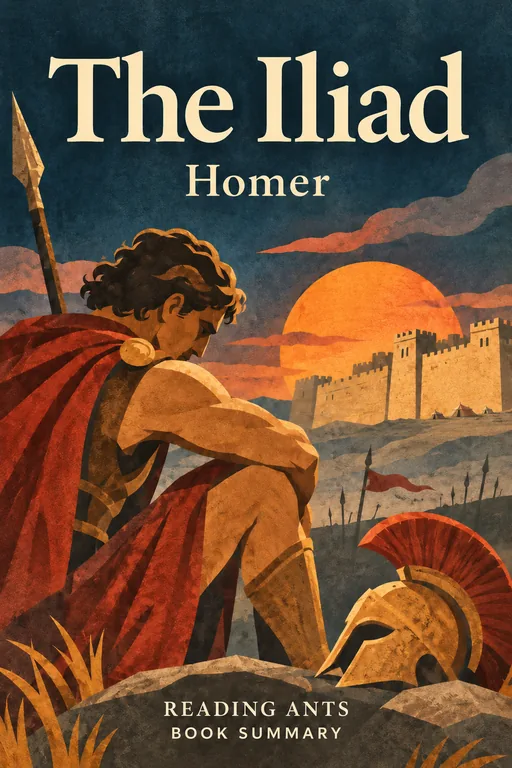
The Iliad
Original title: Ιλιάδα
During the final year of the Trojan War, the great Greek warrior Achilles withdraws from battle in anger, and only the death of his dearest friend drives him back to fight, leading to terrible loss and a moment of shared human grief with his enemy.
Overview
The Iliad, traditionally credited to the Greek poet Homer and composed around the eighth century BCE, is one of the oldest works of Western literature. It tells part of the story of the Trojan War, a ten-year conflict between the Greeks (called Achaeans) and the city of Troy, which began when the Trojan prince Paris carried off Helen, the wife of the Greek king Menelaus. The poem focuses on just a few weeks in the war’s final year and on one central theme: the rage of Achilles, the greatest Greek warrior. Gods take sides and intervene in the fighting, and heroes win glory and meet death. It is a powerful meditation on war, honor, anger and mortality.
Main Characters
- Achilles: the greatest Greek warrior, proud and quick to anger.
- Agamemnon: the commander of the Greek armies.
- Patroclus: Achilles’s closest friend.
- Hector: the noble prince and greatest warrior of Troy.
- Priam: the aged king of Troy, Hector’s father.
- Paris and Helen: the Trojan prince and the Greek queen he took to Troy, whose departure from Sparta caused the war.
- Andromache: Hector’s loving wife.
- Odysseus, Ajax and Diomedes: other Greek heroes.
- The gods: including Zeus, Athena, Apollo, Hera and Thetis, Achilles’s goddess mother.
Full Summary
The Quarrel
The poem begins by calling on the Muse to sing of the rage of Achilles. In the tenth year of the war, the Greek commander Agamemnon has taken a captive woman, the daughter of a priest of Apollo. When he refuses to return her, Apollo sends a plague on the Greek camp. Agamemnon agrees to give her up, but demands Achilles’s own war prize, a woman named Briseis, in exchange. Furious at this insult to his honor, Achilles withdraws from the fighting with his men. He asks his mother, the sea goddess Thetis, to persuade Zeus to let the Trojans win until the Greeks realize how much they need him.
The Battles Begin
Without Achilles, the war turns against the Greeks. There are duels and great battles. Paris fights Menelaus in single combat to settle the war, but the goddess Aphrodite rescues Paris before he can be killed. The truce breaks down. Hector, Troy’s greatest warrior, leads the Trojans forward. In a tender scene, Hector says goodbye to his wife, Andromache, and their baby son, who is frightened by his father’s helmet until Hector takes it off.
The Embassy to Achilles
As the Trojans push the Greeks back to their ships, Agamemnon admits his mistake. He sends Odysseus and others to Achilles with an offer: Briseis will be returned, along with enormous gifts. Achilles refuses. He says that no gifts can repair the insult, and he questions whether glory is worth dying for. The Trojans break through the Greek defenses and begin setting fire to the ships.
Patroclus
Achilles’s dear friend Patroclus begs to be allowed to fight. Achilles agrees to lend him his own armor, so the Trojans will think Achilles has returned, but warns him only to drive the Trojans away from the ships. Patroclus fights brilliantly but pushes too far. Apollo strikes him, a Trojan warrior wounds him, and Hector kills him and strips off Achilles’s armor.
When Achilles learns of Patroclus’s death, his grief is overwhelming. He pours dust on his head and cries out so terribly that the Trojans are frightened. His mother brings him new armor, forged by the god Hephaestus, including a magnificent shield decorated with scenes of peace and war, cities, weddings, farming and dancing.
The Rage of Achilles
Achilles makes peace with Agamemnon and returns to battle, filled with fury. He slaughters countless Trojans and even fights the river god, who is angry that his waters are choked with bodies. The Trojans flee into their city, but Hector stays outside the gates to face Achilles. At first, he runs, chased three times around the walls of Troy. Then, deceived by the goddess Athena, he stands and fights. Achilles kills him with a spear through the throat. Dying, Hector begs Achilles to return his body to his family. Achilles refuses, ties Hector’s body to his chariot and drags it in the dust before the eyes of Hector’s parents and wife.
Funeral Games
Achilles holds a great funeral for Patroclus, with chariot races and athletic contests. Every day, he drags Hector’s body around Patroclus’s tomb, but the gods protect the body from damage.
Priam and Achilles
The gods decide that this treatment of Hector must end. Guided by the god Hermes, the old king Priam secretly crosses enemy lines at night and enters Achilles’s tent. He kneels and kisses the hands that killed his son, asking Achilles to think of his own father. Achilles, moved, weeps with Priam: one for his son, the other for his father and for Patroclus. Achilles returns Hector’s body and grants a truce for his funeral. The poem ends with the Trojans mourning and burying Hector, the tamer of horses.
Why It Matters
The Iliad is one of the foundational works of Western literature and has been read, studied and admired for nearly three thousand years. It shaped Greek education and culture, and later Roman literature, especially Virgil’s Aeneid. Its characters, Achilles, Hector, Helen and Paris, and phrases such as “Achilles’ heel,” though that particular story comes from later myths, are part of world culture.
The poem is remarkable for its honest portrayal of war: the glory and courage, but also the terrible cost to soldiers and families on both sides. Its final scene, where enemies weep together, is often seen as one of the most powerful expressions of shared humanity in literature. It continues to inspire novels, films and plays, including The Song of Achilles and the film Troy.
Key Takeaways
- Anger has devastating consequences. Achilles’s rage costs countless lives, including his best friend’s.
- War brings glory and grief. Heroes win fame, but families suffer.
- Honor drives the heroes. Pride and reputation shape their choices.
- Enemies share humanity. Achilles and Priam find common ground in grief.
- Death is the fate of all. Even the greatest heroes cannot escape it.
What We Can Learn
The Iliad warns us about the danger of uncontrolled anger. Achilles’s pride and rage seem justified at first, but they lead to tragedy. When we feel insulted or treated unfairly, taking time to cool down can prevent decisions we will later regret.
It also teaches compassion for those on the other side of a conflict. Priam and Achilles are enemies, yet they recognize each other’s pain. Remembering that opponents are also human beings, with families and feelings, can help us resolve conflicts.
Finally, the poem reminds us of the human cost of war, encouraging us to value peace and to honor those who have suffered.
Criticism and Counterpoints
Many modern readers find the long, detailed battle scenes, full of names and gory deaths, difficult and repetitive, along with the lengthy “Catalogue of Ships” listing the Greek forces. The poem’s values, centered on warrior honor, can seem distant and troubling today, especially the treatment of women as war prizes.
Scholars have also long debated whether Homer was a single poet, or whether the Iliad grew from generations of oral storytelling. Translations vary widely in style, and choosing a modern, readable version, such as Emily Wilson’s or Robert Fagles’s, makes a great difference.
Who Should Read It
This epic suits older teens and adults interested in mythology, war and ancient history. Its battle scenes are intense and violent. Readers new to Homer may enjoy starting with a retelling or with The Odyssey, then returning to the Iliad.
Want the whole book?
A summary is a taste, not the meal. Here is where to find the full book.
You reached the end 🎉
Nicely done. Mark this one as read, and we will suggest what to read next.
Read this next
The Odyssey
Homer
After the Trojan War, the clever hero Odysseus struggles for ten years against monsters, gods and temptations to return home to his faithful wife and son, then must win back his house from the men trying to steal it.
🎭 Epics, Drama & Poetry
The Aeneid
Virgil
After the fall of Troy, the hero Aeneas leads a band of refugees across the sea to Italy, where he is fated to found the line that will build Rome, at great personal cost.
🎭 Epics, Drama & Poetry
The Song of Achilles
Madeline Miller
Retelling the story of the Trojan War from the viewpoint of Patroclus, the gentle outcast who becomes the companion and lover of the great hero Achilles, this novel follows their love from boyhood to the ruin at Troy.
✨ Modern Fiction
The Epic of Gilgamesh
Anonymous
A proud, powerful king of ancient Mesopotamia gains a true friend, loses him to death, and journeys to the edge of the world in search of eternal life, only to learn that what lasts is the life and legacy we leave behind.
🎭 Epics, Drama & Poetry
The Mahabharata
Vyasa
Two branches of a royal family, the five righteous Pandava brothers and their hundred cousins the Kauravas, fight over the throne of an ancient Indian kingdom, leading to a catastrophic war that raises deep questions about duty, justice and the meaning of life.
🎭 Epics, Drama & Poetry
Hamlet
William Shakespeare
A grieving prince of Denmark learns from his father's ghost that his uncle murdered the king to take the throne, and his struggle to decide whether and how to take revenge leads to madness and death.
🎭 Epics, Drama & PoetryWant something different?
Pick another topic and we will show you three books to start with.