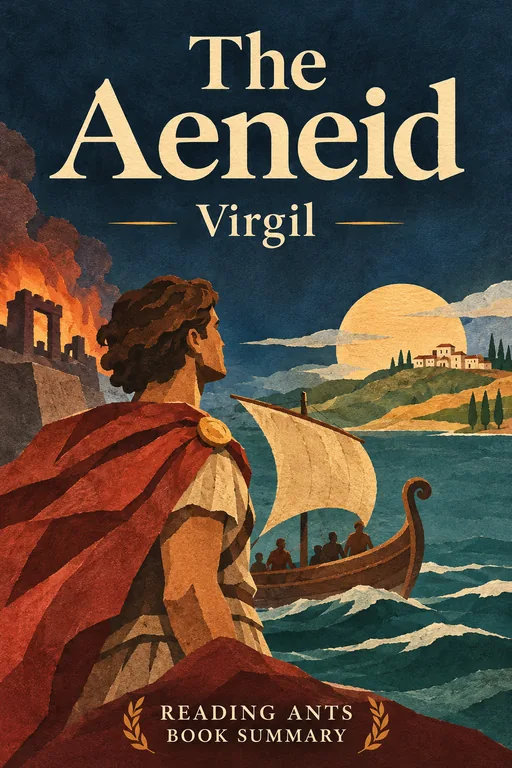
The Aeneid
Original title: Aeneis
After the fall of Troy, the hero Aeneas leads a band of refugees across the sea to Italy, where he is fated to found the line that will build Rome, at great personal cost.
Overview
The Aeneid is an epic poem in twelve books, written in Latin by the Roman poet Virgil between about 29 and 19 BC. It was written in the age of the emperor Augustus, whose regime it celebrates, and it tells the story of Aeneas, a Trojan prince who survives the destruction of Troy. It is modeled on Homer’s two epics: the first six books resemble the Odyssey, with a journey, and the last six the Iliad, with a war. The poem was meant to give Rome a heroic past, and to celebrate the idea of Roman destiny. At the same time, it is full of sorrow, and shows the price of empire. Virgil died before finishing the final revision, and asked for it to be burned, but Augustus had it published.
Main Characters
- Aeneas: the Trojan hero, son of the goddess Venus, who is dutiful, brave and burdened by his mission.
- Dido: the queen of Carthage, who falls in love with Aeneas.
- Turnus: the king of the Rutulians, Aeneas’s proud enemy in Italy.
- Juno: the queen of the gods, who hates the Trojans and tries to stop Aeneas.
- Venus: Aeneas’s divine mother, who helps him.
- Anchises: Aeneas’s father, whom he carries from Troy.
- Latinus and Lavinia: the king of Latium and his daughter, whom Aeneas is destined to marry.
- The Sibyl: the prophetess who guides Aeneas to the underworld.
Full Summary
The Fall of Troy and the Storm
The poem begins with Aeneas and his fleet of refugees, seven years after Troy’s fall, being driven off course by a storm that is sent by Juno, who hates the Trojans. They land on the coast of North Africa, near the new city of Carthage, ruled by Queen Dido. Aeneas tells her, in a long flashback, the story of Troy’s fall: how the Greeks tricked the city with the wooden horse, how he fled the burning city, carrying his father on his back and leading his son by the hand, and how his wife, Creusa, was lost in the chaos.
Dido
Dido welcomes the Trojans, and she and Aeneas fall in love, helped by the gods Venus and Juno, who have different aims. For a while he stays in Carthage and helps to build it, forgetting his mission. But Jupiter sends the god Mercury to remind him that his destiny is in Italy. Aeneas prepares to leave in secret. Dido, discovering it, begs him to stay, and when he sails away, she kills herself on a funeral pyre, cursing him and his descendants, and foretelling the long struggle between Carthage and Rome.
The Underworld
Aeneas and his men sail on to Sicily, where they hold games to honor his dead father, then arrive in Italy. At Cumae, Aeneas visits the Sibyl, who guides him to the underworld. There he meets the shade of Dido, who turns from him in silence, and his father Anchises, who shows him a parade of the future heroes of Rome, from Romulus to Augustus. The vision gives him a sense of purpose and of the glory to come, and he returns to the world of the living with new resolve.
War in Italy
In Latium, King Latinus welcomes the Trojans, and offers his daughter Lavinia in marriage, as an oracle had foretold. But Juno stirs up trouble, sending the fury Allecto to rouse the local people. The queen of Latium and Turnus, who had hoped to marry Lavinia, lead a rebellion. War breaks out between the Trojans and the Italians. Aeneas finds allies in Evander, king of a small settlement on the site of future Rome, whose son Pallas joins him in the fight.
Pallas and the Battle
The war is bloody. There are moving episodes of friendship and sacrifice among the soldiers, including the story of Nisus and Euryalus, two young friends who die together on a night raid. Young Pallas is killed by Turnus, who takes his sword belt as a trophy. Aeneas, filled with grief and anger, fights fiercely and kills many. The book mourns the waste of youth even as it celebrates the cause.
The Duel
At last, Aeneas and Turnus meet in single combat. Aeneas wounds Turnus, who begs for mercy. Aeneas is about to spare him when he sees the belt of Pallas on Turnus’s shoulder, and, enraged, kills him. The poem ends abruptly with Turnus’s soul fleeing to the shades, leaving readers to ponder whether this final act is justice or an unrestrained fury, and what it says about the cost of founding an empire.
Why It Matters
The Aeneid is the national epic of Rome, and one of the foundational works of Western literature. It shaped the way that Europeans thought about empire, duty and destiny for two thousand years. Dante chose Virgil as his guide in the Divine Comedy, and writers from Milton to modern poets have been inspired by it. For centuries it was a core text of education.
The poem is also loved for its poetry, its portrait of Dido, which has inspired operas and paintings, and its mixture of triumph and sadness.
Its famous opening, which speaks of arms and a man, has been echoed by many poets, and its scenes of the burning of Troy, the death of Dido and the visit to the underworld became models for later literature and art.
Key Takeaways
- Duty can conflict with desire. Aeneas must give up Dido for his mission.
- Empire has a cost. Many suffer for Rome’s founding.
- Fate guides, but heroes must choose. Aeneas accepts his destiny.
- Grief and loyalty run deep. The poem mourns the dead.
- Mercy and anger struggle. The ending leaves the balance uncertain.
What We Can Learn
The poem invites us to consider what we owe to our family, community and goals, and what we may have to give up. Aeneas’s willingness to carry his father and his duty is a model of loyalty, though it also leads to loss.
It also shows that even great achievements can be tainted by pain. The poem celebrates Rome but does not hide the suffering that it caused, which can encourage us to look at success with honesty.
Finally, it shows how stories can shape national identity, for better and worse.
Criticism and Counterpoints
Some modern readers see the poem as propaganda for Augustus and for imperial rule, and find Aeneas cold, since he abandons Dido and kills Turnus. Others argue that Virgil is deeply ambivalent and uses the poem to question the price of empire, as shown by the final scene and the sympathetic portrayal of Dido and Turnus.
Some find it less spontaneous than Homer, as it is a literary epic that draws on earlier works. Its length and its references to Roman history can make it hard for new readers. Translations vary greatly in style.
Who Should Read It
This poem suits teenagers and adults who enjoy myth and ancient history. It is long, so a modern translation with notes is helpful. Readers may wish to begin with Books 1, 2, 4 and 6, which contain the best-known episodes.
Want the whole book?
A summary is a taste, not the meal. Here is where to find the full book.
You reached the end 🎉
Nicely done. Mark this one as read, and we will suggest what to read next.
Read this next
The Iliad
Homer
During the final year of the Trojan War, the great Greek warrior Achilles withdraws from battle in anger, and only the death of his dearest friend drives him back to fight, leading to terrible loss and a moment of shared human grief with his enemy.
🎭 Epics, Drama & Poetry
The Odyssey
Homer
After the Trojan War, the clever hero Odysseus struggles for ten years against monsters, gods and temptations to return home to his faithful wife and son, then must win back his house from the men trying to steal it.
🎭 Epics, Drama & Poetry
Paradise Lost
John Milton
Milton's epic poem tells how Satan rebelled against God, was cast into hell, tempted Adam and Eve to disobey, and caused humanity's expulsion from the Garden of Eden.
🎭 Epics, Drama & Poetry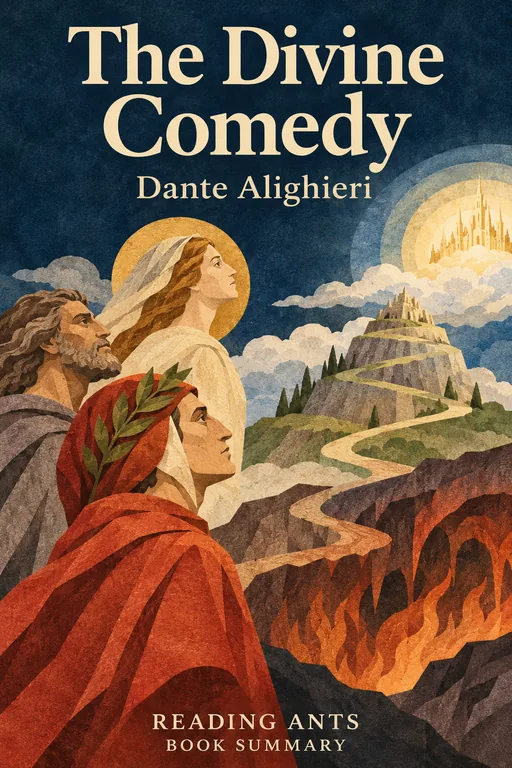
The Divine Comedy
Dante Alighieri
Lost in a dark wood in the middle of his life, the poet Dante journeys through Hell, Purgatory and Heaven, guided first by the poet Virgil and then by his beloved Beatrice, on a quest to understand sin, redemption and divine love.
🎭 Epics, Drama & Poetry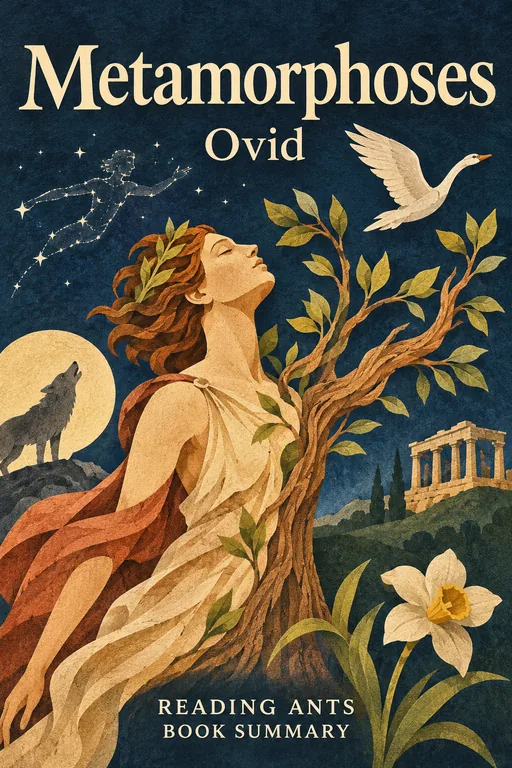
Metamorphoses
Ovid
In fifteen books of Latin verse, Ovid retells more than two hundred myths from the creation of the world to the death of Julius Caesar, linked by a single theme: change, often a person turned into an animal, plant or star.
🎭 Epics, Drama & Poetry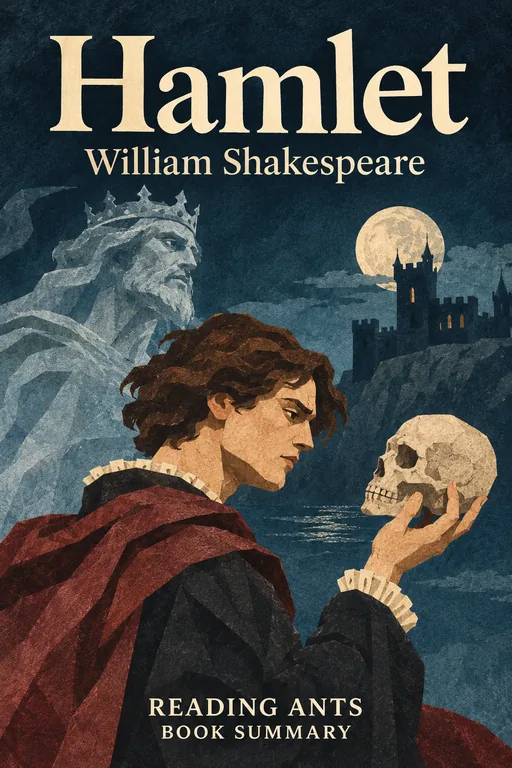
Hamlet
William Shakespeare
A grieving prince of Denmark learns from his father's ghost that his uncle murdered the king to take the throne, and his struggle to decide whether and how to take revenge leads to madness and death.
🎭 Epics, Drama & PoetryWant something different?
Pick another topic and we will show you three books to start with.