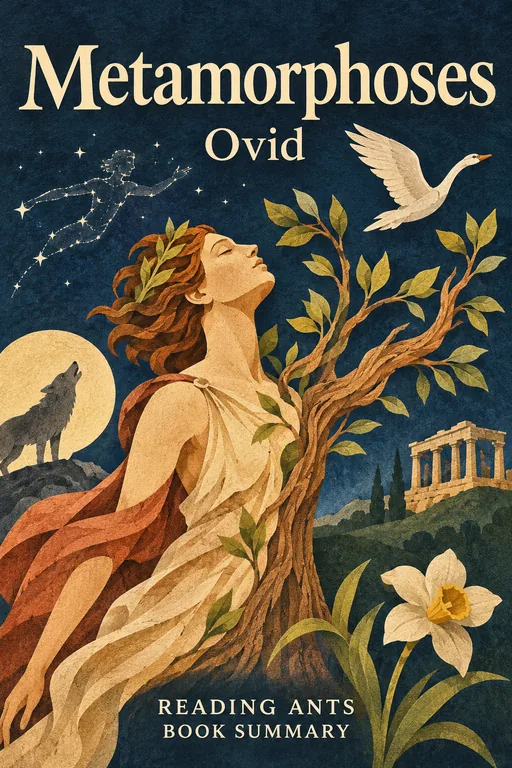
Metamorphoses
In fifteen books of Latin verse, Ovid retells more than two hundred myths from the creation of the world to the death of Julius Caesar, linked by a single theme: change, often a person turned into an animal, plant or star.
Overview
Metamorphoses is a long narrative poem by the Roman poet Ovid, completed around 8 AD. It is written in the same meter as epics like The Aeneid, but instead of telling one hero’s story, it weaves together a vast number of tales, many of them taken from Greek mythology. Each story involves a transformation, whether a girl who becomes a tree, a boy who becomes a flower or a man who becomes a wolf. The stories are often funny, strange or tragic, and they flow into one another like a chain. The poem has been one of the most important sources of myths for later artists and writers, and remains one of the most widely read works of Latin literature.
Main Characters
- Jupiter (Zeus): the king of the gods, who often pursues mortals.
- Apollo and Daphne: the god and the nymph who becomes a laurel tree.
- Narcissus and Echo: the beautiful youth and the nymph who fades to a voice.
- Pygmalion: the sculptor whose statue comes to life.
- Orpheus and Eurydice: the musician who tries to bring his wife back from the dead.
- Arachne and Minerva: the weaver and the goddess in a contest.
- Daedalus and Icarus: the inventor and his son who fly with wings.
- Medea, Perseus, Hercules and Midas: heroes and mortals from other myths.
Full Summary
Creation and the Flood
The poem begins with the origin of the world from chaos, as the elements separate into earth, sea and sky, and the first humans are made. Ovid describes the ages of humanity, from a golden age to an age of iron, in which people grow violent and greedy. Jupiter, angry at human wickedness, decides to destroy mankind with a flood. Only Deucalion and Pyrrha survive, and they repopulate the earth by throwing stones behind them, which turn into people.
Gods and Mortals in Love
Many stories show gods who desire mortals. Apollo chases the nymph Daphne, who prays for help, and is turned into a laurel tree, which Apollo then adopts as his symbol. Jupiter pursues Io, the daughter of a river god, and turns her into a cow to hide her from his wife, Juno. Many of these tales are told from the point of view of those who suffer from the gods’ desires, and they are often disturbing for modern readers. Ovid shows the gods as powerful, capricious and sometimes cruel.
Pride and Punishment
A number of tales warn against pride. Arachne, a weaver, boasts that she is better than the goddess Minerva, and challenges her to a contest. Minerva is furious when she sees that Arachne’s tapestry is flawless but shows the gods’ misdeeds, and turns her into a spider. Narcissus, who rejects the love of all, falls in love with his own reflection in a pool, and wastes away, to be turned into a flower. The nymph Echo, whom he scorned, fades until only her voice remains.
Love and Loss
Other stories explore love. Pygmalion, a sculptor, makes a statue of a woman so beautiful that he falls in love with it, and Venus brings it to life. Orpheus, whose music moves even the rocks, descends to the underworld to bring back his wife Eurydice, but looks back too soon, and loses her again. Pyramus and Thisbe, two young lovers who meet through a crack in a wall, die through a tragic misunderstanding, a tale that Shakespeare later reused in A Midsummer Night’s Dream.
Heroes and Monsters
The poem also tells of heroes. Perseus kills the Gorgon Medusa, and frees Andromeda from a sea monster. Daedalus builds wings of wax and feathers for himself and his son, Icarus, who flies too close to the sun and falls into the sea. Jason and Medea, Theseus and the Minotaur, and Hercules appear in the middle books.
Medea, who helped Jason win the Golden Fleece, uses herbs and spells to restore Jason’s old father to youth, and later takes terrible revenge when Jason leaves her. Hercules’s death, caused by a poisoned robe, leads to his entry among the gods, though many more tales follow.
Rome and Immortality
In the final books, the myths blend into history. Ovid tells of the Trojan War, the travels of Aeneas and the founding of Rome, ending with the deification of Julius Caesar, who becomes a star. The poem closes with Ovid’s claim that his poem will make him immortal, and that his name will live on wherever Roman power extends, and wherever people read him.
Why It Matters
Metamorphoses is one of the great storehouses of classical myth, and for centuries it was the main source from which poets, painters and sculptors learned about the stories. Shakespeare, Milton, Dante, Chaucer and many others drew on it, and artists from Titian to Bernini painted its scenes. Modern writers, from Ted Hughes to Mary Zimmerman, have retold it.
The poem’s central idea, that everything changes, makes it a lasting reflection on identity, desire and the instability of the world. It also shows Ovid’s wit and love of storytelling.
Its stories are so familiar that many people know them without knowing their source: the idea of a Midas touch, the image of a Narcissus and the warning of Icarus all come, in large part, from Ovid’s lively versions.
Key Takeaways
- Change is constant. Everything in the poem is transformed.
- Pride invites downfall. Arachne and Narcissus are punished.
- Desire can be destructive. Many myths show harm from uncontrolled passion.
- Art and love can transform. Pygmalion’s statue lives.
- Stories outlast their tellers. Ovid claims immortality for his poem.
What We Can Learn
The poem encourages us to accept change as part of life, and to think about how experience changes who we are. Its stories of transformation are vivid images of how emotions, fears and desires can alter a person.
It also teaches that myths are a language for exploring human feelings, and that old stories can still help us to think about love, envy, loss and power.
Finally, it invites us to read critically, noticing whose perspective is told and whose is missing, especially in the many stories of abuse by powerful beings.
Criticism and Counterpoints
Modern readers often criticize the poem for its many scenes of sexual violence, which are treated with elegance or humor, and the way that victims are often punished or transformed. Some find the sheer number of stories confusing or repetitive, and the Latin style hard to translate.
Others argue that Ovid is not endorsing violence but exposing the abuse of power, and that his sympathy for victims is clear. In his own time, he offended Augustus, and was exiled for reasons that remain unknown. The poem demands a thoughtful reading.
Who Should Read It
This book suits mature teenagers and adults. It contains sexual violence and cruelty in some stories, so it may be best read in selections, with a good translation and notes. It is a rich source for anyone interested in myth.
Want the whole book?
A summary is a taste, not the meal. Here is where to find the full book.
You reached the end 🎉
Nicely done. Mark this one as read, and we will suggest what to read next.
Read this next
The Aeneid
Virgil
After the fall of Troy, the hero Aeneas leads a band of refugees across the sea to Italy, where he is fated to found the line that will build Rome, at great personal cost.
🎭 Epics, Drama & Poetry
The Odyssey
Homer
After the Trojan War, the clever hero Odysseus struggles for ten years against monsters, gods and temptations to return home to his faithful wife and son, then must win back his house from the men trying to steal it.
🎭 Epics, Drama & Poetry
The Iliad
Homer
During the final year of the Trojan War, the great Greek warrior Achilles withdraws from battle in anger, and only the death of his dearest friend drives him back to fight, leading to terrible loss and a moment of shared human grief with his enemy.
🎭 Epics, Drama & Poetry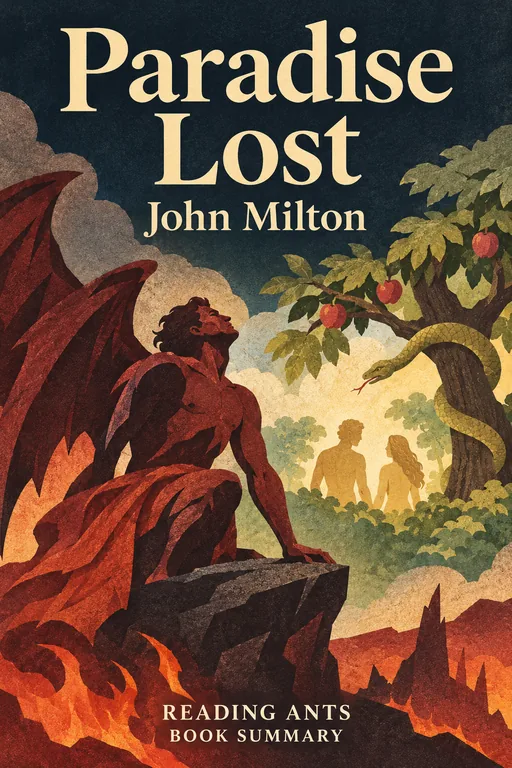
Paradise Lost
John Milton
Milton's epic poem tells how Satan rebelled against God, was cast into hell, tempted Adam and Eve to disobey, and caused humanity's expulsion from the Garden of Eden.
🎭 Epics, Drama & Poetry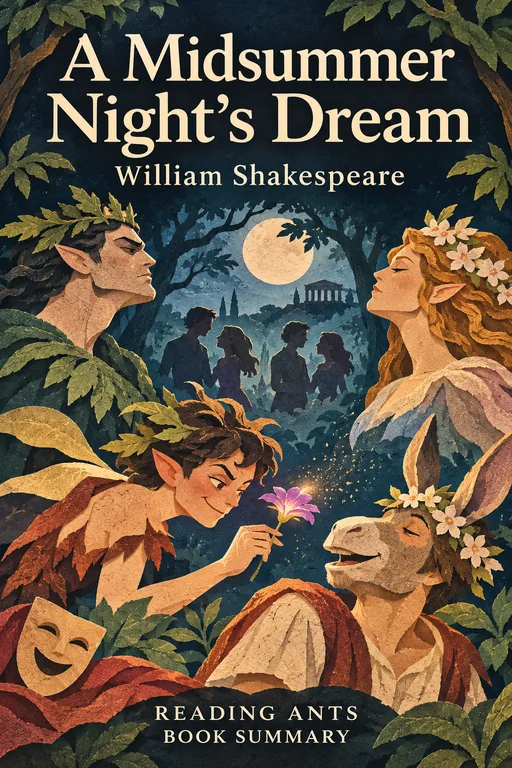
A Midsummer Night's Dream
William Shakespeare
Four young lovers lost in an enchanted forest near Athens, a group of clumsy amateur actors and a quarreling fairy king and queen all get tangled up in magical mix-ups on a midsummer night, until love is set right.
🎭 Epics, Drama & Poetry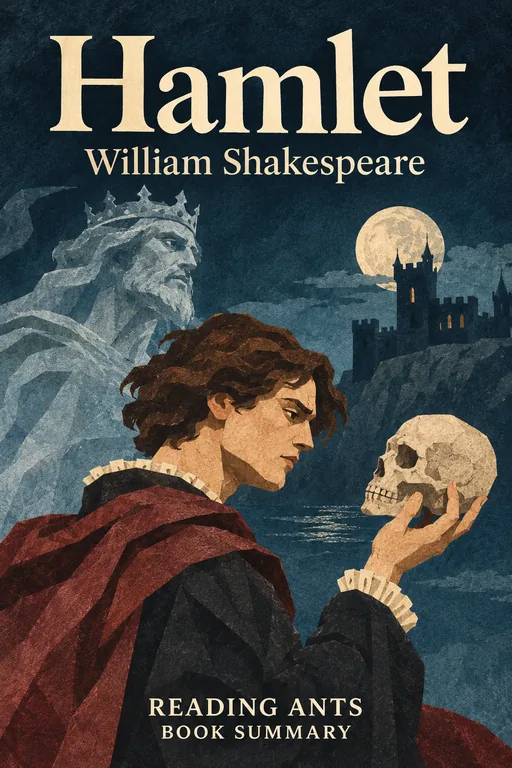
Hamlet
William Shakespeare
A grieving prince of Denmark learns from his father's ghost that his uncle murdered the king to take the throne, and his struggle to decide whether and how to take revenge leads to madness and death.
🎭 Epics, Drama & PoetryWant something different?
Pick another topic and we will show you three books to start with.