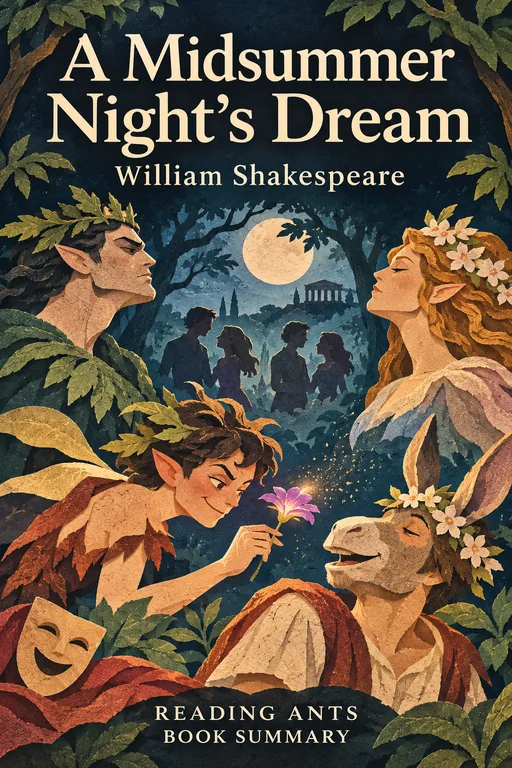
Four young lovers lost in an enchanted forest near Athens, a group of clumsy amateur actors and a quarreling fairy king and queen all get tangled up in magical mix-ups on a midsummer night, until love is set right.
Overview
A Midsummer Night’s Dream is one of William Shakespeare’s most popular comedies, written in the mid-1590s. It weaves together several stories. In Athens, Duke Theseus is preparing to marry Hippolyta, queen of the Amazons. Meanwhile, two young couples are caught in a tangle of love, and they flee into a nearby forest. In the same forest, the fairy king Oberon and queen Titania are fighting, and Oberon’s mischievous servant, Puck, uses a magic flower that makes people fall in love with the first creature they see. A group of working men, rehearsing a play for the Duke’s wedding, also wander into the woods. The result is a delightful mix of romance, magic and slapstick comedy.
Main Characters
- Hermia: a young woman in love with Lysander.
- Lysander: a young man who loves Hermia.
- Demetrius: a young man Hermia’s father wants her to marry.
- Helena: Hermia’s friend, who loves Demetrius.
- Oberon: the king of the fairies.
- Titania: the queen of the fairies.
- Puck (Robin Goodfellow): Oberon’s mischievous servant.
- Nick Bottom: a confident, comical weaver and amateur actor.
- Theseus and Hippolyta: the Duke of Athens and his bride.
Full Summary
Trouble in Athens
Duke Theseus of Athens is about to marry Hippolyta. Egeus arrives with his daughter Hermia, demanding that she marry Demetrius, the man he has chosen. But Hermia loves Lysander. Under Athenian law, if Hermia disobeys her father, she must either die or become a nun. Theseus gives her a few days to decide.
Hermia and Lysander plan to run away through the forest. They tell Hermia’s friend Helena, who loves Demetrius, although he has rejected her. Hoping to win his favor, Helena tells Demetrius about the plan, and he follows the couple into the woods, with Helena chasing after him.
The Fairy Quarrel
In the forest, Oberon and Titania are arguing over a young boy Titania is raising, whom Oberon wants as a servant. Their quarrel has thrown nature into chaos, causing bad weather and floods. To punish Titania, Oberon sends Puck to fetch a magic flower whose juice, when placed on a sleeper’s eyelids, makes them fall in love with the first creature they see when they wake.
Oberon sees Helena chasing Demetrius and, feeling sorry for her, tells Puck to put some of the juice on the eyes of the young Athenian man so he will love her. But Puck finds Lysander sleeping instead. When Lysander wakes, the first person he sees is Helena, and he falls instantly in love with her, abandoning Hermia.
The Mechanicals
Meanwhile, a group of Athenian workmen, known as the mechanicals, gather in the woods to rehearse a play for the Duke’s wedding: Pyramus and Thisbe, a tragic love story. Their leader, Peter Quince, struggles to direct, while the overconfident weaver Nick Bottom wants to play every part.
Puck, watching for fun, transforms Bottom’s head into a donkey’s head. His friends flee in terror. Bottom, not realizing what has happened, sings to show he isn’t afraid, which wakes Titania, whose eyes Oberon has anointed with the magic juice. She falls instantly in love with Bottom, donkey head and all, and orders her fairies to care for him.
Lovers’ Chaos
To fix the mistake, Oberon puts the love juice on Demetrius’s eyes, while Puck brings Helena to him, and now both young men love Helena. Helena thinks they are mocking her, and Hermia, confused and furious, believes Helena has stolen Lysander. The two friends quarrel bitterly, and the men prepare to fight a duel. Oberon orders Puck to lead the lovers around the forest in the fog until they collapse in exhaustion, then to undo the spell on Lysander.
Setting Things Right
Oberon gets the young boy from Titania while she is under the spell, then releases her. She wakes, horrified to see whom she loved, and the fairy king and queen make peace. Puck removes the donkey’s head from Bottom. When the four lovers wake, Lysander loves Hermia again, and Demetrius, still under the spell, loves Helena. Theseus, hunting in the woods, finds them and overrules Egeus, allowing both couples to marry.
Bottom wakes and believes he has had a strange dream, which he decides to turn into a ballad.
The Play Within the Play
At the triple wedding celebration, the mechanicals perform Pyramus and Thisbe. It is wonderfully terrible: an actor plays a wall, another plays the moonshine, and Bottom overacts his death scene. The noble audience laughs and teases them, but they enjoy it. After the couples go to bed, the fairies bless the house. Puck addresses the audience, suggesting that if they did not enjoy the play, they should simply think of it as a dream.
Why It Matters
A Midsummer Night’s Dream is one of Shakespeare’s most frequently performed plays, loved for its humor, imagination and magic. It is often the first Shakespeare play young people see, because its comedy and fairy world are easy to enjoy. Puck and Bottom are among Shakespeare’s most beloved comic characters.
The play has inspired music, ballet and art, including Felix Mendelssohn’s famous incidental music, whose “Wedding March” is still played at weddings around the world. It has been adapted for film, opera and countless school productions. Its playful exploration of love’s foolishness, and of the line between dreams and reality, continues to delight audiences.
Key Takeaways
- Love can be irrational. The magic flower shows how unpredictable love is.
- Imagination is powerful. Dreams, magic and theater transform reality.
- Misunderstandings cause chaos. Mistaken identities create humor and conflict.
- Harmony can be restored. The quarrels end in reconciliation and celebration.
- Everyone can create art. The workmen’s clumsy play is still honored.
What We Can Learn
A Midsummer Night’s Dream reminds us not to take love too seriously all the time. People can fall in and out of love quickly, and it’s okay to laugh at ourselves when romance gets confusing.
It also teaches the value of forgiveness. After all the misunderstandings, the friends make peace, and the fairy king and queen end their quarrel. Letting go of arguments makes room for happiness.
Finally, the mechanicals show that it’s worth trying creative things even when we’re not experts. Putting on a play, writing a song or painting a picture brings joy, and the effort deserves respect.
Criticism and Counterpoints
Some modern readers are uncomfortable with parts of the play: Hermia’s father can demand her death for disobedience, Theseus won Hippolyta in battle, and Oberon humiliates Titania by drugging her to get what he wants. Demetrius also remains under the love spell at the end, which raises questions about whether his love for Helena is real.
Others find the four young lovers hard to tell apart, since they are less fully developed than the comic characters. Nonetheless, most audiences enjoy the play as a joyful fantasy, and many productions find ways to explore its darker undertones.
Who Should Read It
This play is an excellent introduction to Shakespeare for readers from about 10 upward, especially when seen performed. Its fairies, magic and comedy appeal to children and adults alike. School productions and film versions are a great way to start.
Want the whole book?
A summary is a taste, not the meal. Here is where to find the full book.
You reached the end 🎉
Nicely done. Mark this one as read, and we will suggest what to read next.
Read this next
Romeo and Juliet
William Shakespeare
Two teenagers from feuding families in Verona fall in love at first sight and marry in secret, but hatred, haste and bad luck lead them to a tragic end that finally brings their families together.
🎭 Epics, Drama & Poetry
Twelfth Night
William Shakespeare
After a shipwreck, a young woman named Viola disguises herself as a man and serves a duke, falls in love with him, and becomes tangled in a love triangle that is only resolved by the return of her twin brother.
🎭 Epics, Drama & Poetry
The Tempest
William Shakespeare
A wronged duke named Prospero, living on a magical island, raises a storm to bring his enemies to him, and in the end chooses forgiveness over revenge.
🎭 Epics, Drama & Poetry
Much Ado About Nothing
William Shakespeare
Two pairs of lovers in Messina, the witty rivals Beatrice and Benedick and the young couple Hero and Claudio, are tricked by their friends and enemies, in a comedy of wit, deception and reconciliation.
🎭 Epics, Drama & Poetry
Alice's Adventures in Wonderland
Lewis Carroll
A curious girl follows a white rabbit down a hole into a crazy world where she keeps changing size, meets mad and marvelous creatures, and stands up to a furious Queen.
🧸 Children's Books
The Odyssey
Homer
After the Trojan War, the clever hero Odysseus struggles for ten years against monsters, gods and temptations to return home to his faithful wife and son, then must win back his house from the men trying to steal it.
🎭 Epics, Drama & PoetryWant something different?
Pick another topic and we will show you three books to start with.