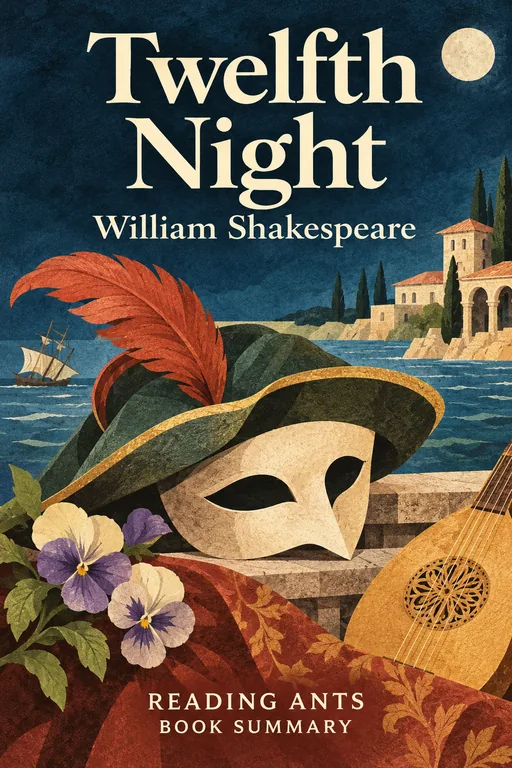
Twelfth Night
After a shipwreck, a young woman named Viola disguises herself as a man and serves a duke, falls in love with him, and becomes tangled in a love triangle that is only resolved by the return of her twin brother.
Overview
Twelfth Night, or What You Will is a comedy by William Shakespeare, first performed around 1601 and published in 1623. The title refers to the twelfth night after Christmas, a festival of misrule and fun. It is set in Illyria, a theatrical version of a real Adriatic region, and combines a romantic plot of mistaken identity with a comic subplot about a steward who is tricked into thinking that his mistress loves him. The play is full of music, wit and mixed-up feelings, and it asks questions about gender, love and self-deception.
Main Characters
- Viola: a clever, brave young woman who disguises herself as a boy named Cesario.
- Sebastian: her twin brother, whom she thinks is dead.
- Duke Orsino: the lovesick ruler of Illyria.
- Countess Olivia: a wealthy noblewoman in mourning for her brother.
- Malvolio: Olivia’s pompous steward.
- Sir Toby Belch: Olivia’s fun-loving, drunken uncle.
- Sir Andrew Aguecheek: a foolish knight who is Toby’s friend.
- Maria: Olivia’s witty maid.
- Feste: a wise jester.
- Antonio: a sea captain who rescues Sebastian and is devoted to him; he is a different man from the captain who helps Viola.
Full Summary
The Shipwreck
The play begins with Orsino, the Duke of Illyria, who is languishing in love for Olivia and calls for music. Meanwhile, on the coast, Viola has survived a shipwreck, and believes that her twin brother, Sebastian, has drowned. To protect herself in a strange land, she disguises herself as a young man, Cesario, and takes a job in Orsino’s household. She quickly becomes his favorite page, and falls in love with him secretly.
Viola persuades the captain who rescued her to help her take a position at the court, and asks him to keep her secret. As she enters Orsino’s service, she quickly learns to match her words to her disguise, and she gives wise and gentle advice about love that she herself needs. Orsino, who is fond of music and poetry, enjoys her company.
A Tangled Triangle
Orsino sends Cesario to woo Olivia on his behalf. But Olivia, who has vowed to mourn her brother for seven years, ignores the duke and instead falls in love with the page. Viola is dismayed, since she loves Orsino, who thinks of her as a young man, and Olivia loves Cesario, who is really a woman. This love triangle drives the comedy, as each person pursues someone who does not love them back.
The Plot Against Malvolio
In Olivia’s house, Sir Toby, Sir Andrew and Maria spend their nights in drinking and singing. The stiff, self-important Malvolio scolds them, which makes them angry. Maria devises a trick: she forges a letter in Olivia’s handwriting, saying that she loves him and wants him to wear yellow stockings, cross-gartered, and smile constantly. Malvolio, who dreams of rising in rank by marrying his mistress, believes the letter and acts as instructed, to the horror of Olivia, who thinks that he has gone mad.
Mistaken Identities
Sir Toby goads Sir Andrew into a duel with Cesario, over Olivia, though both are terrified. The duel is interrupted by Antonio, who thinks that Cesario is his friend Sebastian, who has indeed survived and is also in Illyria. Antonio is arrested. Soon after, Sebastian appears, and Olivia, who mistakes him for Cesario, kisses him and asks him to marry her. Sebastian, astonished but delighted, agrees.
Sebastian, a young man who is as brave as his sister, has been rescued by Antonio, who has become devoted to him and risks arrest in Orsino’s city to look after him. When Sebastian meets Olivia, he finds himself pulled into an astonishing situation, and, deciding to accept his good luck, he marries Olivia in haste.
Malvolio’s Humiliation
Malvolio is locked in a dark room as a madman, and the jester Feste, disguised as a priest, taunts him. Eventually Malvolio, who has been mocked, writes to Olivia, and she discovers the trick. Though some think that the joke has gone too far, and Olivia is sympathetic, Malvolio is deeply insulted and leaves vowing revenge on the whole pack of them.
The Reunion
At last Viola and Sebastian meet, and the confusion is cleared up. Orsino, who has realized that he cares for Viola, says that he will wait to see her in her woman’s clothes, which are held by the sea captain who first brought her ashore, who is under arrest. The prank on Malvolio is also exposed in this final scene. Olivia’s marriage to Sebastian stands, and Sir Toby marries Maria. The play ends with Feste singing a melancholy song about the passage of time and the rain that rains every day, a note of sadness beneath the happy ending.
Why It Matters
Twelfth Night is one of Shakespeare’s most popular comedies, loved for its wit, music and memorable characters, and is regularly performed in theaters worldwide. It has inspired films such as She’s the Man (2006), a modern teen comedy that moves the story to a high school soccer team.
The play’s exploration of gender disguise and desire has made it a favorite for modern scholars and directors. Malvolio, who is both a comic figure and a victim, is considered one of Shakespeare’s most complex comic characters.
The play has also been a rich source for composers and filmmakers, and its songs, including Feste’s closing ballad, are among the most beloved in Shakespeare. Its blend of broad comedy and gentle sadness is often cited as a model of how a comedy can be funny and moving at once.
Key Takeaways
- Love can be blind and confusing. Characters fall for the wrong people.
- Disguise can reveal truth. Viola’s disguise lets her see love clearly.
- Pride invites a fall. Malvolio is tricked by his vanity.
- Cruelty in jokes has a cost. The prank on Malvolio goes too far.
- Joy and sadness mix. The ending blends laughter and melancholy.
What We Can Learn
The play shows that love often comes unexpectedly and does not follow our plans. Characters must adjust their expectations when reality turns out differently.
It also teaches that mockery can hurt. The audience laughs at Malvolio at first, but his suffering makes us reflect on the difference between teasing and cruelty.
Finally, it reminds us that identity can be more flexible than we think, and that seeing another person’s perspective, as Viola does, builds understanding.
It also encourages us to see that laughter and sadness are close together, and that a good life has room for both song and reflection.
Criticism and Counterpoints
Some modern readers are uncomfortable with the treatment of Malvolio, whose harsh imprisonment is considered by many to be too cruel for a comedy, and some read him as a victim of class prejudice. Others find that the plot depends too much on coincidence and mistaken identity, and the resolution is too quick.
The language, which includes much wordplay and old jokes, can be hard for modern audiences. Some feminist and queer readings see the play as subversive, while others see it as upholding traditional marriage in the end. It is an enduring favorite.
Who Should Read It
This play suits readers from about age ten, especially with help or an adaptation, and also adults. A good edition with notes helps with language. Seeing it performed is often the best way to enjoy it.
Want the whole book?
A summary is a taste, not the meal. Here is where to find the full book.
You reached the end 🎉
Nicely done. Mark this one as read, and we will suggest what to read next.
Read this next
A Midsummer Night's Dream
William Shakespeare
Four young lovers lost in an enchanted forest near Athens, a group of clumsy amateur actors and a quarreling fairy king and queen all get tangled up in magical mix-ups on a midsummer night, until love is set right.
🎭 Epics, Drama & Poetry
Much Ado About Nothing
William Shakespeare
Two pairs of lovers in Messina, the witty rivals Beatrice and Benedick and the young couple Hero and Claudio, are tricked by their friends and enemies, in a comedy of wit, deception and reconciliation.
🎭 Epics, Drama & Poetry
The Tempest
William Shakespeare
A wronged duke named Prospero, living on a magical island, raises a storm to bring his enemies to him, and in the end chooses forgiveness over revenge.
🎭 Epics, Drama & Poetry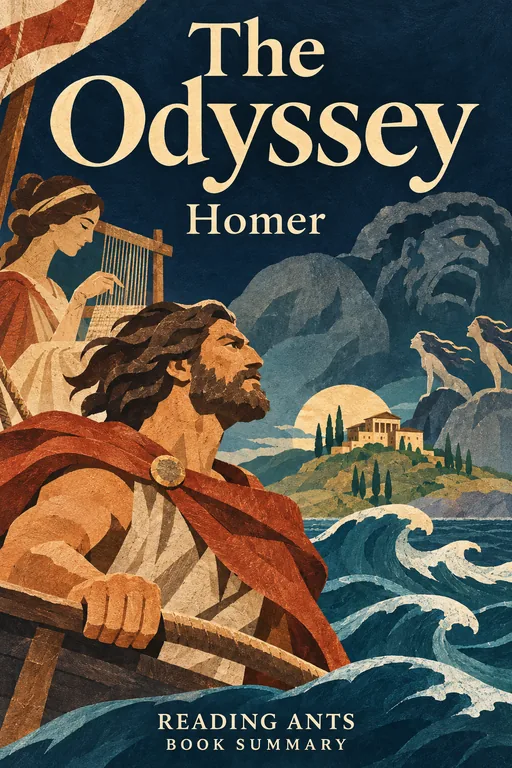
The Odyssey
Homer
After the Trojan War, the clever hero Odysseus struggles for ten years against monsters, gods and temptations to return home to his faithful wife and son, then must win back his house from the men trying to steal it.
🎭 Epics, Drama & Poetry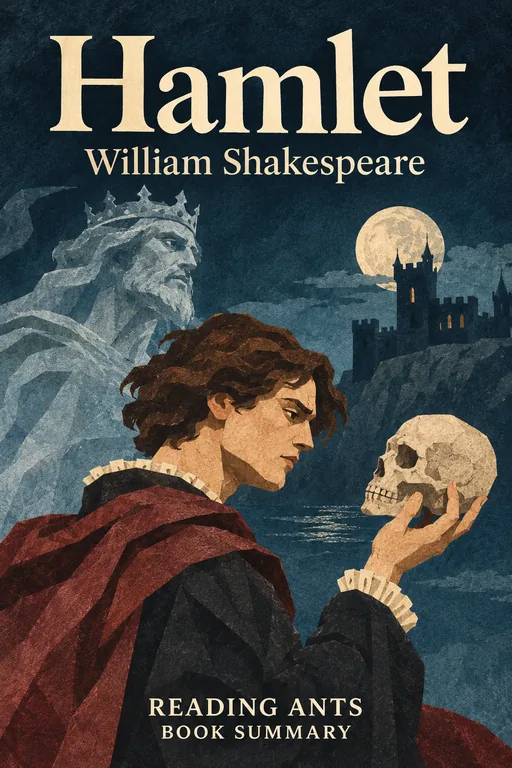
Hamlet
William Shakespeare
A grieving prince of Denmark learns from his father's ghost that his uncle murdered the king to take the throne, and his struggle to decide whether and how to take revenge leads to madness and death.
🎭 Epics, Drama & Poetry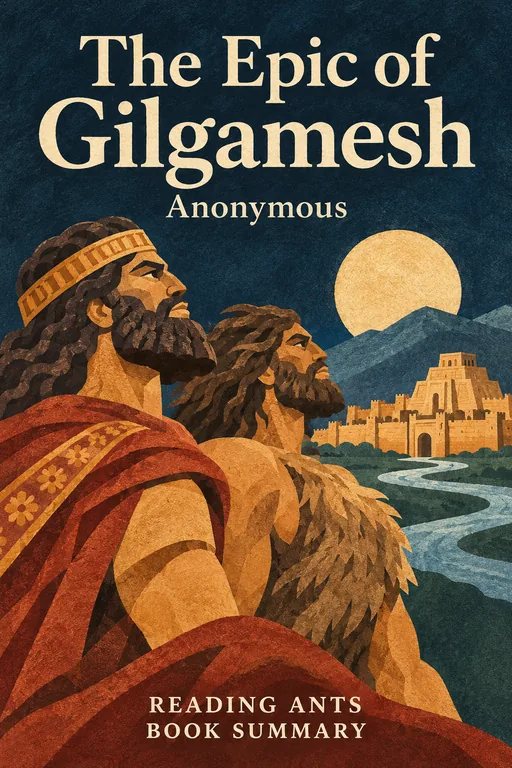
The Epic of Gilgamesh
Anonymous
A proud, powerful king of ancient Mesopotamia gains a true friend, loses him to death, and journeys to the edge of the world in search of eternal life, only to learn that what lasts is the life and legacy we leave behind.
🎭 Epics, Drama & PoetryWant something different?
Pick another topic and we will show you three books to start with.