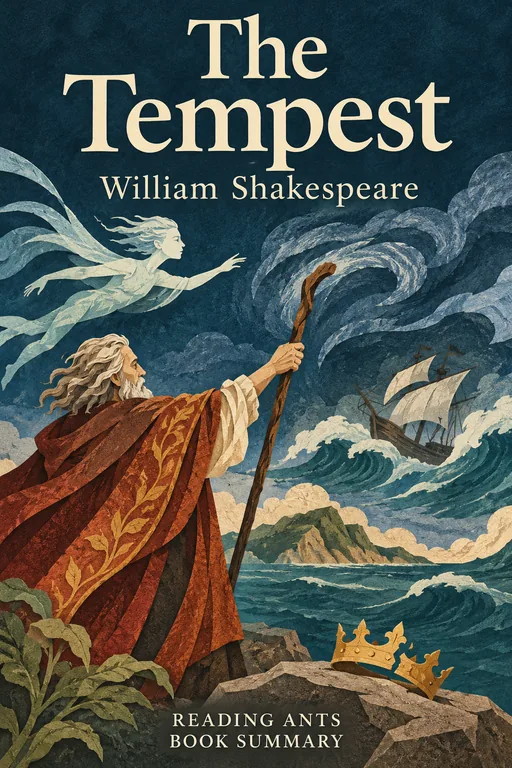
The Tempest
A wronged duke named Prospero, living on a magical island, raises a storm to bring his enemies to him, and in the end chooses forgiveness over revenge.
Overview
The Tempest is a play by William Shakespeare, probably written around 1610 to 1611, and published in 1623. It is generally considered one of his last plays, and is classified as a romance, a mix of comedy and tragedy with a happy ending. The story takes place on a remote island, where Prospero, the rightful Duke of Milan, has lived for twelve years after being overthrown by his brother, with his daughter, Miranda. He controls the island with magic, helped by the spirit Ariel and the half-human Caliban. When he sees his enemies sailing by, he creates a storm to wreck their ship. The play is about power, forgiveness and the end of an artist’s career.
Main Characters
- Prospero: the rightful Duke of Milan, a scholar and magician.
- Miranda: his daughter, innocent and compassionate.
- Ariel: a spirit who serves Prospero and longs for freedom.
- Caliban: the island’s native, a bitter, earthy creature whom Prospero enslaves.
- Ferdinand: the young prince of Naples who falls in love with Miranda.
- Antonio: Prospero’s usurping brother, the Duke of Milan.
- Alonso: the King of Naples, who helped Antonio.
- Gonzalo: an old, kind counselor.
- Trinculo and Stephano: comic characters, a jester and a butler.
Full Summary
The Storm and the Backstory
The play opens with a violent storm at sea, in which a ship is tossed about and the crew and passengers fear for their lives. On the island, Miranda begs her father to calm the storm, and Prospero reassures her that no one has been harmed. He then tells her of how, twelve years earlier, his brother Antonio, with the help of King Alonso of Naples, took his dukedom and set him and Miranda adrift in a leaky boat. Gonzalo, a kind lord, helped them by providing supplies and books. Now, he says, his enemies are on the ship, and fortune has brought them to him.
Ariel and Caliban
Prospero calls on Ariel, who has caused the storm and brought everyone safely to shore, in separate groups. Ariel reminds Prospero of the promise of freedom after he has done his work, and Prospero, irritated, says that he rescued Ariel from the tree in which the witch Sycorax had imprisoned him. Caliban, Sycorax’s son, curses Prospero for taking the island, but Prospero says that he was kind to him at first, Miranda says that she taught him language, and Prospero says that Caliban tried to violate Miranda.
Prospero has told Ariel that he will be freed in two more days if he continues to serve loyally. Caliban resents his bondage and says that he showed Prospero the island’s springs and fruits in return for kindness, and now he has been made a slave. Prospero says that Caliban has shown that he is not capable of gratitude. The relationship between the three reveals the play’s mix of power and care.
Love at First Sight
Ferdinand, the son of the King of Naples, is led by Ariel’s music to Prospero and Miranda. He thinks that his father has drowned. He and Miranda fall in love at first sight, and exchange vows. Prospero is pleased, but pretends to be harsh and sets Ferdinand to carry logs, to test whether his love is true. The two young people enjoy their love, even in hard labor.
Plots
Elsewhere on the island, Alonso grieves for his son, while his brother Sebastian and Antonio plan to murder the king and seize the crown. Ariel, invisible, wakes the king and Gonzalo in time. Meanwhile, Caliban meets two drunken sailors, Stephano and Trinculo, and persuades them to kill Prospero. This comic plot of the fools is a parody of the serious plots. Ariel overhears and warns Prospero.
The Banquet and the Masque
Prospero’s spirits present the nobles with a banquet that vanishes, and Ariel, as a harpy, accuses Alonso, Antonio and Sebastian of their crimes, driving them to despair. Prospero then blesses the engagement of Miranda and Ferdinand with a masque performed by spirits of the goddesses Juno, Ceres and Iris, but he suddenly remembers Caliban’s plot and ends the vision, saying that all such spectacles melt into thin air, and that human life itself is as insubstantial as a dream.
Forgiveness
Prospero deals with Caliban, Stephano and Trinculo by sending spirits in the shape of dogs to chase them. Then, as Ariel describes how the nobles are suffering, Prospero says that if Ariel, who is only a spirit, can feel pity, he, a human, must do likewise. He chooses forgiveness over revenge. He promises to give up his magic, to break his staff and to drown his book. He forgives his brother and the king, regains his dukedom and arranges Miranda’s marriage to Ferdinand. He frees Ariel, and acknowledges responsibility for Caliban. In the epilogue, he asks the audience to set him free with their applause.
Why It Matters
The Tempest is one of Shakespeare’s most produced and adapted plays. It has inspired operas, ballets, films and novels, including the 1956 science fiction film Forbidden Planet and Julie Taymor’s 2010 film version with Helen Mirren as Prospera. Prospero’s farewell to magic is often read as Shakespeare’s own farewell to the theater.
The play has also become central to the study of colonialism, with Caliban seen as a symbol of the colonized native, and has been reinterpreted by writers from the Caribbean, Africa and elsewhere.
Teachers often use it to introduce students to Shakespeare, because the plot is clear and the characters are memorable, and because its themes of forgiveness and power lend themselves to discussion. Its songs, such as Ariel’s about a sea change, have been set to music by many composers.
Key Takeaways
- Forgiveness can be stronger than revenge. Prospero chooses mercy.
- Power must be used responsibly. His magic can be harmful or healing.
- Freedom matters. Ariel and Caliban both long for freedom.
- Love can heal old wounds. Miranda and Ferdinand’s union brings reconciliation.
- Art and illusion shape life. Theater and magic are linked.
What We Can Learn
The play shows that when we hold power, we have a choice: to use it to punish, or to pardon. Prospero’s decision to forgive shows moral growth.
It also invites us to think about how we treat those who serve us or who are different, such as Ariel and Caliban. The play challenges us to consider whether Prospero’s rule is fair.
Finally, it reminds us that life is short and that our achievements are fragile, and that this should lead us to be generous.
Criticism and Counterpoints
Many modern readers criticize Prospero as a colonizer who takes over an island and enslaves its inhabitant, and see Caliban’s complaints as justified, though others argue that Caliban is portrayed as dangerous. Some find the plot thin or slow, with too much exposition and spectacle. Others are bothered by the play’s treatment of women, since Miranda is mostly a prize.
The ending, in which Prospero forgives but does not receive an apology from Antonio, who stays silent, feels incomplete to some. The play is also hard to stage because of its magic and its mix of tones. Still, it is loved.
Who Should Read It
This play suits readers from about age ten, especially in an adapted or illustrated form, and also adults. Shakespeare’s language takes some effort, so a version with notes, or seeing a performance, is helpful.
Want the whole book?
A summary is a taste, not the meal. Here is where to find the full book.
You reached the end 🎉
Nicely done. Mark this one as read, and we will suggest what to read next.
Read this next
A Midsummer Night's Dream
William Shakespeare
Four young lovers lost in an enchanted forest near Athens, a group of clumsy amateur actors and a quarreling fairy king and queen all get tangled up in magical mix-ups on a midsummer night, until love is set right.
🎭 Epics, Drama & Poetry
Hamlet
William Shakespeare
A grieving prince of Denmark learns from his father's ghost that his uncle murdered the king to take the throne, and his struggle to decide whether and how to take revenge leads to madness and death.
🎭 Epics, Drama & Poetry
King Lear
William Shakespeare
An aging king divides his kingdom among his daughters based on how much they flatter him, banishes the one who truly loves him, and is driven to madness on a stormy heath as his family and kingdom collapse.
🎭 Epics, Drama & Poetry
Twelfth Night
William Shakespeare
After a shipwreck, a young woman named Viola disguises herself as a man and serves a duke, falls in love with him, and becomes tangled in a love triangle that is only resolved by the return of her twin brother.
🎭 Epics, Drama & Poetry
Much Ado About Nothing
William Shakespeare
Two pairs of lovers in Messina, the witty rivals Beatrice and Benedick and the young couple Hero and Claudio, are tricked by their friends and enemies, in a comedy of wit, deception and reconciliation.
🎭 Epics, Drama & Poetry
The Odyssey
Homer
After the Trojan War, the clever hero Odysseus struggles for ten years against monsters, gods and temptations to return home to his faithful wife and son, then must win back his house from the men trying to steal it.
🎭 Epics, Drama & PoetryWant something different?
Pick another topic and we will show you three books to start with.