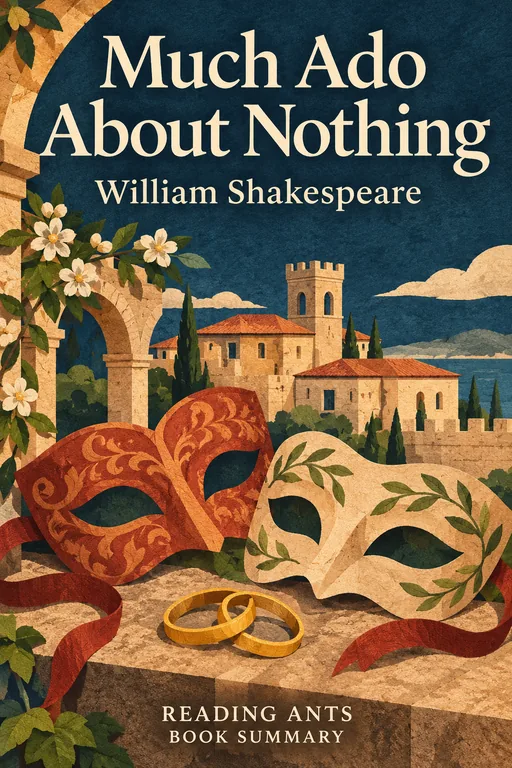
Much Ado About Nothing
Two pairs of lovers in Messina, the witty rivals Beatrice and Benedick and the young couple Hero and Claudio, are tricked by their friends and enemies, in a comedy of wit, deception and reconciliation.
Overview
Much Ado About Nothing is a comedy by William Shakespeare, written around 1598 to 1599 and printed in 1600. It is set in Messina, a town in Sicily, where a group of soldiers returning from war visit the governor, Leonato. The play has two main plots: the romance of Hero and Claudio, which is threatened by a villain’s scheme, and the battle of wits between Beatrice and Benedick, who profess to hate each other but who are tricked into love. The title suggests that the troubles are over trifles, though in the play “nothing” also sounds like “noting,” meaning observing and overhearing.
Main Characters
- Beatrice: Leonato’s niece, a quick-witted woman who scorns marriage.
- Benedick: a clever soldier who prides himself on being a bachelor.
- Hero: Leonato’s gentle, beautiful daughter.
- Claudio: a young lord who falls in love with Hero.
- Don Pedro: the Prince of Aragon, a generous friend who plays matchmaker.
- Don John: his bitter half-brother, the villain.
- Leonato: the governor of Messina.
- Dogberry and Verges: comic, bumbling watchmen.
- Borachio and Conrade: Don John’s followers.
Full Summary
Returning Soldiers
Don Pedro and his men, including Claudio and Benedick, arrive in Messina after a war, and stay at Leonato’s house. Beatrice and Benedick resume their old war of words. She says that she wishes he would not be so annoying, and he says that he would rather be a bachelor all his life than marry. Claudio, meanwhile, falls in love with Hero, and asks Don Pedro to speak on his behalf. Don Pedro woos Hero in disguise at a masked ball, and an agreement is reached.
Beatrice’s uncle Leonato welcomes the guests, and Beatrice asks first about Benedick, whom she calls Signior Mountanto and mocks for his supposed cowardice, though she is clearly interested. Benedick, for his part, is also unable to ignore her. Their wordplay is a game of skill in which each tries to have the last word, and it reveals that they know each other very well.
Tricking the Lovers
Don Pedro and the others decide to play a trick on Beatrice and Benedick. They arrange for Benedick to overhear them talking, as he hides in the garden, about how Beatrice is secretly in love with him and is dying of love. Hero and her maids do the same for Beatrice. Both are convinced, and they soon begin to see each other differently. Their wit remains, but there is an undercurrent of tenderness.
Don John’s Plot
Don John, who is envious of his brother and of Claudio, plans to ruin the wedding. His follower Borachio proposes a trick, and Don John promises him a reward: Borachio will court the maid Margaret at Hero’s window, and she will be mistaken for Hero, while Don John brings Claudio and Don Pedro to watch from a distance. They are shocked, thinking that Hero is unfaithful. Claudio decides to shame her publicly at the wedding.
The Wedding
At the wedding, Claudio refuses to marry Hero, accusing her of being unchaste, and Don Pedro supports him. Hero faints, and Leonato, in grief, almost wishes that she were dead. The friar, who believes in her innocence, suggests that they say she has died, and hide her until the truth is found. Beatrice, furious, says that she would like to eat Claudio’s heart in the marketplace, and asks Benedick to prove his love by killing Claudio. He is shocked, but agrees to challenge him.
The scene is one of the most painful in the play. Claudio, in front of everyone, says that he will not give a rotten orange to a friend, and returns Hero to her father. Leonato, convinced by the evidence, says that he is ashamed of her, while Hero, who has done nothing wrong, can only ask what man she is supposed to have spoken with. Only the friar, Beatrice and Benedick believe her.
Dogberry’s Discovery
On the night before the wedding, the watch, led by the foolish constable Dogberry, overhears Borachio boasting of how he deceived Claudio, and arrests him and Conrade. Dogberry, in his misuse of words, cannot make Leonato listen in time, so the wedding disaster goes ahead; only afterward, when the prisoners are questioned, does the truth come out. Claudio and Don Pedro learn that Hero was innocent, and are overcome with remorse. Don John flees, and is later captured.
Resolution
Leonato tells Claudio to marry his brother’s daughter, whom he describes as Hero’s cousin, as penance. Claudio agrees, and at the ceremony, a masked bride reveals herself as Hero, alive. Claudio is overjoyed. Beatrice and Benedick, who have each admitted their love, are still reluctant to say so, until their friends produce love poems that they have written for each other. They agree to marry, and the play ends with a dance and the news that Don John has been captured.
Why It Matters
Much Ado About Nothing has long been one of Shakespeare’s most popular comedies. The sparring of Beatrice and Benedick is often seen as a model for later romantic comedies, and has been compared to the couple in Pride and Prejudice. The play has been adapted many times, including Kenneth Branagh’s 1993 film and Joss Whedon’s 2012 modern version.
It is also valued for its mixture of comedy and darkness. The humiliation of Hero shows how reputation and honor could destroy a woman’s life.
Audiences often say that Beatrice is one of the first great independent women in English comedy, because she speaks her mind, mocks conventions and is the equal of any man on stage. The play is also a favorite for modern productions because it adapts easily to different settings, from a Sicilian villa to a modern office.
Key Takeaways
- Wit can hide feelings. Beatrice and Benedick use jokes as armor.
- Gossip and appearances mislead. Claudio believes what he sees.
- Trust matters in love. Claudio’s lack of trust causes harm.
- Truth comes out, sometimes through fools. Dogberry’s watch uncovers the plot.
- Forgiveness restores harmony. The play ends with reconciliation.
What We Can Learn
The play shows how easily we can be fooled by what we think we see, and how important it is to check the facts before accusing someone. Claudio’s quick judgment nearly destroys Hero.
It also shows that love can grow from friendship and arguments. Beatrice and Benedick need a push, but their respect for each other’s minds is the basis of their bond.
Finally, it demonstrates that forgiveness is important in relationships, though it needs repentance and effort.
It also reminds us that wit is a way to connect with others, and that those who joke constantly may be hiding how much they care.
Criticism and Counterpoints
Many modern readers find the treatment of Hero troubling: Claudio shames her publicly with little evidence, and then agrees to marry a new bride without apparent guilt or an apology that fits the wrong. Some find the forgiveness too quick. The reliance on trickery and mistaken identity can seem contrived.
Others note that the play’s world is sexist, with women judged by their chastity and obedience. Dogberry’s comedy, based on malapropisms, may seem forced to some, but many love his bumbling. Despite these issues, the play remains a favorite.
Who Should Read It
This play suits teenagers and adults, and is enjoyable in performance. Some language is complex, so a modern edition with notes is useful. It includes a theme of a false accusation, which may be upsetting for some readers.
Want the whole book?
A summary is a taste, not the meal. Here is where to find the full book.
You reached the end 🎉
Nicely done. Mark this one as read, and we will suggest what to read next.
Read this next
Twelfth Night
William Shakespeare
After a shipwreck, a young woman named Viola disguises herself as a man and serves a duke, falls in love with him, and becomes tangled in a love triangle that is only resolved by the return of her twin brother.
🎭 Epics, Drama & Poetry
Pride and Prejudice
Jane Austen
Quick-witted Elizabeth Bennet and the proud, wealthy Mr. Darcy badly misjudge each other, and only by facing their own faults do they find their way to love.
📜 Classics
A Midsummer Night's Dream
William Shakespeare
Four young lovers lost in an enchanted forest near Athens, a group of clumsy amateur actors and a quarreling fairy king and queen all get tangled up in magical mix-ups on a midsummer night, until love is set right.
🎭 Epics, Drama & Poetry
The Odyssey
Homer
After the Trojan War, the clever hero Odysseus struggles for ten years against monsters, gods and temptations to return home to his faithful wife and son, then must win back his house from the men trying to steal it.
🎭 Epics, Drama & Poetry
Hamlet
William Shakespeare
A grieving prince of Denmark learns from his father's ghost that his uncle murdered the king to take the throne, and his struggle to decide whether and how to take revenge leads to madness and death.
🎭 Epics, Drama & Poetry
The Epic of Gilgamesh
Anonymous
A proud, powerful king of ancient Mesopotamia gains a true friend, loses him to death, and journeys to the edge of the world in search of eternal life, only to learn that what lasts is the life and legacy we leave behind.
🎭 Epics, Drama & PoetryWant something different?
Pick another topic and we will show you three books to start with.