 Reading Ants
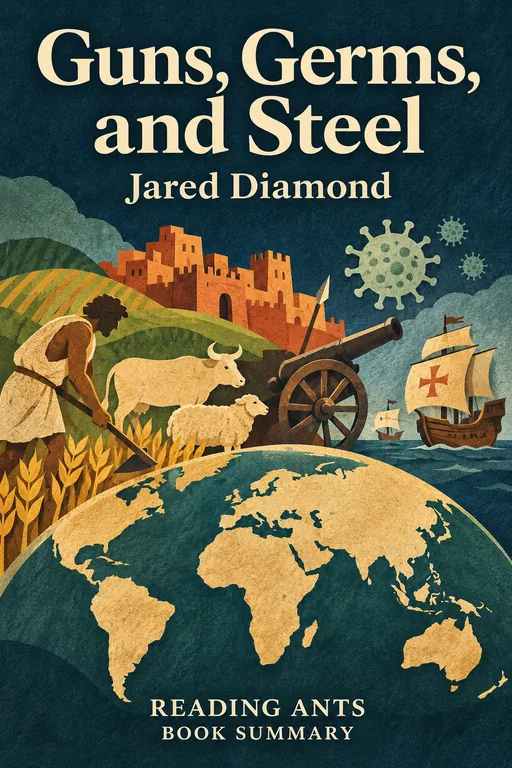
Guns, Germs, and Steel
Some societies came to conquer others not because their people were smarter or better, but because geography gave them a head start in farming, animals, germs and technology.
Overview
Why did Europeans conquer the Americas, Africa and Australia, instead of the other way around? In Guns, Germs, and Steel, Jared Diamond, an American scientist who worked for decades in New Guinea, tries to answer this enormous question. He rejects racist explanations that some peoples are biologically superior. Instead, he argues that the answer lies in differences in environment that began more than ten thousand years ago: which wild plants and animals were available to domesticate, how continents were shaped, and how easily ideas and crops could spread. These differences led to farming, dense populations, cities, writing, weapons and deadly diseases, the tools of conquest. The book won the Pulitzer Prize in 1998.
Full Summary
1. Yali’s question
The idea: Diamond begins with a conversation in 1972 with Yali, a local politician in New Guinea. Yali asked him why white people had developed and brought so much “cargo,” meaning manufactured goods, to New Guinea, while New Guineans had so little of their own. Diamond spent decades trying to answer this question. He insists that the answer cannot be differences in intelligence, since in his experience New Guineans were at least as intelligent as Europeans.
In real life: When people notice inequality between countries today, it is tempting to blame the people themselves. Diamond’s book challenges us to look for deeper causes such as history, environment and opportunity.
2. How a few conquered many
The idea: Diamond describes the “proximate,” or immediate, causes of European conquest: guns, steel swords and armor, horses, ocean-going ships, centralized governments, writing, and above all, infectious diseases like smallpox, which killed far more Native Americans than weapons did.
From the book: In 1532, at Cajamarca in Peru, the Spanish conquistador Francisco Pizarro, with fewer than two hundred soldiers, captured the Inca emperor Atahuallpa, who was surrounded by an army of thousands. Diamond uses this astonishing event to ask why the Spanish had all these advantages, and not the Incas.
In real life: Think of a sports team that wins easily against a weaker one. The score is the proximate result, but the deeper causes are training, coaching and funding built up over years.
3. Farming changed everything
The idea: The ultimate cause, Diamond argues, was food production. Farming and herding allowed far more people to live in one place, and created food surpluses that could feed kings, soldiers, priests, craftsmen and inventors who didn’t grow their own food. Farming began independently in only a few places, such as the Fertile Crescent in the Middle East, China, Mesoamerica and the Andes, and the Fertile Crescent had an unusually rich supply of easily domesticated plants, like wheat, barley and peas.
In real life: A town with a supermarket and reliable food supply can support schools, hospitals and businesses. A community constantly searching for food has little time for anything else.
4. The animals that mattered
The idea: Only a small number of large animals have ever been domesticated, and most of them came from Eurasia: cows, sheep, goats, pigs and horses. Such animals provided meat, milk, wool, transport and power for plowing and war. The Americas and Australia had very few suitable large animals. Diamond explains that domestication requires many conditions to be right at once: a suitable diet, fast growth, a calm temperament and willingness to breed in captivity. Animals like zebras were too aggressive.
From the book: Diamond borrows the opening idea of Tolstoy’s Anna Karenina, that happy families are all alike while unhappy families are each unhappy in their own way. Domesticable animals are all alike in having every necessary quality; each wild species fails for its own reason.
In real life: A hamster is easy to keep as a pet, but a wild squirrel isn’t, even though they are similar sizes. Temperament makes all the difference.
5. Continents with different shapes
The idea: Eurasia stretches mainly from east to west, so places at the same latitude share similar climates and day lengths. Crops and animals could spread easily across thousands of miles. The Americas and Africa stretch mainly north to south, across deserts, jungles and very different climates, which slowed the spread of crops, animals and ideas.
In real life: A plant that grows well in Spain will probably also grow in Italy or Turkey. But a crop from Mexico might fail completely in Canada or Chile.
6. Germs from animals
The idea: Living closely with domesticated animals exposed Eurasians to many diseases, such as smallpox, measles and influenza, which originally came from animals. Over thousands of years, Eurasian populations built up some resistance. When Europeans arrived in the Americas, they brought these diseases to people with no immunity, and epidemics killed a huge share of the population, often before Europeans even arrived in person.
In real life: The COVID-19 pandemic reminded the world how quickly a new disease can spread through a population with no immunity.
7. Why Europe and not China?
The idea: China had early farming, great inventions such as paper, the compass and gunpowder, and a huge unified empire. Diamond argues that China’s unity was a weakness in one way: a single ruler could stop innovation for the whole country. When the Chinese court ended its great ocean voyages in the 1400s, the decision applied everywhere. Europe, divided into many competing states, gave inventors and explorers more chances. When one ruler refused to fund Columbus, he could ask another.
In real life: A company where one boss must approve every idea may move slowly, while a city with many competing startups produces more experiments and more breakthroughs.
Why It Matters
Guns, Germs, and Steel became an international bestseller, was translated into dozens of languages and won the 1998 Pulitzer Prize for general nonfiction. It was adapted into a television documentary and is widely read in universities and schools.
Its greatest impact was to offer a clear, science-based alternative to racist explanations of world inequality. By combining biology, geography, archaeology, linguistics and history, it helped popularize “big history,” the study of human history on the largest scale. It inspired many later books, including Yuval Noah Harari’s Sapiens, and sparked lasting debates about why some nations are rich and others poor.
Key Takeaways
- Geography, not race, shaped history. Environmental differences explain why societies developed differently.
- Farming was the foundation. Food surpluses led to cities, governments, writing and technology.
- Domesticable species were unevenly spread. Eurasia had more useful plants and animals.
- Germs were powerful weapons. Diseases from livestock devastated peoples without immunity.
- Competition can drive innovation. Europe’s divisions helped it advance faster than unified empires.
What We Can Learn
The book teaches us to look for deep causes behind big differences. When we see one group doing better than another, it is worth asking what advantages or obstacles each started with, rather than assuming people are simply more or less capable.
It also shows the value of combining many fields of knowledge. Diamond uses biology, geography and history together to answer a single question. Many problems in life and work are easier to understand when we look at them from several angles.
Finally, it encourages humility and fairness. The success of any society, including our own, depends partly on luck and circumstances we didn’t create.
Criticism and Counterpoints
Many historians and anthropologists praise the book’s ambition but criticize it for “geographic determinism,” the idea that environment largely decides a society’s fate. They argue that it gives too little weight to human choices, culture, politics and specific historical events. Economists such as Daron Acemoglu and James Robinson, in Why Nations Fail, argue that institutions such as laws, property rights and governments matter more than geography.
Some scholars feel the book oversimplifies complex histories, especially of Africa and the Americas, and that it can make European conquest seem inevitable, downplaying the role of greed, violence and political decisions. Others note that new archaeological evidence has complicated some of its claims about where and how farming began.
Who Should Read It
This book is ideal for older teens and adults who enjoy history, science and big questions about the world. It is long and detailed in places, so readers may want to focus on the main chapters first. Those interested in debates about global inequality will find it essential reading.
Want the whole book?
A summary is a taste, not the meal. Here is where to find the full book.
You reached the end 🎉
Nicely done. Mark this one as read, and we will suggest what to read next.
Read this next
Sapiens: A Brief History of Humankind
Yuval Noah Harari
Humans came to rule the planet not because we are the strongest animals but because we can believe in shared stories (gods, nations, money, companies) that let millions of strangers cooperate.
🏛️ History
Why Nations Fail
Daron Acemoglu and James A. Robinson
Nations become rich or stay poor mainly because of their institutions: countries that share power and reward ordinary people's effort prosper, while those run by narrow elites for their own benefit stay poor.
💰 Money & Economics
The Silk Roads
Peter Frankopan
Instead of seeing history as centered on Europe, this book argues that the regions linking East and West, Central Asia and the Middle East, were the true center of the world, where trade, religion, empire and ideas met.
🏛️ History
The Histories
Herodotus
Herodotus, often called the father of history, tells how the Greeks and the Persians came into conflict and fought the great wars of the early fifth century BCE, with long, colorful detours into the lands, customs and legends of the known world.
🏛️ History
History of the Peloponnesian War
Thucydides
Thucydides, an Athenian general turned historian, records the long war between Athens and Sparta in the fifth century BCE and uses it to study power, fear, politics and how human nature behaves in crisis.
🏛️ History
The Muqaddimah
Ibn Khaldun
Ibn Khaldun, a North African scholar of the fourteenth century, sets out a pioneering theory of how societies are organized, how states rise and fall, and how economies work, as an introduction to a larger history of the world.
🏛️ HistoryWant something different?
Pick another topic and we will show you three books to start with.