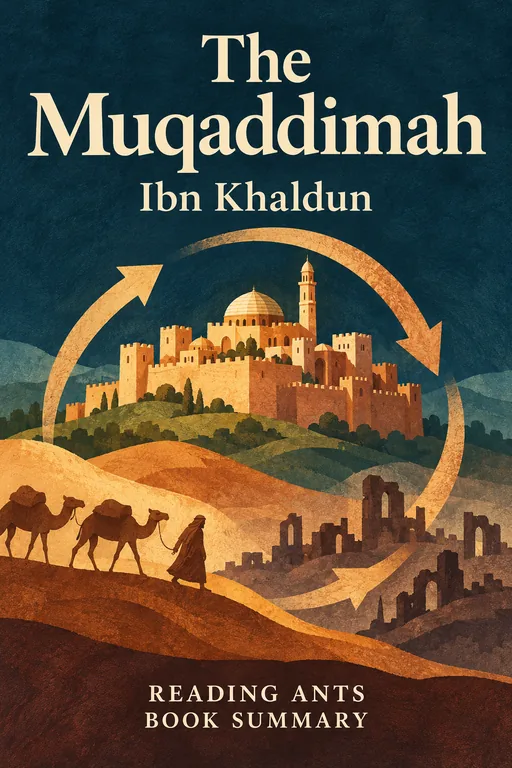
The Muqaddimah
Original title: مقدمة ابن خلدون
Ibn Khaldun, a North African scholar of the fourteenth century, sets out a pioneering theory of how societies are organized, how states rise and fall, and how economies work, as an introduction to a larger history of the world.
Overview
The Muqaddimah, which means “introduction” in Arabic, was written in 1377 by Ibn Khaldun, who was born in Tunis and worked as a judge, adviser and teacher in North Africa, Spain and Egypt. It is the first volume of a long history of the world, but it became more famous than the history itself. Ibn Khaldun wanted to explain how the past works and how to judge whether reports of it are true. To do so, he looked for general patterns in how people live together, and he called this the science of culture, or civilization. Many scholars regard him as an early founder of sociology and economics.
Full Summary
1. A new science of society
The idea: Ibn Khaldun begins by saying that historians often repeat stories without checking whether they could be true. To judge such reports, he says, we need to understand the nature of society itself: how people live, work, govern and change. He proposes a new field of study that looks at the causes behind events, such as climate, economy and group feeling, and not only at the list of kings and battles.
In real life: If someone tells you that a team of ten players beat a hundred, you ask how it was possible, and check against what you know of the world.
2. Group feeling
The idea: The most famous idea in the book is a concept that Ibn Khaldun calls asabiyyah, often translated as group feeling or social solidarity. It is the bond of loyalty and cooperation that holds a tribe or a community together, and it gives it the strength to defend itself and to win power. Groups with strong cohesion, often those living in harsh conditions, can overcome more comfortable and divided ones.
In real life: A small team that trusts each other and acts as one can beat a team of stars who do not cooperate.
3. Nomads and city dwellers
The idea: Ibn Khaldun contrasts life in the desert and countryside with city life. Nomads, he says, are tougher and more united, but have fewer comforts. City dwellers have arts, trade and luxury, but are more dependent on others, and can lose their fighting spirit. He argues that these two ways of life interact, and that nomadic groups often take over cities.
In real life: A person who is used to hard work may be more resilient than one who has always had help.
4. The life cycle of dynasties
The idea: Ibn Khaldun suggests that states have a life span, like a person. A dynasty arises when a united group takes power, then enjoys the comforts of rule, grows complacent and relies on paid soldiers, and finally weakens until a new group replaces it. He says that this takes about three generations, which he puts at about a hundred and twenty years, and that the pattern repeats.
In real life: A family business started by hardworking parents may be run poorly by grandchildren who have never faced difficulty.
5. Economics and taxes
The idea: The book also contains early ideas about economics. Ibn Khaldun notes that the division of labor makes people more productive, that wealth comes from work and that prices depend on supply and demand. He argues that when a ruler raises taxes too high, people lose their incentive to work and tax revenues can actually fall, while moderate taxes encourage trade and bring more income.
In real life: If a lemonade stand must give away most of its earnings, the children running it might decide to stop.
6. Knowledge, crafts and learning
The idea: In the final parts, Ibn Khaldun discusses the crafts, sciences, language and education. He says that the sciences flourish only where cities and civilization are large and highly developed. He gives views on how to teach: step by step, with repetition, and without harsh punishment, which he says harms students. He also surveys many fields of knowledge, from law and theology to mathematics, astronomy, logic, medicine, language and poetry.
In real life: A student who is taught gradually, with encouragement, tends to learn better than one who is pressured.
Why It Matters
The Muqaddimah is considered one of the great works of world scholarship. Ibn Khaldun’s attempt to find general laws of social change anticipated much that later thinkers in sociology, history and economics developed centuries later. Scholars of many countries have studied his ideas of group feeling, the dynastic cycle and the relationship between taxes and revenue. The book also gives a rich picture of the medieval Islamic and North African world, with its trade, learning and politics. Translated into many languages, it continues to be read by those who want to understand how societies rise and fall, and by readers who value its mix of observation, reasoning and wisdom.
Key Takeaways
- Society has patterns. Events have causes that can be studied.
- Cohesion is power. Groups bound by strong loyalty can achieve a great deal.
- Comfort can weaken. Prosperity may erode the qualities that created it.
- Taxes can be too high. Overtaxing can reduce effort and income.
- Check your sources. Understanding how the world works helps us to judge claims.
What We Can Learn
The book invites you to look for patterns behind events, and to ask why groups succeed or fail. In your own communities, you can notice how trust and shared purpose make a difference. Be careful of taking success for granted: the habits that build something good may need to be maintained. Also learn to test stories against what you know. And try to learn about the history and thought of other cultures, since they often contain wisdom and insights that are still useful.
Criticism and Counterpoints
Some modern historians say that Ibn Khaldun’s model of the dynastic cycle fits the history of North Africa better than other regions, and that his sharp contrast between nomads and city dwellers is too simple. Others point out that he was influenced by the beliefs of his time, such as ideas about climate and the character of peoples, that are not accepted today, and that he sometimes included unreliable reports. Some scholars say that later writers have read modern ideas into his work. Still, many believe that he was ahead of his time, and the book is respected as a milestone.
Who Should Read It
This book is for readers interested in history, social science and the Islamic world, and for anyone who likes big ideas from the past. It is long and some passages are demanding, so selections or an introduction are helpful. Readers who want a short, modern overview of sociology may start there, and come to this classic later.
Want the whole book?
A summary is a taste, not the meal. Here is where to find the full book.
You reached the end 🎉
Nicely done. Mark this one as read, and we will suggest what to read next.
Read this next
The Histories
Herodotus
Herodotus, often called the father of history, tells how the Greeks and the Persians came into conflict and fought the great wars of the early fifth century BCE, with long, colorful detours into the lands, customs and legends of the known world.
🏛️ History
The Wealth of Nations
Adam Smith
A nation's true wealth is not its stock of gold but the goods and services its people produce, and that wealth grows fastest when people specialize, trade freely and compete, with government providing justice, defense and public goods.
💰 Money & Economics
Guns, Germs, and Steel
Jared Diamond
Some societies came to conquer others not because their people were smarter or better, but because geography gave them a head start in farming, animals, germs and technology.
🏛️ History
The Prince
Niccolo Machiavelli
A Renaissance diplomat advises rulers to judge their actions by results rather than morality, arguing that a successful leader must sometimes be cunning and ruthless to win and keep power.
⚖️ Politics & Society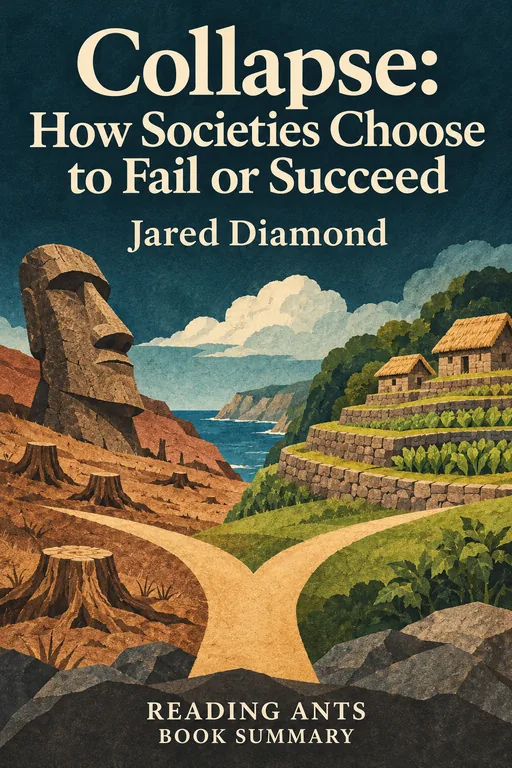
Collapse: How Societies Choose to Fail or Succeed
Jared Diamond
Jared Diamond studies societies that collapsed and societies that survived, and argues that environmental damage, climate change, enemies, trade and the way a society responds to problems decide whether it fails or succeeds.
🏛️ History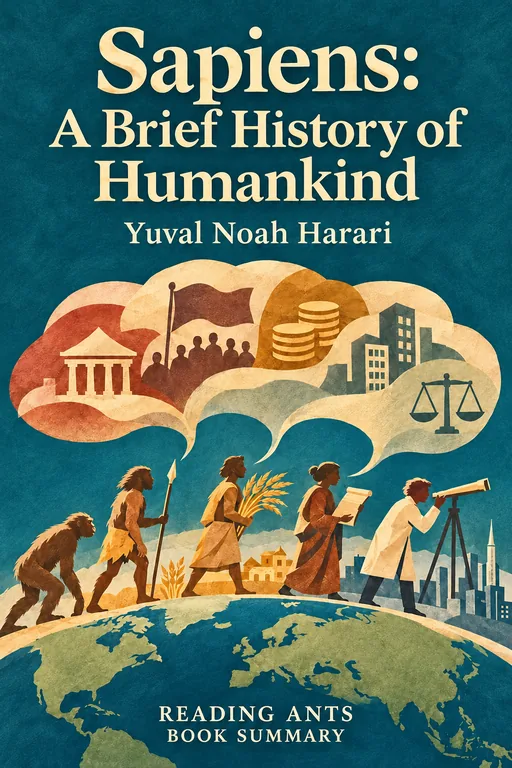
Sapiens: A Brief History of Humankind
Yuval Noah Harari
Humans came to rule the planet not because we are the strongest animals but because we can believe in shared stories (gods, nations, money, companies) that let millions of strangers cooperate.
🏛️ HistoryWant something different?
Pick another topic and we will show you three books to start with.