Collapse: How Societies Choose to Fail or Succeed
Jared Diamond studies societies that collapsed and societies that survived, and argues that environmental damage, climate change, enemies, trade and the way a society responds to problems decide whether it fails or succeeds.
Overview
Collapse: How Societies Choose to Fail or Succeed was published in 2005 by Jared Diamond, a geographer and scientist who also wrote Guns, Germs, and Steel. In this book, Diamond looks at past societies that collapsed or declined, such as the people of Easter Island, the Maya and the Norse settlers of Greenland, and compares them with others that managed to live sustainably. Diamond defines collapse as a drastic fall, over a large area and a long time, in a society’s population or in its political, economic and social complexity. He opens with modern Montana, to show how environmental problems reach the present, and he also asks why groups fail to make decisions about problems that they can see. He then turns to modern cases, and asks what we can learn for the present. He proposes a five-part framework and says that the human decisions matter as much as the environment.
Full Summary
1. A framework with five factors
The idea: Diamond says that when a society collapses, five kinds of factors may be at work: damage that people do to their environment, a change in climate, hostile neighbors, the loss of friendly trading partners and the society’s own response to its problems. The last factor is always significant, because it reflects the choices and values of the people. Not every collapse involves all five, but this checklist helps to compare cases.
In real life: A family business may fail because of a fire, a rival, a loss of suppliers, or because it did not adapt, and often several of them combine.
2. Easter Island
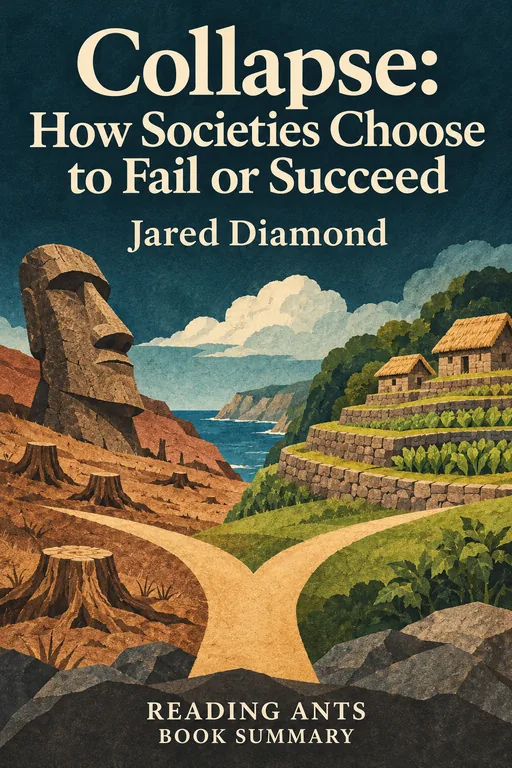
The idea: The island, in the Pacific, is known for its great stone statues. Diamond argues that the Polynesian settlers cut down the forests that once covered it, perhaps to move statues, build canoes and clear land, which led to soil erosion, loss of food and the end of the ability to build boats. He suggests that competition among chiefs to build statues made them blind to the long-term harm, and that the society fell into conflict and hunger.
In real life: If everyone in a village cuts a little more wood for their own needs, the forest can vanish.
3. The Maya and the Ancestral Pueblo
The idea: In Central America, the Maya built large cities, but a combination of overuse of land, drought and warfare may have contributed to the collapse of many of them more than a thousand years ago. In the American Southwest, the Ancestral Pueblo, or Anasazi, farmed in a dry region and built impressive towns, but struggled when droughts came. Diamond says that these societies show how growth in population and in demands on resources can exceed what a fragile environment can support.
In real life: A city that grows faster than its water supply will eventually face a crisis.
4. The Norse in Greenland
The idea: Viking settlers colonized Greenland around the year 1000 and survived for several centuries, but eventually disappeared. Diamond argues that they tried to keep their European way of life, based on cattle, in a cold land, refused to adopt the techniques of the Inuit neighbors, were hurt by a cooling climate and lost trade with Europe. He says that cultural values prevented them from adapting.
In real life: A group that insists on doing things the old way, even when conditions change, may be at a disadvantage.
5. Societies that succeeded
The idea: The book also gives examples of societies that managed their resources well. The people of the island of Tikopia limited their population and cared for their land very carefully, and are presented as a success. In the New Guinea highlands, farmers developed methods to maintain the soil. In Japan, in the seventeenth century, leaders saw a shortage of timber and put in place strict forest management. Diamond says that these cases show that collapse is not inevitable.
In real life: A neighborhood that sets clear rules about shared resources, such as a park, can keep them in good condition.
6. Modern cases and big lessons
The idea: The last section looks at the modern world, such as the genocide in Rwanda, which he links in part to population pressure, the difference between Haiti and the Dominican Republic, and environmental problems in China, Australia and the United States. Diamond concludes that societies need to plan for the long term, to be willing to change, and to avoid the denial of problems. He says that we are in a global society, so that the stakes are larger.
In real life: Noticing a small leak early and fixing it is much cheaper than waiting until the house floods.
Why It Matters
Collapse was a bestseller that put the connection between environment and society at the center of public debate. It helped many readers to see why the health of forests, soil and water matters for human survival, and it was widely used in classes about geography, history and sustainability. The five-part framework gave a simple way to analyze complex situations. The book also provoked reactions from scientists and historians, and stimulated research on the cases it discusses. Whether or not every example holds up, it raised an important question: how do societies decide what to do about problems that threaten their future, and can we do better?
Key Takeaways
- Environment and choices interact. Natural limits matter, and so do human decisions.
- A society’s response is decisive. Some adapt, others deny.
- Long-term thinking is crucial. Short-term gains can undermine future survival.
- Collapse is not inevitable. Some societies found sustainable ways of living.
- We share one world. Modern problems cross borders.
What We Can Learn
You can start by noticing how your own community uses shared resources, such as water, energy and green spaces, and ask how they will last. Be willing to change habits when evidence shows a problem. Watch for denial and for decisions that benefit a few at the expense of the many. Learn from successful examples of local rules and cooperation. And remember that people in the past were as intelligent as we are, so their failures should be taken as a warning, not a cause for superiority.
Criticism and Counterpoints
Many specialists have criticized the book. Archaeologists who study Easter Island say that Diamond’s account of ecological suicide is not supported by the latest evidence, which suggests that rats and the arrival of Europeans, who brought diseases and slave raids, played a large role in the island’s decline. Others say that the Norse in Greenland and the Maya collapse are more complex than the book suggests, and that he overlooks the role of politics, inequality and colonialism. Some scholars say that the term “collapse” is vague. These criticisms mean that readers should treat individual case studies with caution, while the general question remains important.
Who Should Read It
This book is for readers interested in history, the environment and what might happen to modern societies. It is long, with many case studies, but written in an engaging style. Those who want the latest findings on any particular society should check recent research, and those who are looking for solutions to climate change will find the book more concerned with analysis than with policy.
Want the whole book?
A summary is a taste, not the meal. Here is where to find the full book.
You reached the end 🎉
Nicely done. Mark this one as read, and we will suggest what to read next.
Read this next
Guns, Germs, and Steel
Jared Diamond
Some societies came to conquer others not because their people were smarter or better, but because geography gave them a head start in farming, animals, germs and technology.
🏛️ History
1491: New Revelations of the Americas Before Columbus
Charles C. Mann
Charles Mann gathers recent research to argue that the Americas before Columbus held more people, older cities and more skillful land managers than most of us were taught, and that the picture of a pristine, empty wilderness is wrong.
🏛️ History
The Lessons of History
Will and Ariel Durant
After spending decades writing a huge history of civilization, Will and Ariel Durant distill what they learned into a short book of reflections on geography, human nature, morals, religion, economics, government, war and progress.
🏛️ History
The Dawn of Everything
David Graeber and David Wengrow
Anthropologist David Graeber and archaeologist David Wengrow argue that the standard story of human history, in which small equal bands slowly turned into large unequal states, is wrong, and that early societies experimented with many ways of living.
🏛️ History
Silent Spring
Rachel Carson
The careless spraying of powerful chemical pesticides like DDT was poisoning birds, fish, soil, water and people, and humans must learn to live with nature instead of waging war on it.
🔬 Science
Sapiens: A Brief History of Humankind
Yuval Noah Harari
Humans came to rule the planet not because we are the strongest animals but because we can believe in shared stories (gods, nations, money, companies) that let millions of strangers cooperate.
🏛️ HistoryWant something different?
Pick another topic and we will show you three books to start with.