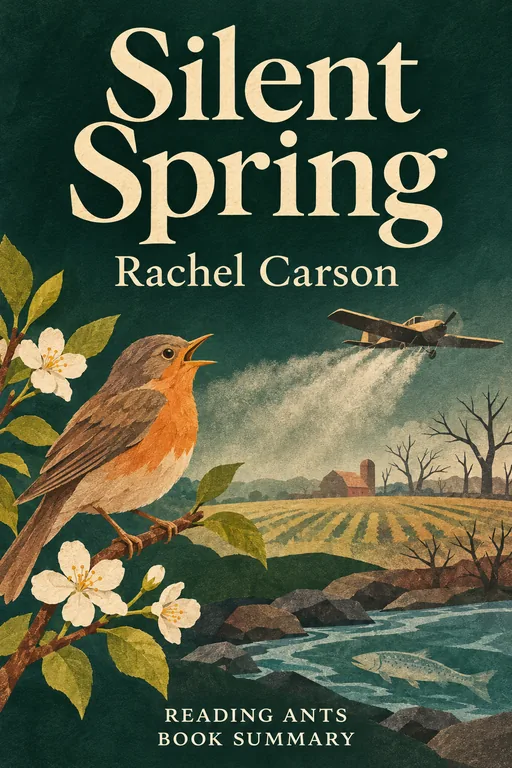
The careless spraying of powerful chemical pesticides like DDT was poisoning birds, fish, soil, water and people, and humans must learn to live with nature instead of waging war on it.
Overview
Silent Spring is the book that launched the modern environmental movement. Rachel Carson, an American marine biologist and award-winning nature writer, spent years gathering scientific evidence about synthetic pesticides, chemicals that had been developed during and after the Second World War and were sprayed in enormous quantities on farms, forests, towns and gardens. Carson showed that these chemicals did not just kill insects. They built up in the food chain, killed birds and fish, polluted water and soil, and might cause cancer in humans. Written in clear, beautiful language for ordinary readers, the book caused a sensation when it was published in 1962, and it led to major changes in how governments regulate chemicals.
Full Summary
1. A fable for tomorrow
The idea: Carson opens with an imagined American town where all life once lived in harmony. Then a strange blight falls on it: chickens die, cattle sicken, children fall ill, and in the spring no birds sing. It is a silent spring. No enemy has done this; the people have done it to themselves. Carson explains that no single town has suffered all these disasters, but each has happened somewhere.
In real life: Imagine walking outside on a spring morning and hearing no birdsong at all. Carson’s image works because it turns a scientific problem into something anyone can feel.
2. Chemicals that never go away
The idea: Carson explains that many new pesticides, like DDT, are extremely stable: they don’t break down quickly in nature. They are stored in the fat of animals and become more concentrated as they move up the food chain, from tiny organisms to fish, to birds and to humans. This process, now called biomagnification, means a small amount sprayed on a lake can become a deadly dose in the animals at the top.
From the book: Carson describes Clear Lake in California, where a pesticide was applied in very small amounts to control gnats. Over time, the chemical built up in plankton, fish and then the grebes, water birds that ate the fish. Many grebes died, and their bodies contained far higher concentrations than the water.
In real life: Health advice to limit eating certain large fish, such as some types of tuna, because of mercury follows the same idea: toxic substances can build up as they move up the food chain.
3. Poisoned water and soil
The idea: Chemicals sprayed on land do not stay where they fall. Rain washes them into rivers, lakes and underground water supplies, where they mix in unpredictable ways. Soil, which is full of living organisms essential for plant growth, is damaged too. Carson describes how weedkillers sprayed along roadsides destroyed plants that wildlife depended on.
In real life: Rainwater running off fields, lawns and city streets carries fertilizers and chemicals into nearby rivers, which is why many communities now monitor water quality closely.
4. Death of birds and fish
The idea: Carson documents mass deaths of birds and fish after spraying campaigns. Robins died after eating earthworms that had absorbed DDT from trees sprayed against Dutch elm disease. Salmon in rivers died after forests were sprayed. Birds of prey, such as eagles, were declining, and scientists later confirmed that DDT made their eggshells thin and fragile.
In real life: The bald eagle, the national bird of the United States, became endangered in the decades after Carson wrote. After DDT was banned, eagle populations recovered dramatically.
5. Danger to human health
The idea: Carson warns that pesticides also threaten people. Farmers, gardeners and families were exposed through food, water and spraying near homes. She discusses evidence linking some chemicals to cancer and other illnesses, and argues that people have a right to know what is being put into their environment.
In real life: Washing fruit and vegetables, reading the labels on household chemicals and storing them safely away from children are simple precautions that reflect Carson’s concerns.
6. Insects fight back
The idea: Carson shows that heavy spraying often backfires. Insects reproduce quickly, and those with natural resistance survive and multiply, so pests become resistant to the chemicals, requiring ever stronger doses. Spraying also kills the natural predators that keep pests under control, which can lead to even bigger outbreaks.
In real life: Doctors warn against overusing antibiotics for the same reason: bacteria can become resistant, making the medicines less effective when we really need them.
7. The other road
The idea: Carson does not call for banning all pesticides. She argues for using them carefully and sparingly, and for exploring safer methods of pest control, such as introducing natural predators, using insect diseases, or releasing sterile insects so pests can’t reproduce. Above all, humans should see themselves as part of nature, not as its masters, and should respect the complex web of life.
In real life: Many gardeners today encourage ladybugs, which eat aphids, rather than spraying chemicals. It is a small version of the “other road” Carson described.
Why It Matters
Silent Spring is often credited with starting the modern environmental movement. When it was published in 1962, chemical companies attacked Carson fiercely, but the public was alarmed. President John F. Kennedy asked his science advisers to study the issue, and their report largely supported her warnings.
The book led to important changes. In 1970, the United States created the Environmental Protection Agency, and in 1972 it banned most uses of DDT. Many other countries followed. Silent Spring also inspired the first Earth Day and a generation of activists and scientists. Carson, who was battling cancer while writing it, died in 1964, but her book remains one of the most influential science books ever written.
Key Takeaways
- Everything in nature is connected. Poisons spread through food chains, water and soil.
- Some chemicals persist and accumulate. Small doses can become deadly at the top of the food chain.
- Overuse backfires. Pests develop resistance, and their natural enemies are destroyed.
- People have a right to know. Citizens should be informed about the chemicals in their environment.
- Work with nature. Safer, smarter methods can control pests without harming everything else.
What We Can Learn
Carson’s book shows that one person, armed with careful research and clear writing, can change the world. Speaking up about problems in your community, backed by facts, can make a real difference.
It also encourages us to think about our own impact. Using fewer chemicals at home and in the garden, supporting sustainable farming and protecting local wildlife are ways to follow her example.
Finally, Silent Spring reminds us to look at the bigger picture. Quick fixes can create bigger problems later. Asking what the long-term effects of a decision might be is a habit that helps in science, in the environment and in daily life.
Criticism and Counterpoints
When it was published, the chemical industry accused Carson of being emotional and unscientific, and some critics attacked her personally. Later, some commentators argued that the reduced use of DDT made it harder to fight malaria-carrying mosquitoes in poorer countries, leading to more deaths. Others respond that Carson never called for a total ban, that DDT is still permitted for limited indoor use against malaria, and that mosquito resistance was already reducing its effectiveness.
Some scientists also note that a few of her claims, especially about cancer risks, went beyond the evidence available at the time. Nonetheless, her central warnings about the ecological effects of persistent pesticides have been widely confirmed.
Who Should Read It
This book is valuable for teenagers and adults interested in nature, science, health or environmental issues. Its writing is clear and often beautiful, though some chapters contain technical detail about chemicals. Anyone curious about the roots of today’s environmental movement should read it.
Want the whole book?
A summary is a taste, not the meal. Here is where to find the full book.
You reached the end 🎉
Nicely done. Mark this one as read, and we will suggest what to read next.
Read this next
The Sixth Extinction
Elizabeth Kolbert
Elizabeth Kolbert travels the world to show that humans are causing a new mass extinction, the sixth major mass extinction in Earth's history (after the five widely recognized ones), by changing the climate, the oceans and habitats faster than species can adapt.
🔬 Science
A Sand County Almanac
Aldo Leopold
Forester and ecologist Aldo Leopold describes a year on a worn-out Wisconsin farm and his travels, and argues for a "land ethic," a view in which humans are members of the community of the land, with a duty to care for it.
🔬 Science
Braiding Sweetgrass
Robin Wall Kimmerer
Botanist and Potawatomi writer Robin Wall Kimmerer weaves together Indigenous wisdom, plant science and personal stories to show that people and the Earth can live in a relationship of gratitude and reciprocity.
🔬 Science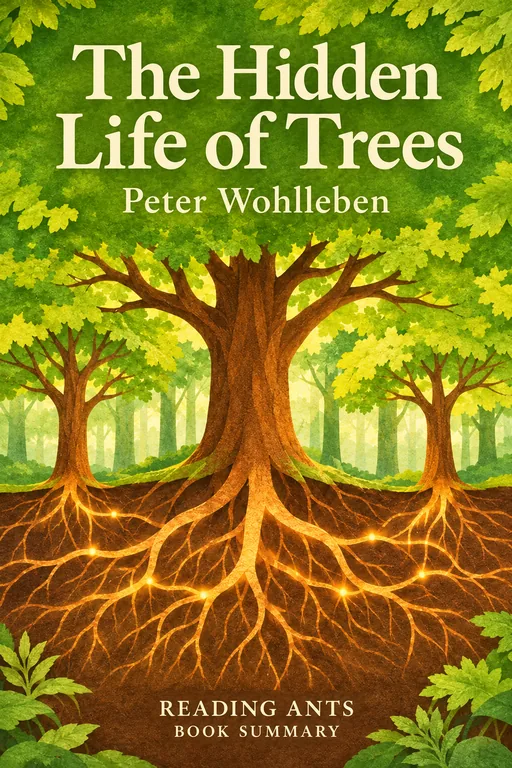
The Hidden Life of Trees
Peter Wohlleben
Forester Peter Wohlleben describes how trees communicate, share resources and care for one another in forests, and argues that we should treat them as living beings with social lives.
🔬 Science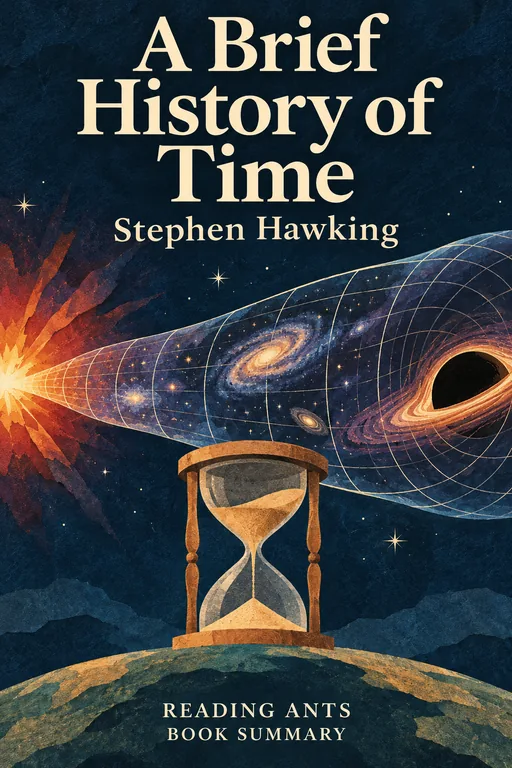
A Brief History of Time
Stephen Hawking
One of the world's greatest physicists explains, with almost no math, what we know about the origin, structure and fate of the universe, from the Big Bang to black holes and the nature of time itself.
🔬 Science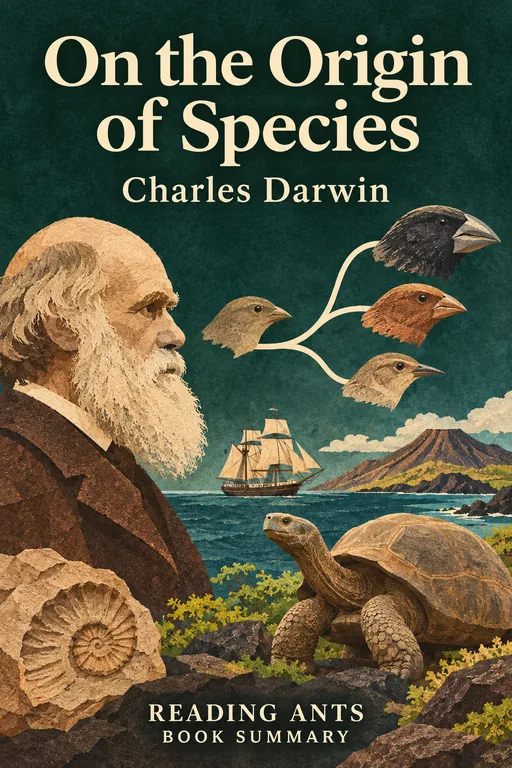
On the Origin of Species
Charles Darwin
All living things are related and have slowly changed over immense periods of time, shaped by natural selection, the process by which individuals better suited to their environment survive and pass on their traits.
🔬 ScienceWant something different?
Pick another topic and we will show you three books to start with.