 Reading Ants
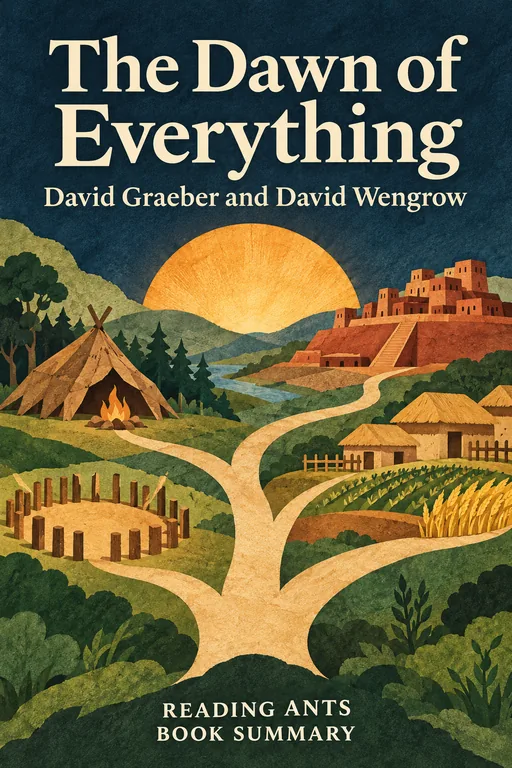
Anthropologist David Graeber and archaeologist David Wengrow argue that the standard story of human history, in which small equal bands slowly turned into large unequal states, is wrong, and that early societies experimented with many ways of living.
Overview
The Dawn of Everything: A New History of Humanity was published in 2021 by David Graeber, an anthropologist, and David Wengrow, an archaeologist. Graeber died in 2020, soon after the book was finished. The authors say that popular books on world history often tell a simple tale: for most of history, people lived in small, egalitarian groups of hunters and gatherers, then farming led to cities, inequality and kings, and nothing could have been done differently. They examine new evidence from archaeology and anthropology, including the Indigenous critique of European society, recorded in the dialogues of Lahontan, and argue that human societies were far more varied and creative.
Full Summary
1. A story we tell ourselves
The idea: The authors begin by describing the familiar view that early humans were equal because they were few and simple, and that inequality arrived with agriculture and large populations. They argue that this story is used to say that large-scale societies must have rulers and bureaucracy, and that we cannot return to equality. They say that such a story is not supported by the data, and that it limits our sense of what is possible.
In real life: If you believe that there is only one way a school can be run, you will not try other methods.
2. Indigenous critique and the Enlightenment
The idea: The authors tell of European encounters with Native Americans in the seventeenth and eighteenth centuries. They say that Native thinkers, such as a Wendat statesman known as Kandiaronk, criticized European society for its inequality and lack of freedom, and that their arguments, recorded in dialogues published in Europe, may have influenced the Enlightenment. The authors suggest that ideas of equality did not simply grow from Europe, but arose in conversation with Indigenous societies.
In real life: A visitor who sees your customs with fresh eyes may point out problems that you no longer notice.
3. Seasonal societies and political experiments
The idea: Graeber and Wengrow show that many peoples changed their social structure with the seasons. For example, some Plains peoples were organized with strict authority during the buffalo hunt, and then loosened it afterward, while some groups in the Arctic changed their way of living between summer and winter. Archaeological findings suggest that some Ice Age communities built monuments and had rich burials, which suggests that complex social arrangements existed long before farming.
In real life: A team might have a strong captain during a match, but a relaxed, equal group at the picnic afterward.
4. Farming without a fixed path
The idea: The authors argue that the move to agriculture was slow and uneven, and that it did not automatically produce private property, kings or inequality. People experimented with growing crops for thousands of years, sometimes returning to foraging. In places such as the Fertile Crescent and in the Americas, early farming societies had many forms of organization, some of them more equal than others.
In real life: Adopting a new tool, such as a computer, does not by itself determine how a class is organized.
5. Cities without kings
The idea: Graeber and Wengrow describe large settlements that appear to have had no obvious rulers, such as the huge settlements in what is now Ukraine, which were inhabited from roughly 4100 to 3300 BCE, and the city of Teotihuacan in Mexico, which seems to have focused on housing for ordinary people after an early period of building temples. They say these cases show that size does not always bring a ruling elite.
In real life: A big town can run community services through councils and shared decisions, without a single ruler.
6. Three freedoms and the question “how did we get stuck?”
The idea: In the last chapters, the authors argue that early societies valued three basic freedoms: the freedom to move away, the freedom to disobey orders, and the freedom to build new kinds of social arrangements. Over time, these freedoms were lost in many places. The authors also name three basic forms of domination, separate from the three freedoms: control of violence, control of information, and individual charisma. They say that modern states combine all three, but argue that the state has no single origin and that these forms of power have often existed apart from one another. They suggest that the right question is not how inequality began, but how humanity became stuck in a few fixed arrangements, and how we might get unstuck. Their readings of sites such as Ukrainian megasites and Teotihuacan are interpretations of evidence, not direct observations of how those societies governed themselves.
In real life: Being able to leave a group, to say no to a rule and to propose a new one is a mark of real freedom.
Why It Matters
The Dawn of Everything was a surprise bestseller, and it was widely discussed. It challenges a very common way of explaining history, and asks readers to see the past as a story of choice and imagination, not of inevitable stages. By drawing on recent findings in archaeology and anthropology, it brings fresh evidence to a general audience. The book also encourages a hopeful view of the future, since if societies in the past tried many ways of organizing themselves, we could too. It has inspired debate among scholars, and many have used it in teaching. It was Graeber’s last major work, which adds to its significance.
Key Takeaways
- The standard story is too simple. Human history is more varied than a march from equality to inequality.
- Early societies experimented. They tried different political and economic forms.
- Size does not require rulers. Some large settlements seem to have lacked kings.
- Ideas travel in both directions. Indigenous thinkers influenced European thought.
- We can imagine alternatives. Knowing the range of the past widens our sense of what is possible.
What We Can Learn
The book encourages us to question stories that claim that things must be the way they are. Look at your school, your town and your workplace, and ask what other arrangements might exist. Be curious about the knowledge of other cultures and about what they can teach us. And be careful about big generalizations, in both directions. The idea that people can change how they live together is hopeful, and it asks us to think about what freedoms we most value.
Criticism and Counterpoints
Many scholars have criticized the book. Archaeologists and historians say that it overstates the evidence for early complex societies and for the absence of rulers, and that it sets up a caricature of other authors as holders of the “standard story.” Some say that its reading of Kandiaronk and his influence on the Enlightenment is exaggerated. Others find the argument sprawling and the book too long, or think that it does not offer a clear alternative theory. Supporters respond that it correctly challenges established assumptions and opens new questions. Because it is a work of synthesis, readers should check particular claims against specialist research.
Who Should Read It
This book is for readers who are interested in big questions about human history and society, and who are comfortable with long, detailed arguments. It is thought-provoking and often entertaining. Those who want a short introduction to prehistory may begin with a more conventional survey, and then read this as a challenge.
Want the whole book?
A summary is a taste, not the meal. Here is where to find the full book.
You reached the end 🎉
Nicely done. Mark this one as read, and we will suggest what to read next.
Read this next
Sapiens: A Brief History of Humankind
Yuval Noah Harari
Humans came to rule the planet not because we are the strongest animals but because we can believe in shared stories (gods, nations, money, companies) that let millions of strangers cooperate.
🏛️ History
Debt: The First 5,000 Years
David Graeber
David Graeber argues that debt, and not barter, was the earliest basis of economic life, and that the moral idea that debts must always be repaid has shaped, and often justified, violence and inequality throughout history.
💰 Money & Economics
1491: New Revelations of the Americas Before Columbus
Charles C. Mann
Charles Mann gathers recent research to argue that the Americas before Columbus held more people, older cities and more skillful land managers than most of us were taught, and that the picture of a pristine, empty wilderness is wrong.
🏛️ History
Collapse: How Societies Choose to Fail or Succeed
Jared Diamond
Jared Diamond studies societies that collapsed and societies that survived, and argues that environmental damage, climate change, enemies, trade and the way a society responds to problems decide whether it fails or succeeds.
🏛️ History
Humankind: A Hopeful History
Rutger Bregman
Rutger Bregman argues that people are, deep down, more decent than cynics believe, and that many famous stories used to prove human selfishness and cruelty are false or misleading.
🏛️ History
Guns, Germs, and Steel
Jared Diamond
Some societies came to conquer others not because their people were smarter or better, but because geography gave them a head start in farming, animals, germs and technology.
🏛️ HistoryWant something different?
Pick another topic and we will show you three books to start with.