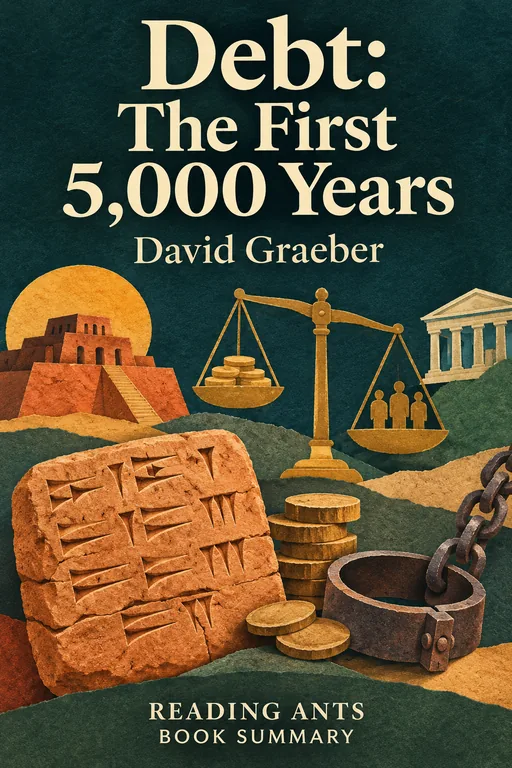
Debt: The First 5,000 Years
David Graeber argues that debt, and not barter, was the earliest basis of economic life, and that the moral idea that debts must always be repaid has shaped, and often justified, violence and inequality throughout history.
Overview
Debt: The First 5,000 Years was published in 2011 by David Graeber, an anthropologist who taught in Britain and the United States and who was also an activist. The book is a long history of debt and money, from ancient Mesopotamia to the modern financial system. Graeber challenges the usual story told by economists, that money began as a way to make barter easier. He draws on evidence from anthropology and history to propose a different account. The book is also a moral inquiry into what it means to owe something to others, and how debt has been used as a tool of power.
Full Summary
1. The myth of barter
The idea: Graeber starts by challenging a story found in many textbooks, that early people traded goods directly, and then invented money because barter was awkward. He says that anthropologists have found no economy that worked by pure barter, though people did barter in some situations, especially with strangers. Instead, small communities usually handled exchange through gifts, favors and informal credit, with people keeping track of what they owed to each other.
In real life: In a group of friends, nobody keeps an exact record of who paid for each pizza, but everyone remembers who has been generous.
2. Three kinds of moral relationship
The idea: Graeber describes three moral principles that exist side by side in all societies, not as stages of history. In “communism,” in his sense, people share according to need, as in a family. In “exchange,” people trade items of equal value and the relationship ends when it is settled. In “hierarchy,” people of lower status give to those of higher status, with custom guiding the exchange. He says that debt becomes a powerful force when it turns a human obligation into a precise number that can be demanded.
In real life: A parent does not charge a child for dinner, while a shop does, and the two relationships feel very different.
3. Credit, temples and jubilees
The idea: Graeber tells how the earliest records of debt, from ancient Mesopotamia, show systems of credit managed by temples and palaces, long before coins. When farmers fell into debt, they could lose land or family members as servants. Rulers sometimes responded by proclaiming a general cancellation of debts, a “clean slate,” to prevent unrest. This practice echoes in the idea of the jubilee in later religious traditions. Across history, he sees an alternation between eras of credit and virtual money and eras of coins and bullion, which he links to war and slavery.
In real life: A teacher who sets a new start after a hard term gives students the chance to begin again.
4. Coins, war and slavery
The idea: In the centuries that followed, Graeber says, the invention of coined money was closely tied to armies, since soldiers were paid in metal that could be traded for food, and rulers taxed their subjects so that coins would be needed. He argues that slavery and debt were often linked, and that they helped create societies in which some people could be treated as property or as bound by obligation. He notes that this was also the age in which major religions and philosophies spread, and that they often reflected on debt and ethics.
In real life: When a company pays its workers in vouchers that can only be spent in its own shop, it keeps control over them.
5. The Middle Ages and the return of credit
The idea: The book then looks at the period after the collapse of old empires, in which gold and silver were hoarded in some places and credit systems took many forms. Graeber discusses how religious thinkers debated interest and the fairness of lending. He says that, in many cultures, trade relied on trust and on virtual credit, with actual money often playing a lesser role than we imagine.
In real life: A market stall owner may let a regular customer pay next week, based on trust alone.
6. The age of capital and modern debt
The idea: The final sections trace how in the modern period, debt has become a vast structure of states, banks and individuals. Graeber discusses the end of the link between the dollar and gold in the early 1970s, the power of institutions such as the International Monetary Fund and the burden of debt on poor countries. He asks whether it is right that ordinary people, and nations, should be bound to repay at all costs, and he suggests that a modern jubilee might be considered.
In real life: A student who leaves school with large loans may have less freedom to choose a career they love.
Why It Matters
Debt became an influential and widely debated book, in part because it appeared at a time of financial crisis and public anger over debt, and during the protests of the Occupy movement, in which Graeber played a role. It offered a different account of the origins of money, and a long history that made debt seem not natural and unavoidable but the product of choices and power. Its ideas were taken up by writers, activists and scholars, and the book has been translated into many languages. It also invites readers to look at the moral language of debt, with its words such as guilt, redemption and obligation, and to ask who benefits from the idea that debts must always be paid.
Key Takeaways
- Barter was not the origin of money. Credit and obligation came first.
- Debt is a moral and political idea. It is not just a matter of numbers.
- Canceling debts has a history. Rulers have sometimes wiped the slate to keep order.
- Money and power are linked. Armies, taxes and slavery shaped early currency.
- Alternatives exist. Societies have organized their economies in many ways.
What We Can Learn
The book invites you to question assumptions that seem like common sense, such as the idea that everything is a trade between equals. Notice the different kinds of relationships in your life: some are about sharing, some about fair trade, and some about status. Think about when it is right to forgive a debt, a favor or a mistake. If you take a loan, consider the terms and the power that comes with it. And be aware that economic history includes many choices, which means that the future can also be different.
Criticism and Counterpoints
Many historians and economists have criticized the book. They argue that his claims about the history of barter and money are overstated, although he does allow that barter happens between strangers and in special conditions, and that his broad leaps across time and place rely on selective evidence. Others say that his picture of the past is sometimes romantic, and that some of his historical details are contested. Critics from different political views disagree with his proposals about debt cancellation. Even those who disagree with his conclusions often praise the book’s range and its challenge to the standard story. It should be read as an argument, not as settled history.
Who Should Read It
This book is for readers who like big historical arguments, and who are curious about the roots of money, debt and power. It is very long and wide-ranging, and parts are demanding. Those who want a short, balanced introduction to economic history may prefer a more conventional book, and then return to this one as a challenge.
Want the whole book?
A summary is a taste, not the meal. Here is where to find the full book.
You reached the end 🎉
Nicely done. Mark this one as read, and we will suggest what to read next.
Read this next
The Ascent of Money
Niall Ferguson
Niall Ferguson tells the history of finance, from ancient credit and Renaissance banks to bonds, stock markets, insurance, mortgages and global crises, to show that money and markets have shaped the story of civilization.
💰 Money & Economics
The Dawn of Everything
David Graeber and David Wengrow
Anthropologist David Graeber and archaeologist David Wengrow argue that the standard story of human history, in which small equal bands slowly turned into large unequal states, is wrong, and that early societies experimented with many ways of living.
🏛️ History
Sapiens: A Brief History of Humankind
Yuval Noah Harari
Humans came to rule the planet not because we are the strongest animals but because we can believe in shared stories (gods, nations, money, companies) that let millions of strangers cooperate.
🏛️ History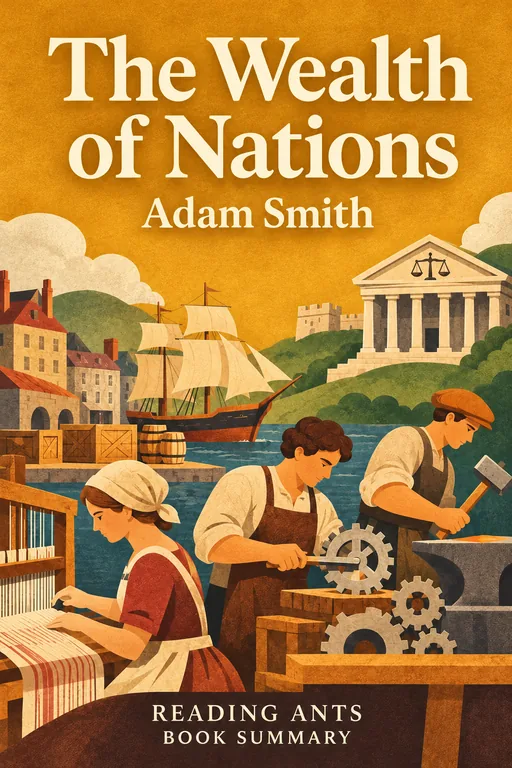
The Wealth of Nations
Adam Smith
A nation's true wealth is not its stock of gold but the goods and services its people produce, and that wealth grows fastest when people specialize, trade freely and compete, with government providing justice, defense and public goods.
💰 Money & Economics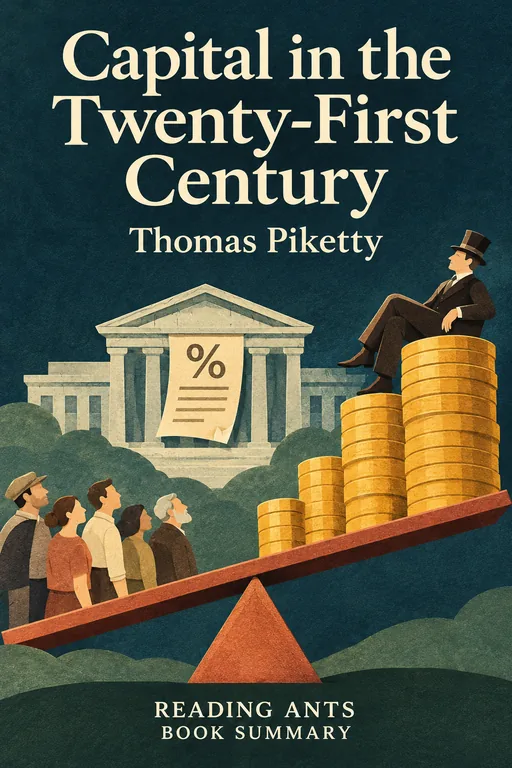
Capital in the Twenty-First Century
Thomas Piketty
Thomas Piketty argues that when the return on wealth grows faster than the economy as a whole, wealth naturally concentrates in fewer hands, and that only policy choices such as progressive taxes can keep inequality in check.
💰 Money & Economics
Rich Dad Poor Dad
Robert T. Kiyosaki
Schools teach people to work for money, but the rich learn to make money work for them by understanding the difference between assets and liabilities and by building businesses and investments.
💰 Money & EconomicsWant something different?
Pick another topic and we will show you three books to start with.