 Reading Ants
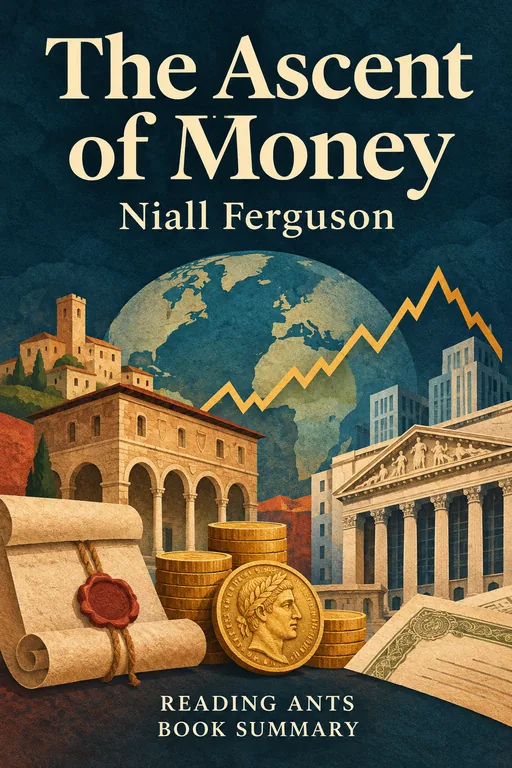
Niall Ferguson tells the history of finance, from ancient credit and Renaissance banks to bonds, stock markets, insurance, mortgages and global crises, to show that money and markets have shaped the story of civilization.
Overview
The Ascent of Money: A Financial History of the World was published in 2008 by Niall Ferguson, a historian from Scotland who has taught in Britain and the United States. The book accompanied a television series. It argues that financial innovations, such as banking, bonds, stock companies, insurance and mortgages, have been as important to human progress as technological inventions. Ferguson tells the story through colorful episodes and also shows how booms and busts have repeated. Its publication coincided with the financial crisis of 2008, which gave its themes extra urgency.
Full Summary
1. Money, credit and the first bankers
The idea: Ferguson begins by saying that money is not a thing but a relationship, based on trust and debt. He tells the story of how metals such as silver were mined and used, including the large amounts of silver taken from the mountain of Potosí in South America by the Spanish, which led to rising prices in Europe. He then describes the rise of banking in the Italian Renaissance, with families such as the Medici of Florence, the most famous banking family of the Renaissance.
In real life: When a friend lends you lunch money, you trust that you will pay it back, and that trust is the heart of finance.
2. Bonds and the power of the bond market
The idea: Governments need to borrow, especially for war, and bonds were the way to do it. Ferguson describes how the ability to borrow cheaply gave some states an advantage, and how the bond market became a powerful judge of government policy. He tells the story of the Rothschild family, who built a fortune by dealing in bonds across Europe, and shows how the interest rates a government pays reflect how much investors trust it.
In real life: A student who has a good record of paying back loans can borrow on better terms than one who does not.
3. Stocks, bubbles and shared risk
The idea: The next chapter looks at companies owned by many shareholders. Ferguson tells of the Dutch East India Company, which was one of the first to sell shares to the public, and then of the speculative bubble of the early eighteenth century in France, led by the Scottish financier John Law, when share prices soared and then crashed. He says that the stock market lets people share risks and invest, but also invites excitement and panic.
In real life: When everyone rushes to buy something because prices are rising, a crash can follow when the excitement fades.
4. Insurance and managing risk
The idea: Ferguson explains how insurance developed as a way to share risk, from marine insurance in medieval Italy and the coffee house that became Lloyd’s of London to a fund for the widows of Scottish ministers in the eighteenth century. He says that the growth of probability and statistics helped people to estimate chances and to price risks. Insurance, he says, allowed people to take risks that they otherwise would not, helping the economy to grow.
In real life: A neighborhood where everyone pays a small amount into a fund can help a family whose house burns down.
5. Property, mortgages and home ownership
The idea: The book looks at the idea of the “property-owning democracy” and how mortgages made it possible for many families to own homes. Ferguson describes the growth of government-backed housing finance in the United States, and how lending to riskier borrowers expanded in the early 2000s, leading to the crisis that began in 2007. He argues that housing is a source of security, but also a danger when debt grows too fast.
In real life: A family that borrows a lot to buy a house may feel secure while prices rise, but the terms of the loan and the family’s income still matter, and they could be in trouble if prices fall and income drops.
6. A global economy and its fragility
The idea: The final chapters look at how financial markets became global. Ferguson describes the failure in 1998 of the hedge fund Long-Term Capital Management, led by John Meriwether and including Nobel-winning economists, to show that complex models can fail. He also looks at the close economic relationship between China and the United States, which he calls “Chimerica,” in which Chinese savings funded American spending. He ends with a warning that financial institutions evolve, and that history, including the first age of globalization before the First World War, shows how fragile such systems can be.
In real life: If two friends depend on one another for money and favors, a problem for one will quickly become a problem for the other.
Why It Matters
The Ascent of Money is a popular introduction to financial history, and it helped to put the 2008 crisis in context. It reminds readers that finance is not a modern invention but an old and essential part of human societies, and that its innovations have both created wealth and caused disasters. The book and the television series reached a large audience and helped to make economic history more accessible. By telling the story through people and places, Ferguson shows that financial markets are shaped by human behavior, with its mix of ingenuity, greed and fear. It remains a good starting point for understanding why crises recur and what finance does for society.
Key Takeaways
- Money is trust. Finance rests on belief that promises will be kept.
- Credit builds civilizations. Banks, bonds and shares have funded trade, wars and growth.
- Risk can be shared. Insurance and stock markets spread risks across many people.
- Bubbles repeat. History shows cycles of excitement and collapse.
- Debt is double-edged. It helps people to build, but can cause ruin when it grows too fast.
What We Can Learn
You can use this history to think about your own money. Remember that trust and reputation are valuable, in finance and in life. Be cautious when a crowd rushes toward a bargain that seems too good, and ask what happens if prices fall. Learn how insurance, savings and borrowing work, because they affect you and your family. Pay attention to the news about banks and governments, and recall that similar events have happened before. Also, appreciate the ingenuity that financial tools have brought, and consider how they can be used for good.
Criticism and Counterpoints
Some critics said that the book, being a broad survey, skims over complex subjects. One reviewer called it rushed and uneven, and another complained that it spends little time on the intellectual history of capital. Others said that it offers a rather reverential picture of capitalism and gives little attention to the losers in the story of money’s ascent, such as people harmed by financial failures. Ferguson’s wider political views are controversial, and this colors how some readers see his work. Still, many appreciate it as a lively introduction.
Who Should Read It
This book is for readers who like history and want to understand how money and markets work. It is full of stories and easy to follow. Those who want a detailed technical account of finance, or an argument that is critical of the financial industry, may need to supplement it with other books.
Want the whole book?
A summary is a taste, not the meal. Here is where to find the full book.
You reached the end 🎉
Nicely done. Mark this one as read, and we will suggest what to read next.
Read this next
Debt: The First 5,000 Years
David Graeber
David Graeber argues that debt, and not barter, was the earliest basis of economic life, and that the moral idea that debts must always be repaid has shaped, and often justified, violence and inequality throughout history.
💰 Money & Economics
A Random Walk Down Wall Street
Burton G. Malkiel
Burton Malkiel argues that stock prices are so hard to predict that most investors, professional or not, are better off holding a broad, low-cost index fund than trying to beat the market.
💰 Money & Economics
The Big Short
Michael Lewis
Michael Lewis follows a handful of unusual investors who saw that the American housing boom was a bubble before the 2008 financial crisis, bet against it, and discovered how deeply the financial system had misjudged its own risks.
💼 Business
A Short History of Nearly Everything
Bill Bryson
Bill Bryson sets out to understand how we know what we know about the universe, the Earth and life, and tells the story through the odd, brilliant and sometimes unlucky people who figured it out.
🏛️ History
The Wealth of Nations
Adam Smith
A nation's true wealth is not its stock of gold but the goods and services its people produce, and that wealth grows fastest when people specialize, trade freely and compete, with government providing justice, defense and public goods.
💰 Money & Economics
Rich Dad Poor Dad
Robert T. Kiyosaki
Schools teach people to work for money, but the rich learn to make money work for them by understanding the difference between assets and liabilities and by building businesses and investments.
💰 Money & EconomicsWant something different?
Pick another topic and we will show you three books to start with.