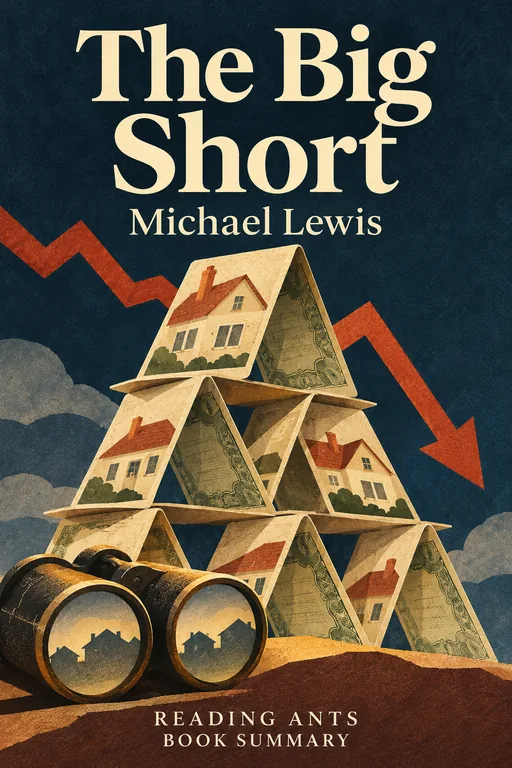
The Big Short
Michael Lewis follows a handful of unusual investors who saw that the American housing boom was a bubble before the 2008 financial crisis, bet against it, and discovered how deeply the financial system had misjudged its own risks.
Overview
The Big Short was published in 2010 by Michael Lewis, a writer who earlier worked on Wall Street and wrote about it in Liar’s Poker. The book looks at the years before the 2008 crash, when banks were creating complex financial products based on home loans, many of them risky. Lewis tells the story through a few outsiders, such as a doctor who became a hedge fund manager, and a group of traders who noticed a flaw. They bet that the products would fail. The story is both a human drama and a lesson in how markets can fail.
Full Summary
1. The boom in risky home loans
The idea: In the early 2000s, American banks and lenders gave many mortgages, including “subprime” loans to people with weak credit and little ability to pay. The loans were bundled together and sold to investors as bonds. Lewis explains that as long as house prices kept rising, everyone seemed to profit, so there was little pressure to ask whether the borrowers could really repay.
In real life: If a friend lends you money without checking if you can pay it back, the loan is risky, even if nothing goes wrong right away.
2. The outsiders who looked closely
The idea: A few investors started to read the fine print of these bonds. Michael Burry, a former doctor who ran a small fund called Scion Capital, studied the details and decided that many of the loans were bound to fail. Others, such as Steve Eisman, a hedge fund manager, and Charlie Ledley and Jamie Mai, who ran a small firm called Cornwall Capital, reached similar views from different directions. They were unusual because they did their own research instead of trusting the ratings given by experts.
In real life: Reading the instructions yourself, and not just trusting the label, can show problems others miss.
3. Betting against the market
The idea: The trouble was that there was no easy way to bet against these particular bonds. The investors found a tool called a credit default swap, a kind of insurance on a bond that pays out if the bond fails. The buyer can lose only the regular payments, while the possible gain is many times larger. They bought swaps, often at a low price, because the market considered failure unlikely. Others on Wall Street, such as Greg Lippmann, a trader at Deutsche Bank, also saw the opportunity and pitched the idea to many investors, while Howie Hubler lost billions on the opposite side of the market. Lewis explains this in plain language and with humor.
In real life: It is like buying fire insurance on a neighbor’s house because you can see that the wiring is faulty.
4. The system that did not want to know
The idea: The investors were surprised to find that many people on Wall Street did not understand the risks, or did not want to. Rating agencies gave high grades to bonds made from weak loans, and banks created even more complex products from the leftovers. Some of the people who sold and rated these products had reasons to keep the machine running, since they earned fees and bonuses. Lewis presents the situation as a failure of incentives as much as of intelligence.
In real life: If a person is paid for approving things, they may not look very hard for reasons to say no.
5. Waiting and doubting
The idea: Even after the investors bought the swaps, the bonds did not fail right away, and the investors had to pay regular costs. Their own clients grew nervous, and some of them threatened to take their money out. Burry in particular came under pressure from investors who thought he was wrong, while he stayed convinced that the bonds would fail. Lewis shows how hard it is to be right when everyone around you says you are wrong, and how the waiting almost broke them.
In real life: Being correct early can feel the same as being wrong, since you must wait for others to see what you see.
6. The collapse and the aftermath
The idea: In 2007 and 2008, the defaults on home loans grew, and the value of the bonds fell. Large financial firms suffered huge losses, one major investment bank failed in the fall of 2008, and the government stepped in with large rescues. The investors who bet against the market made big profits, but Lewis shows that they were not simply happy. Some were disgusted by what they had seen, and by the cost to ordinary families who lost jobs and homes.
In real life: Winning from someone else’s failure can feel hollow when many innocent people are hurt.
Why It Matters
The Big Short became a bestseller and was made into an award-winning film in 2015. It is one of the best-known accounts of the financial crisis of 2008, and it helped ordinary readers to understand what had happened. Lewis took technical subjects such as mortgage bonds and swaps and made them clear through characters and stories. The book matters because it shows how a whole system, including lenders, banks, rating agencies and regulators, can misjudge risk together. It remains a standard reference when people discuss financial regulation and the danger of bubbles. It is also a story about independent thinking and about the courage needed to stand against a crowd.
Key Takeaways
- Bubbles feel like common sense. When everyone believes prices only rise, caution seems foolish.
- Complexity can hide risk. Products that are hard to understand can conceal how weak they are.
- Incentives shape behavior. People rarely look for problems that would cost them money.
- Doing your own research pays. The few who read the details saw what the crowd missed.
- Being right is lonely. Standing apart from a crowd takes patience and nerve.
What We Can Learn
The book teaches us to ask basic questions about anything that sounds too good: Who benefits? What could go wrong? What happens if prices fall? It also teaches us not to rely on a label or a rating when we can check for ourselves. In your own life, you can apply this to borrowing, saving and investing: be careful with debt, and be wary of anything you do not understand. Finally, it encourages independent thinking. If you notice something that others ignore, stay calm, check the facts and be ready to explain your view clearly.
Criticism and Counterpoints
Some critics say that Lewis makes heroes of a small group of investors, and that the book skips over the wider economic causes of the crisis, such as government policy and global money flows. Others note that the story is simplified and told mainly from the point of view of the people who made the bets. Some economists argue that blaming greed and stupidity is too easy. It is a gripping story, but should be read with other accounts.
Who Should Read It
This book is for readers who want to understand the 2008 crisis and enjoy true stories of people who went against the crowd. It contains some strong language and technical terms, but these are well explained. Those who prefer a purely academic account might want a more detailed study, and readers who find financial hardship upsetting may take care.
Want the whole book?
A summary is a taste, not the meal. Here is where to find the full book.
You reached the end 🎉
Nicely done. Mark this one as read, and we will suggest what to read next.
Read this next
Moneyball
Michael Lewis
Michael Lewis tells how the Oakland Athletics, a baseball team with a small budget, used statistics to find overlooked players and compete with richer teams, and how that challenged old beliefs about talent.
💼 Business
Bad Blood
John Carreyrou
John Carreyrou, the reporter who broke the story, shows how the blood-testing start-up Theranos and its young founder Elizabeth Holmes built a company worth billions on a technology that did not work, and how a few brave insiders helped to expose it.
💼 Business
A Random Walk Down Wall Street
Burton G. Malkiel
Burton Malkiel argues that stock prices are so hard to predict that most investors, professional or not, are better off holding a broad, low-cost index fund than trying to beat the market.
💰 Money & Economics
The Ascent of Money
Niall Ferguson
Niall Ferguson tells the history of finance, from ancient credit and Renaissance banks to bonds, stock markets, insurance, mortgages and global crises, to show that money and markets have shaped the story of civilization.
💰 Money & Economics
The Most Important Thing
Howard Marks
Howard Marks, a veteran investor, argues that successful investing depends on thinking more deeply than the crowd, understanding risk and cycles, and avoiding big mistakes, more than on finding secret formulas.
💰 Money & Economics
The Lean Startup
Eric Ries
Startups succeed not by following a detailed plan but by quickly testing their ideas with real customers, learning from the results and changing direction when needed.
💼 BusinessWant something different?
Pick another topic and we will show you three books to start with.