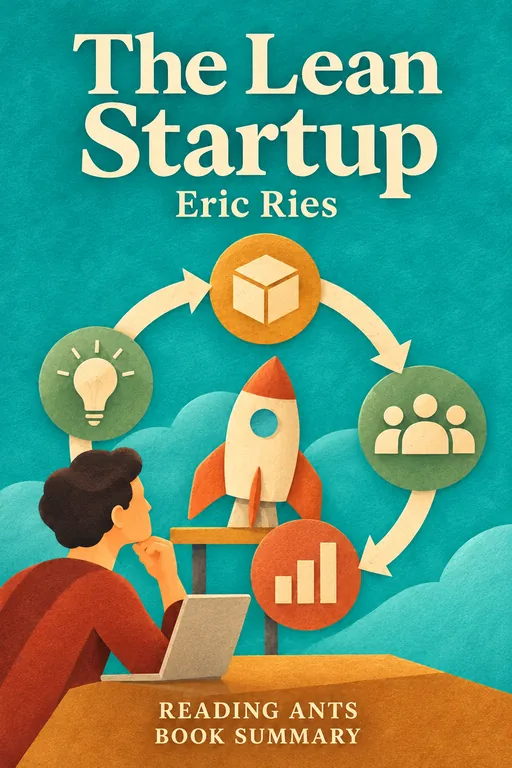
Startups succeed not by following a detailed plan but by quickly testing their ideas with real customers, learning from the results and changing direction when needed.
Overview
The Lean Startup is one of the most influential business books of the twenty-first century. Eric Ries, an American entrepreneur, had worked at startups that failed despite great technology and hard work, because they spent years building products nobody wanted. He developed a new approach, inspired partly by lean manufacturing at Toyota, which aims to eliminate waste. A startup, Ries argues, is an organization creating something new under conditions of extreme uncertainty. Instead of writing long business plans, startups should treat their ideas as experiments, build simple versions quickly, measure how customers respond, and learn. The book’s methods are now used not only by tech startups but by big companies, governments and nonprofits.
Full Summary
1. Startups are experiments
The idea: Traditional management relies on careful planning and forecasting. But when you are creating something new, you don’t know what customers want, so detailed plans are often fantasies. Ries argues that the main goal of a startup is to learn what works, which he calls validated learning: knowledge proven by real customer behavior rather than guesses or opinions.
From the book: Ries describes his time at a company called IMVU, which built a complex add-on that let users chat with friends on existing messaging services. Customers didn’t want it at all. The team had spent months building features based on assumptions they had never tested.
In real life: Before opening a café, you could sell coffee at a weekend market to see whether people like it, rather than signing an expensive lease first.
2. Build, measure, learn
The idea: The core of the method is a feedback loop: build a product or feature, measure how customers respond, and learn whether to continue or change. The faster a team goes around this loop, the faster it learns. Ries suggests planning in reverse: decide what you need to learn, figure out what to measure, then build only what is needed for that test.
In real life: A student creating a school club might first post a simple poster and count how many people show up, before spending time on a website and logo.
3. The minimum viable product
The idea: A minimum viable product (MVP) is the simplest version of a product that allows a team to start learning from real customers. It might be a basic prototype, a video or even a fake product page. Many founders resist releasing something imperfect, but Ries argues that early feedback is more valuable than polish.
From the book: Ries describes how the founders of Dropbox, the file-sharing service, made a short video showing how their product would work before it was finished. Thousands of people signed up to their waiting list, proving there was strong demand.
In real life: Someone thinking of starting a baking business might take orders from friends and neighbors through a simple message before investing in equipment or a shop.
4. Measure what really matters
The idea: Ries warns against vanity metrics, numbers like total sign-ups or page views that look impressive but don’t show whether the business is actually working. Instead, startups should use actionable metrics that reveal cause and effect, such as how many customers return or buy again. He recommends techniques like split testing, where different customers see different versions of a product to compare results.
In real life: A social media account with thousands of followers may seem successful, but if almost nobody clicks, buys or engages, the large follower count is a vanity metric.
5. Pivot or persevere
The idea: After each round of learning, a startup faces a key decision: persevere with its current strategy or pivot, a structured change of direction to test a new hypothesis. A pivot might mean focusing on a different customer group, turning one feature into the whole product, or changing how the company makes money. Pivoting isn’t failure; it’s learning in action.
In real life: A restaurant that sees most of its income coming from takeaway orders might pivot to focus on delivery instead of expanding its dining room.
6. Small batches and continuous improvement
The idea: Borrowing from lean manufacturing, Ries recommends working in small batches: releasing small changes often, rather than huge updates rarely. This allows problems to be spotted early. When something goes wrong, teams should ask “why?” five times to find the root cause and fix the system, not just the symptom.
In real life: If a school project keeps missing deadlines, asking why repeatedly might reveal that the real problem isn’t laziness but that nobody agreed on who does what.
7. Growth and innovation in big organizations
The idea: Ries describes different “engines of growth,” such as customers returning repeatedly, customers recommending the product to others, or paying for advertising to attract new users, and explains that each requires different metrics. He introduces “innovation accounting,” a way to measure real progress when traditional profit figures are still tiny, and argues that large companies can use lean methods by creating small, protected teams with the freedom to experiment.
In real life: Some big companies run internal “startup” teams that test new ideas quickly, without the slow approval processes of the rest of the business.
Why It Matters
The Lean Startup sparked a worldwide movement. Its vocabulary, such as MVP, pivot, validated learning and build-measure-learn, is now standard language in startups, business schools and technology companies. It has sold more than a million copies and has been translated into many languages.
The book’s ideas spread far beyond Silicon Valley. Governments, including the United States government, have used lean methods to improve public services, and large companies like General Electric worked with Ries to apply them. The approach also influenced how universities teach entrepreneurship and how investors evaluate young companies.
Key Takeaways
- Treat ideas as experiments. Test assumptions with real customers before investing heavily.
- Build, measure, learn, fast. The quicker the feedback loop, the faster you improve.
- Start with a minimum viable product. Simple versions bring early, valuable feedback.
- Ignore vanity metrics. Focus on numbers that show real customer behavior.
- Be willing to pivot. Changing direction based on evidence is a strength.
What We Can Learn
The lean approach is useful far beyond business. Whenever you try something new, whether a hobby, a club, a fundraiser or a career change, start small and test whether it works before committing everything.
It also teaches us to welcome feedback, even when it hurts. Asking people what they really think, and watching what they actually do, saves time and avoids building something nobody wants.
Finally, the idea of pivoting encourages flexibility. If a plan isn’t working, changing direction is not giving up; it is using what you’ve learned to find a better path.
Criticism and Counterpoints
Some critics argue that the lean approach works best for software and internet products, where changes are cheap and fast, but is harder to apply in fields like hardware, medicine or construction, where building and testing takes years and mistakes can be dangerous. Others warn that a focus on quick experiments can lead to small, incremental products rather than bold, visionary ones, a point made by Peter Thiel in Zero to One.
The term “minimum viable product” has also been misused to justify releasing poor-quality products. Some readers find the book repetitive, with much of its message summed up in a few key ideas. Still, most agree its principles have made new ventures less wasteful.
Who Should Read It
This book is ideal for entrepreneurs, product managers, students interested in business and anyone launching a new project. Its ideas are clearly explained, though the examples are mostly from technology companies. Readers outside tech can still apply its experimental mindset to many kinds of work.
Want the whole book?
A summary is a taste, not the meal. Here is where to find the full book.
You reached the end 🎉
Nicely done. Mark this one as read, and we will suggest what to read next.
Read this next

Zero to One
Peter Thiel with Blake Masters
The most valuable companies create something new from nothing, and Peter Thiel argues that this means aiming for a monopoly in a small, specific market rather than competing with everyone in a crowded one.
💼 Business
The Innovator's Dilemma
Clayton M. Christensen
Great companies often fail not because they manage badly, but because they do everything right: they listen to their best customers and invest in the best products, and so they miss the cheaper, simpler technology that eventually replaces them.
💼 Business
The Hard Thing About Hard Things: Building a Business When There Are No Easy Answers
Ben Horowitz
A veteran Silicon Valley entrepreneur shares honest lessons from the worst times of building and running a technology company, when there are no easy answers.
💼 Business
Good to Great
Jim Collins
Collins argues that sustained corporate improvement comes from disciplined leaders, carefully chosen people, a focused economic concept and cumulative execution rather than dramatic transformation programs.
💼 Business
Built to Last: Successful Habits of Visionary Companies
Jim Collins and Jerry I. Porras
A six-year study of long-lasting, successful companies, which finds that what sets them apart is a strong core purpose, combined with a constant drive to change and improve.
💼 Business
How Will You Measure Your Life?
Clayton M. Christensen
A Harvard business professor applies the best ideas of management research to personal questions, such as finding a happy career, building lasting relationships and keeping your integrity.
💼 BusinessWant something different?
Pick another topic and we will show you three books to start with.