 Reading Ants
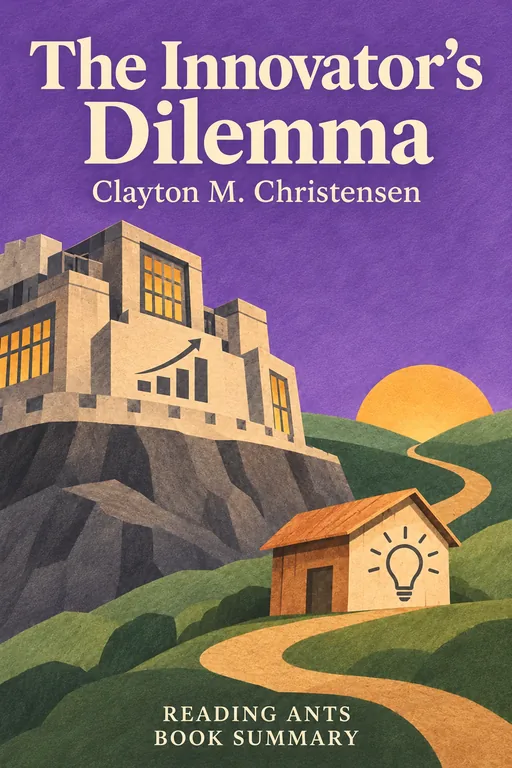
Great companies often fail not because they manage badly, but because they do everything right: they listen to their best customers and invest in the best products, and so they miss the cheaper, simpler technology that eventually replaces them.
Overview
The Innovator’s Dilemma was written by Clayton Christensen, a Harvard Business School professor, and published in 1997. Christensen studied why industry leaders, such as makers of computer disk drives, kept losing their position even though they were well run, well funded and full of talented people. His answer is a surprising idea called disruptive innovation. The book shows that the habits that make a company successful, listening to customers, chasing profit and moving upmarket, can leave it blind to a small, humble newcomer. It became one of the most influential business books ever written and gave the world the word “disruption.”
Full Summary
1. Two kinds of innovation
The idea: Christensen separates innovation into two types. Sustaining innovations make existing products better for existing customers: a faster processor, a sharper screen. Established companies are excellent at these. Disruptive innovations are different. They are usually cheaper, simpler and, at first, worse than the leading products, so mainstream customers do not want them. They find a small, new group of customers who value the simplicity or low price, and then they slowly improve until they threaten the leaders.
In real life: An early digital camera took blurry pictures compared with film. Professional photographers ignored it, but the cheap, convenient camera improved every year until film was largely gone.
2. The disk-drive story
The idea: Christensen spent years studying the computer disk-drive industry, where products changed quickly and the evidence was easy to follow. Each time drives became physically smaller, the leading makers of the larger drives tended to be overtaken by new companies. The smaller drives were worse at first, since they stored less. But they were cheaper and fit into new kinds of computers, so they opened new markets, and soon they improved enough to take over.
From the book: The established firms were not stupid. Their engineers often built the new, smaller drives first. But their best customers did not want them, so the leaders shelved them.
In real life: A company that sells to big, demanding clients may ignore a tiny customer who wants something simpler, even if that tiny customer is the future.
3. Why listening to customers can backfire
The idea: Good managers are taught to listen to their best customers and give them what they ask for. That works for sustaining innovations. But the best customers usually do not ask for a cheaper, simpler, worse product. So a well-run company, by following its customers, is led away from the disruptive technology. Christensen argues that this is the heart of the dilemma: the very practices that make a company successful in normal times cause its failure when a disruption arrives.
In real life: A restaurant that always follows its regulars’ requests for bigger portions and higher prices may never notice that younger people want quick, cheap meals.
4. Resources, processes and values
The idea: Why can’t big companies just copy the newcomers? Christensen says a company’s ability to change depends on three things: its resources (people, money, technology), its processes (the usual ways of getting work done), and its values (what managers decide is important, such as profit margins). Processes and values are hard to change. A company that needs a certain profit margin will naturally turn down a small market with low margins, even if that market will become huge.
In real life: A big bank may be unable to build a cheap, simple app for students, because its processes and cost structure were built for large customers.
5. Small markets don’t solve big problems
The idea: A large company needs growth. When a company is worth billions, a new market worth a few million does not seem worth the effort. So the disruptive technology is ignored while it is still small, and by the time it is large enough to matter, the newcomer is already strong. Christensen also notes that you cannot analyze a market that does not exist yet, so careful planning and forecasting often fail for disruptive products.
From the book: The pattern also appeared in other industries he studied, such as the steel industry, where small mills started by making low-quality products and then moved gradually upmarket.
In real life: Streaming video started as a tiny, poor-quality alternative to cable. For years, it seemed too small to worry about.
6. The trajectory of improvement
The idea: Christensen draws two lines on a graph: how much performance customers can actually use, and how fast technology improves. Technology typically improves faster than customers’ needs grow. That means a product that is “not good enough” today will be more than good enough tomorrow. The disruptive product enters at the bottom, and then climbs until it meets the needs of mainstream customers, usually at a much lower price.
In real life: Early laptop screens were poor for gaming, but over time laptops became good enough for most people, and desktop sales fell.
7. What leaders can do
The idea: Christensen’s advice is practical. Establish a separate, independent organization with its own people, processes and values, so that it can pursue the small new market without the old company’s rules. Match the size of the new unit to the size of the market. Be patient about growth at the start, and be ready to fail early and cheaply, learning as you go.
In real life: Some companies create a small “lab” or a separate brand that is allowed to behave like a startup, with different goals from the main business.
Why It Matters
The Innovator’s Dilemma won the Global Business Book Award in 1998, and it influenced a generation of entrepreneurs and executives. Steve Jobs and Andy Grove of Intel were among its famous admirers. The idea of disruption changed how people think about competition, and the word is now used everywhere, from technology and education to healthcare and banking.
The book also led to Christensen’s later work, such as The Innovator’s Solution and Competing Against Luck. Even people who have never read it use its language: “disruptive technology,” “sustaining innovation” and “the innovator’s dilemma.” Its main lesson, that success can make you blind, applies to schools, governments and families as well as companies.
Key Takeaways
- Success can create blind spots. Doing everything “right” can lead a company to miss what is changing.
- Disruption starts small. New products often begin cheaper, simpler and worse, then improve.
- Customers can mislead. Your best customers won’t ask for a technology that threatens their current favorite.
- Culture is hard to change. Processes and values limit what an organization can do.
- Separate units can help. A new business sometimes needs its own space and rules.
What We Can Learn
The book teaches humility. When we are good at something, we tend to ignore small signs of change, because they seem unimportant or beneath us. Looking at what the people outside our usual group are doing, whether they are younger, poorer or newer, can reveal where things are heading.
It also applies to personal life. A student who has always succeeded with one method may resist a new way of learning, and a professional who relies on one skill may miss a shift in the job market. Spending a small amount of time experimenting with new tools, before they are urgently needed, is a cheap kind of insurance.
Finally, the book shows why good listening needs balance. Hearing customers matters, but so does watching what people actually do, and imagining what might become possible.
Criticism and Counterpoints
Critics argue that “disruption” has been stretched too far. In a well-known 2014 article in The New Yorker, the historian Jill Lepore challenged Christensen’s evidence, arguing that he chose examples that fit and that some of the companies he described as disrupted did not actually fail. Christensen’s own predictions, such as an early forecast about the iPhone, were sometimes wrong, and he later defended and refined his theory.
Others point out that many disruptors fail, and that some established companies survive by adapting. The term has also become a buzzword for any change, which makes it less precise than the original idea. Supporters answer that the core insight about how success can blind a company remains useful.
Who Should Read It
This book is useful for managers, entrepreneurs, investors and students of business. Its disk-drive chapters are detailed, but the main message is easy to follow. Readers who prefer a lighter introduction might start with a summary of the main ideas, then return to the book for the case studies.
Want the whole book?
A summary is a taste, not the meal. Here is where to find the full book.
You reached the end 🎉
Nicely done. Mark this one as read, and we will suggest what to read next.
Read this next
Zero to One
Peter Thiel with Blake Masters
The most valuable companies create something new from nothing, and Peter Thiel argues that this means aiming for a monopoly in a small, specific market rather than competing with everyone in a crowded one.
💼 Business
Good to Great
Jim Collins
Collins argues that sustained corporate improvement comes from disciplined leaders, carefully chosen people, a focused economic concept and cumulative execution rather than dramatic transformation programs.
💼 Business
Blue Ocean Strategy
W. Chan Kim and Renee Mauborgne
Instead of fighting rivals in a crowded market, companies can create a new, uncontested space where competition does not matter, by offering buyers something much more valuable at a lower cost.
💼 Business
The Lean Startup
Eric Ries
Startups succeed not by following a detailed plan but by quickly testing their ideas with real customers, learning from the results and changing direction when needed.
💼 Business
Built to Last: Successful Habits of Visionary Companies
Jim Collins and Jerry I. Porras
A six-year study of long-lasting, successful companies, which finds that what sets them apart is a strong core purpose, combined with a constant drive to change and improve.
💼 Business
How Will You Measure Your Life?
Clayton M. Christensen
A Harvard business professor applies the best ideas of management research to personal questions, such as finding a happy career, building lasting relationships and keeping your integrity.
💼 BusinessWant something different?
Pick another topic and we will show you three books to start with.