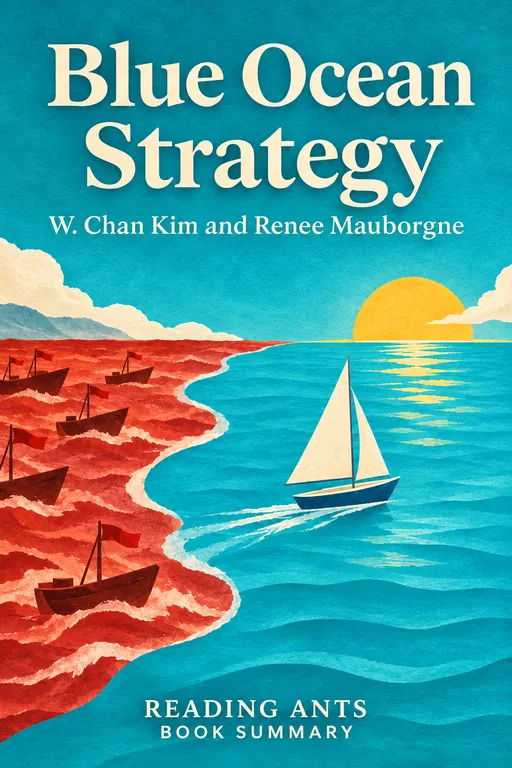
Instead of fighting rivals in a crowded market, companies can create a new, uncontested space where competition does not matter, by offering buyers something much more valuable at a lower cost.
Overview
Blue Ocean Strategy was written by W. Chan Kim and Renée Mauborgne, two professors at the business school INSEAD, and published in 2005. It is based on years of studying companies that created new markets. The authors use a simple picture: the “red ocean” is the known market, bloody with competition, where companies fight over the same customers. The “blue ocean” is unknown market space, where there is no competition because the market does not yet exist. The book offers tools, such as the strategy canvas and the Four Actions Framework, for finding a blue ocean, and became a bestseller around the world.
Full Summary
1. Red oceans and blue oceans
The idea: In a red ocean, companies compete within existing industry boundaries and try to beat rivals by winning a bigger share of the same demand. As markets get crowded, profits shrink and products become commodities. In a blue ocean, a company creates new demand, making competition irrelevant. The authors argue that most companies spend all their energy on the red ocean, though the biggest rewards have come from creating the blue.
In real life: Ten phone makers adding slightly better cameras are in a red ocean. The first phone that let ordinary people carry the internet in a pocket opened a blue one.
2. Value innovation
The idea: The central idea is value innovation: pursuing differentiation and low cost at the same time. Traditionally, strategists said you must choose: either offer something special and charge more, or be cheap and plain. Blue ocean companies break this trade-off. They make the competition irrelevant by offering buyers a leap in value while cutting costs, removing things the industry takes for granted that buyers don’t value.
In real life: A budget hotel that skips the restaurant and lobby, but offers a comfortable bed and quiet room at a low price, delivers what most guests really want.
3. The strategy canvas
The idea: The authors introduce the strategy canvas, a simple graph that shows how an industry competes. Across the bottom are the factors the industry competes on, such as price, service or quality. A line shows how much each company offers on each factor. If all the lines look alike, the industry is in a red ocean. A blue ocean strategy has a line that looks completely different from everyone else’s.
In real life: Draw the lines for three local pizza shops, and you will probably see the same shape: similar prices, similar toppings. A shop with a different line stands out.
4. The Four Actions Framework
The idea: To change the line, the authors propose four questions. Which factors that the industry takes for granted should be eliminated? Which should be reduced well below the industry standard? Which should be raised well above it? And which should be created, since the industry has never offered them? The answers are placed in a grid, sometimes called the “Eliminate-Reduce-Raise-Create grid.”
From the book: One of their best-known examples is Cirque du Soleil, which reinvented the circus by removing star performers and animal acts, and creating a theatrical, artistic experience for adults.
In real life: A school club might eliminate long meetings, reduce paperwork, raise the amount of hands-on activity and create a monthly showcase.
5. Look across boundaries
The idea: The authors describe six paths for finding blue oceans. They include looking at alternative industries (what else do your customers use to solve the same problem?), at other groups of customers, and at complementary products. They also suggest looking at the non-customers, the people who do not use any product in your industry, and asking why. Blue oceans often come from understanding why people stay away.
From the book: They describe a wine called Yellow Tail, designed for people who didn’t drink wine because it seemed complicated. By making it easy to understand and drink, the company reached a huge new group of customers.
In real life: Many people avoid gyms because they feel intimidated. A gym that welcomes beginners could attract those who never signed up before.
6. Think big picture, not numbers
The idea: The authors argue that strategy should be drawn as a picture that everyone can understand, not buried in long documents. Teams should visit customers and non-customers, and see how they actually use products. They recommend a “visual awakening”: showing managers the strategy canvas, so they can see the gap between their company and what the market needs.
In real life: A team that sketches its idea on one page is easier to align than a team with a 50-page plan.
7. Execution and risk
The idea: A good strategy needs people who believe in it. The authors discuss fair process: involving people in decisions, explaining why choices were made and setting clear expectations. They also address risk, arguing that each of the six principles lowers a particular risk (search, planning, scale, business model, organizational and management risk), and that a blue ocean strategy can be checked against a simple sequence: is there exceptional buyer value, is the price accessible, can the cost target be met, and are the adoption hurdles addressed?
In real life: A new idea at school is more likely to succeed if the people who must follow it have had a chance to share their views.
Why It Matters
Blue Ocean Strategy has sold millions of copies in dozens of languages and is a standard text in business schools. Its vivid vocabulary, “red ocean,” “blue ocean” and “value innovation,” is widely used by managers and entrepreneurs. The authors later published Blue Ocean Shift, which offers more practical steps.
The book gave managers a hopeful message: you do not have to beat competitors to succeed, you can sidestep them. It also made the strategy canvas a popular tool for teams, startups and non-profit organizations. Its tools have also been tried in education, public services and community groups, because a simple drawing is easy for any group to use and discuss.
Key Takeaways
- Don’t just fight for the same customers. Look for places where competition doesn’t exist.
- Cut and create at the same time. Removing unneeded features lowers costs while new ones add value.
- Look at non-customers. The people who do not buy at all may hold the key.
- Draw your strategy. A visual picture reveals how similar you are to rivals.
- People must believe in the plan. Fair process helps teams follow through.
What We Can Learn
The book teaches a useful way of thinking about any competition. Instead of asking how to be a little better than everyone else, we can ask what everyone is doing the same, and what would happen if we did it differently.
It also encourages us to listen to people who aren’t already on our side. If a club has few members, the answer may lie in asking why others stay away, instead of improving what we do for the few who join.
Finally, the four questions are a simple tool for any plan, such as a school project or a family routine: what can we stop doing, do less of, do more of, or start doing?
Criticism and Counterpoints
Critics note that the book relies on case studies chosen after the fact, and that many of the featured companies later struggled or lost their blue oceans to imitators. This makes it hard to tell whether the framework predicts success or only explains it afterwards.
Others argue that the idea is too general to be applied, and that real blue oceans are rare and often involve luck or technological change. Some say that the strategy canvas can oversimplify complex markets, and that the distinction between red and blue is less clear than the book suggests. Supporters answer that it offers helpful tools and a fresh way of thinking.
Who Should Read It
This book suits managers, entrepreneurs, marketers and students of business. It is clearly written and full of examples. Readers who already know the main ideas can focus on the tools in the middle chapters.
Want the whole book?
A summary is a taste, not the meal. Here is where to find the full book.
You reached the end 🎉
Nicely done. Mark this one as read, and we will suggest what to read next.
Read this next
Zero to One
Peter Thiel with Blake Masters
The most valuable companies create something new from nothing, and Peter Thiel argues that this means aiming for a monopoly in a small, specific market rather than competing with everyone in a crowded one.
💼 Business
The Innovator's Dilemma
Clayton M. Christensen
Great companies often fail not because they manage badly, but because they do everything right: they listen to their best customers and invest in the best products, and so they miss the cheaper, simpler technology that eventually replaces them.
💼 Business
Good to Great
Jim Collins
Collins argues that sustained corporate improvement comes from disciplined leaders, carefully chosen people, a focused economic concept and cumulative execution rather than dramatic transformation programs.
💼 Business
Start with Why
Simon Sinek
The leaders and companies that inspire people begin by explaining why they exist, their purpose or belief, and only then talk about how and what they do.
💼 Business
The Lean Startup
Eric Ries
Startups succeed not by following a detailed plan but by quickly testing their ideas with real customers, learning from the results and changing direction when needed.
💼 Business
Built to Last: Successful Habits of Visionary Companies
Jim Collins and Jerry I. Porras
A six-year study of long-lasting, successful companies, which finds that what sets them apart is a strong core purpose, combined with a constant drive to change and improve.
💼 BusinessWant something different?
Pick another topic and we will show you three books to start with.