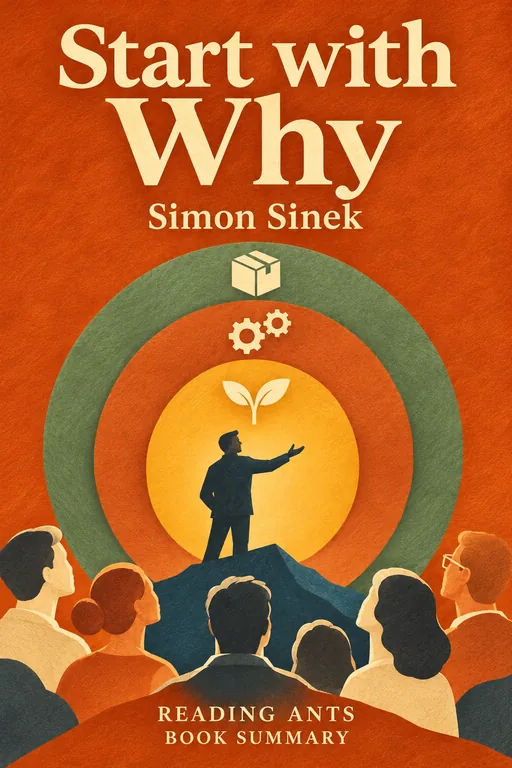
The leaders and companies that inspire people begin by explaining why they exist, their purpose or belief, and only then talk about how and what they do.
Overview
Start with Why was written by Simon Sinek, a British-born American author and speaker, and published in 2009. It grew out of a talk he gave that became one of the most-watched TED talks ever. Sinek noticed that the most inspiring leaders and organizations, such as Apple, Martin Luther King Jr. and the Wright brothers, think, act and communicate from the inside out, starting with a clear sense of purpose. Most others work from the outside in, starting with what they sell. He calls his model the Golden Circle, and his message is simple: people don’t buy what you do, they buy why you do it.
Full Summary
1. The Golden Circle
The idea: Sinek draws three circles, one inside the other. The outside circle is What: the products or services a company offers. The middle is How: the special way it does things. The center is Why: the purpose, cause or belief behind it all. Every company knows what it does, many know how, but very few can clearly say why. And the why is not “to make a profit,” which is a result, not a purpose.
In real life: A school can say what it does (teaches subjects) or why it exists (to help every child discover that they can learn).
2. Inside out versus outside in
The idea: Most companies communicate from the outside in: they say what they make, describe its features and then ask for the sale. Inspiring ones go from the inside out: they begin with what they believe, then explain how they act on that belief, and only last mention that they happen to make a certain product. The second kind of message, Sinek says, speaks to how people actually decide, because it connects to what they care about.
From the book: He uses Apple as his main example, saying that people lined up not for a computer but because they believed in what the company stood for.
In real life: A sports team sells more than tickets when it makes people feel part of something.
3. Why it works: the brain
The idea: Sinek links his model to the brain, in a simplified account that neuroscientists dispute. The outer layer, the neocortex, handles rational thinking and language, and corresponds to the What. The inner, limbic part handles feelings, trust and loyalty, and it has no language. So when a message speaks to the Why, it reaches the part of us that makes decisions based on feeling, and people struggle to explain their choices in words, saying “it just feels right.”
In real life: We often can’t explain why we love a certain band or team. It is a gut feeling and not a list of features.
4. Success and people who are the first to follow
The idea: Sinek uses the Law of Diffusion of Innovations, a model of how new ideas spread. A small group of innovators and early adopters try something first, and then the majority follows. He says that you cannot win the early adopters with a clear What; they respond to a belief they share. In Sinek’s account, once you reach roughly fifteen to eighteen percent of a market, the idea tips, and the majority joins.
In real life: The first few people to wear a new style or use a new app often do so because it expresses who they are.
5. Great leaders and the Why
The idea: The book argues that movements are built around people who believe. Sinek says Martin Luther King Jr. attracted hundreds of thousands to Washington not by announcing a detailed plan, but by sharing a belief. Leaders who start with a Why attract people who share that belief, and those people give their effort, not just their labor.
From the book: He also compares the Wright brothers, who were driven by a cause and had little money, with a rival who had better funding but less passion. In his telling, belief won.
In real life: A volunteer team led by people who truly believe in the cause often works harder than a paid one that doesn’t.
6. When the Why gets lost
The idea: Sinek warns that as companies grow, the Why can become blurry. He calls this the “split” between what a company says and what it does. Leaders begin to chase numbers and short-term results, and employees stop knowing why they come to work. He urges organizations to keep their Why alive, hire people who believe in it and make decisions that match it.
In real life: A club that began to share stories can lose its way if it later only counts members.
7. Finding your own Why
The idea: The final part gives advice for finding your Why, which usually comes from your past, from experiences that shaped you. Sinek suggests that organizations should discover their Why, define how they will act on it, and then make sure everything they do, from hiring to advertising, shows it. He believes that this kind of clarity creates loyalty.
In real life: Try finishing the sentence “I do what I do so that...” for yourself, and see what answer feels true.
Why It Matters
Start with Why became an international bestseller, and Sinek’s 2009 TED talk was one of the most viewed in the conference’s history. Sinek has since written more books, including Leaders Eat Last and The Infinite Game, and speaks to companies, governments and armed forces.
The Golden Circle has become a common tool in marketing, leadership training and personal development. Its message, that purpose is a source of energy, has helped many organizations explain themselves more clearly, and many non-profits find it especially useful, since they depend on shared belief.
Key Takeaways
- People follow belief, not products. A clear purpose inspires more than a list of features.
- Think inside out. Begin with why, then how, then what.
- Profit is a result, not a purpose. A Why is a cause or belief.
- Hire for belief. People who share your Why will give their best.
- Stay consistent. What you do must match what you say.
What We Can Learn
The book invites us to think about purpose in our own lives. Before taking on a project, a job or a hobby, we can ask why it matters to us. Answers that come from our values keep us going when things become hard.
It also helps with communication. When we ask someone for help, explaining why the task matters usually works better than only describing what has to be done.
Finally, it reminds us that it is easy to lose our purpose when we’re busy. Pausing to ask whether our actions still match our beliefs is a useful habit.
Criticism and Counterpoints
Critics argue that Sinek’s use of neuroscience is a loose metaphor and that the brain does not work in the neat layers he describes. Others find his examples cherry-picked: Apple’s success has many causes, including design, timing and strong products, and “why” alone cannot explain it. Some historians have also questioned the way the story of the Wright brothers is told.
Some readers feel the book repeats the same idea many times, and that “Why” can become an empty slogan if a company’s actions do not match. Others note that purpose is not enough without competent execution. Sinek’s supporters say the book is meant as a simple, motivating framework.
Who Should Read It
This book suits leaders, teachers, founders, volunteers and anyone who wants to explain what they do with more meaning. It is easy to read, and the ideas can be understood quickly. Readers who want rigorous research may want to compare it with more academic sources.
Want the whole book?
A summary is a taste, not the meal. Here is where to find the full book.
You reached the end 🎉
Nicely done. Mark this one as read, and we will suggest what to read next.
Read this next
Leaders Eat Last: Why Some Teams Pull Together and Others Don't
Simon Sinek
A book that argues that great leaders create a "circle of safety" for their people, and that trust and cooperation come from the way that our bodies and brains respond to feeling safe.
💼 Business
Good to Great
Jim Collins
Collins argues that sustained corporate improvement comes from disciplined leaders, carefully chosen people, a focused economic concept and cumulative execution rather than dramatic transformation programs.
💼 Business
Zero to One
Peter Thiel with Blake Masters
The most valuable companies create something new from nothing, and Peter Thiel argues that this means aiming for a monopoly in a small, specific market rather than competing with everyone in a crowded one.
💼 Business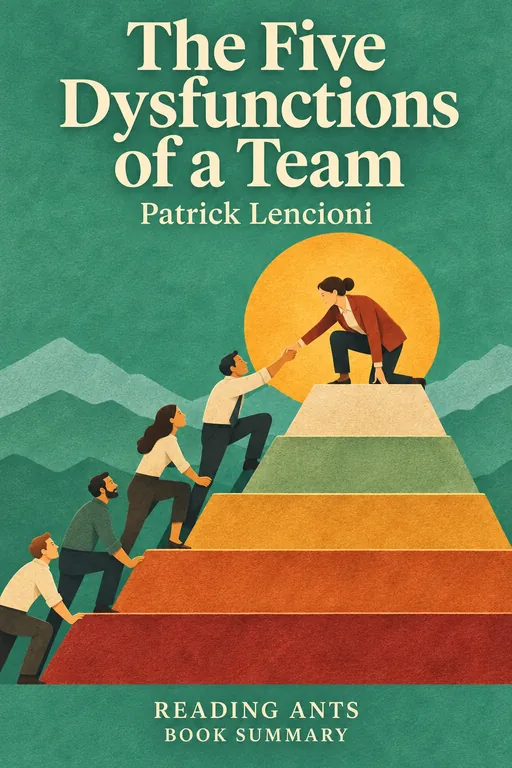
The Five Dysfunctions of a Team
Patrick Lencioni
Teams fail for five connected reasons, starting with a lack of trust, and the way to build a strong team is to fix them in order from the bottom of the pyramid up.
💼 Business
The Lean Startup
Eric Ries
Startups succeed not by following a detailed plan but by quickly testing their ideas with real customers, learning from the results and changing direction when needed.
💼 Business
Built to Last: Successful Habits of Visionary Companies
Jim Collins and Jerry I. Porras
A six-year study of long-lasting, successful companies, which finds that what sets them apart is a strong core purpose, combined with a constant drive to change and improve.
💼 BusinessWant something different?
Pick another topic and we will show you three books to start with.