 Reading Ants
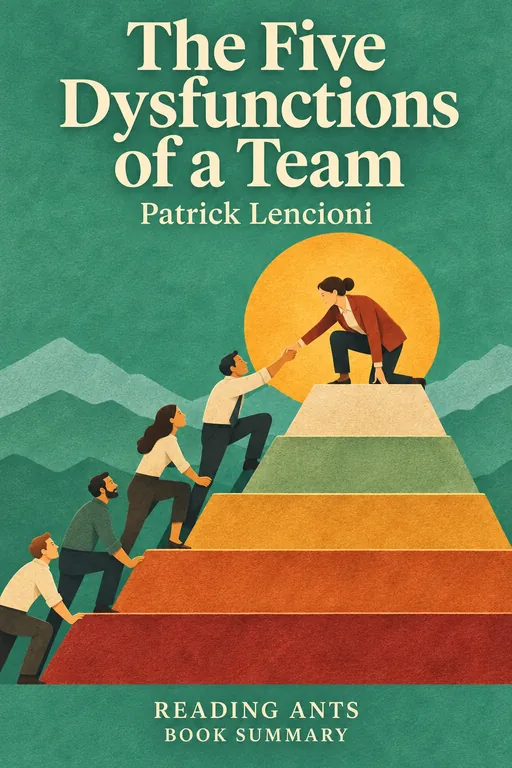
Teams fail for five connected reasons, starting with a lack of trust, and the way to build a strong team is to fix them in order from the bottom of the pyramid up.
Overview
The Five Dysfunctions of a Team was written by Patrick Lencioni, a business consultant, and published in 2002. It is unusual because most of the book is a story. A fictional technology company is struggling because its talented executives do not work well together, and a new CEO, Kathryn Petersen, takes over to fix it. Through her experience, readers watch each problem appear, and see how it can be solved. A shorter section at the end explains the model and gives practical tools. Lencioni’s idea is that teamwork is not about talent or strategy but about behavior, and that it is simple in theory but hard in practice.
Full Summary
1. The story of a struggling team
The idea: The book opens in a company called DecisionTech, a fictional Silicon Valley firm with strong technology and a leadership team that is failing. The executives are smart and experienced, but they avoid honest conversations and protect their own areas, so the company is losing ground to rivals. The board brings in Kathryn Petersen, an outsider with a background in operations and an unusual style, as the new CEO. She faces a team of people who do not trust each other.
In real life: Think of a sports team full of great players who never pass the ball. Talent without teamwork rarely wins.
2. Dysfunction one: absence of trust
The idea: At the base of Lencioni’s pyramid is an absence of trust. He does not mean predicting each other’s behavior, but vulnerability-based trust: being willing to admit mistakes, weaknesses and the need for help without fear of being punished. Without this kind of trust, teams hide problems and waste energy protecting themselves. Kathryn’s first step is to take the team away for a retreat, where each person shares something personal.
In real life: A student who can say “I don’t understand this” in a group project helps the whole group more than one who hides it.
3. Dysfunction two: fear of conflict
The idea: Trust makes healthy conflict possible. Lencioni argues that teams need to argue about ideas, not people, with passion and honesty. Teams that avoid conflict reach only artificial harmony, and the real problems go on in private conversations and corridors. Kathryn encourages the executives to speak openly, even when it is uncomfortable, and reminds them that disagreement about ideas is not an attack.
In real life: A group that never disagrees often agrees to a plan nobody believes in.
4. Dysfunction three: lack of commitment
The idea: When people haven’t been able to say what they really think, they do not truly buy into decisions. Commitment, Lencioni says, comes from having a chance to be heard, even if the final decision goes another way. He stresses the importance of clarity: leaders must make decisions on time, even without perfect information, and make sure everyone knows what was agreed. Ambiguity breeds hesitation and second-guessing.
In real life: After a team meeting, if everyone leaves with a different idea of what was decided, the plan will fall apart.
5. Dysfunction four: avoidance of accountability
The idea: Without commitment, people are reluctant to call out each other’s behavior, and so standards slip. Lencioni argues that the best form of accountability is peer pressure: teammates who care about the team’s results hold one another to the standards, instead of relying on the boss. This is harder than it sounds, because it requires being willing to have an uncomfortable conversation with a friend.
In real life: A teammate who reminds you gently that you missed practice does you a favor.
6. Dysfunction five: inattention to results
The idea: At the top of the pyramid is inattention to results. Team members focus on their own status or their department’s goals instead of the team’s collective outcome. Lencioni says that a team needs a clear, shared goal and should measure itself by it, with rewards linked to the team’s success. If trust, conflict, commitment and accountability are present, results follow.
In real life: A group in which each student only cares about their own part of the grade is less likely to produce a good project.
7. Putting the model to work
The idea: The last section of the book explains the model and offers tools: team assessments, exercises and advice for leaders. Lencioni says that leaders must go first by showing vulnerability, and that building a team takes time and constant effort. He suggests regular, structured meetings, honest feedback and a clear sense of the team’s purpose.
In real life: A family can try it too: share what went well and badly in the week, speak honestly and agree on shared goals.
Why It Matters
The Five Dysfunctions of a Team sold millions of copies and became one of the most widely used books on teamwork. Companies and schools around the world use its pyramid in training sessions, and Lencioni’s firm built a business around it. Its simple model made a complicated topic easy to discuss.
The book helped popularize the “leadership fable,” a story-based way to teach business ideas, and led to similar books by Lencioni and others. Its focus on trust and honest disagreement fits with later research on psychological safety in teams, such as Google’s well-known study of what makes teams effective.
Key Takeaways
- Trust comes first. Being open about weaknesses is the base of teamwork.
- Healthy conflict is good. Debating ideas openly prevents hidden resentment.
- Commitment needs clarity. Everyone must know and support what was decided.
- Peers keep standards high. Accountability works best among teammates.
- Shared results matter most. Teams succeed when they put the group first.
What We Can Learn
The model is a useful checklist for any group, from a school club to a family. If a team is struggling, the five layers suggest where to look: do people feel safe being honest, do they argue about ideas, do they leave meetings aligned?
It also shows why leaders must go first. When someone in charge admits a mistake, others find it easier to do the same. Showing a bit of vulnerability is a sign of strength.
Finally, the book reminds us that teamwork is a skill and takes practice. Good intentions are not enough; teams need regular habits of talking, listening and following through.
Criticism and Counterpoints
Critics point out that the book’s story is too tidy, since a team transforms within a few months, and real organizations change more slowly. They also note that the evidence for the model comes from Lencioni’s experience as a consultant, not from controlled research, and that the neat pyramid may oversimplify a complicated problem.
Others find that the advice, such as “be vulnerable” and “embrace conflict,” can be hard to apply in workplaces with power imbalances or cultures that punish honesty. Some readers dislike the fictional section as too simple, and others find the final model section too short. Many readers, however, still find it a useful, memorable starting point.
Who Should Read It
This book suits managers, team leaders, teachers and anyone working in a group. It is short, easy to read and can be finished in an afternoon. It is especially helpful for teams who want a shared language for talking about how they work together.
Want the whole book?
A summary is a taste, not the meal. Here is where to find the full book.
You reached the end 🎉
Nicely done. Mark this one as read, and we will suggest what to read next.
Read this next
Start with Why
Simon Sinek
The leaders and companies that inspire people begin by explaining why they exist, their purpose or belief, and only then talk about how and what they do.
💼 Business
The One Minute Manager
Kenneth Blanchard and Spencer Johnson
A short story about a young man searching for a good boss teaches three quick habits, clear goals, immediate praise and immediate, fair correction, that can make people more productive and happier.
💼 Business
Good to Great
Jim Collins
Collins argues that sustained corporate improvement comes from disciplined leaders, carefully chosen people, a focused economic concept and cumulative execution rather than dramatic transformation programs.
💼 Business
Radical Candor
Kim Scott
Kim Scott argues that the best bosses and colleagues combine two habits, caring personally about people and challenging them directly, and she shows how to give honest feedback without being cruel or being fake.
💼 Business
The Lean Startup
Eric Ries
Startups succeed not by following a detailed plan but by quickly testing their ideas with real customers, learning from the results and changing direction when needed.
💼 Business
Built to Last: Successful Habits of Visionary Companies
Jim Collins and Jerry I. Porras
A six-year study of long-lasting, successful companies, which finds that what sets them apart is a strong core purpose, combined with a constant drive to change and improve.
💼 BusinessWant something different?
Pick another topic and we will show you three books to start with.