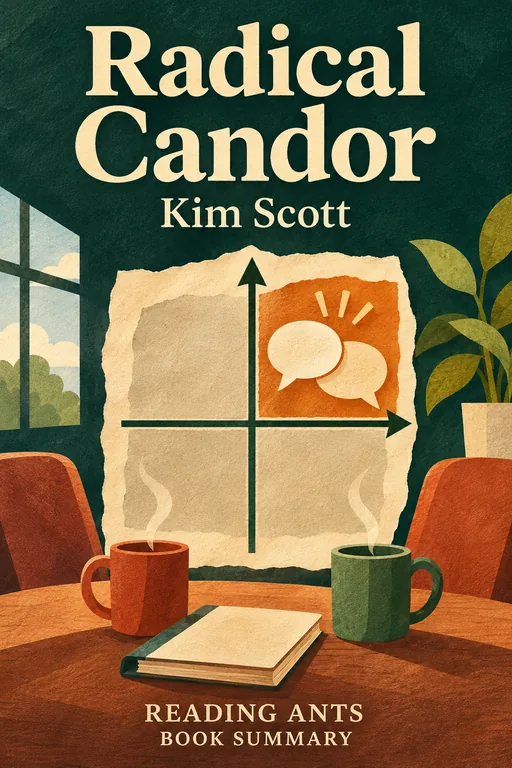
Kim Scott argues that the best bosses and colleagues combine two habits, caring personally about people and challenging them directly, and she shows how to give honest feedback without being cruel or being fake.
Overview
Radical Candor is a management book by Kim Scott, published in 2017. Scott held leadership roles at technology companies, including Google and Apple, and later coached business leaders. The book starts from a simple problem: most people find it hard to tell others what they really think of their work. Bosses stay quiet to be nice, or they blast people in a way that hurts. Scott offers a simple map of the choices and a set of practical habits for building teams where honest talk is normal. The ideas apply well beyond offices, to schools, sports teams and families.
Full Summary
1. Care personally, challenge directly
The idea: Scott’s whole approach rests on two lines drawn on a page. One is “care personally”: showing that you truly care about the person in front of you as a human being. The other is “challenge directly”: saying clearly when work is not good enough, or when something needs to change. Great relationships at work, she says, have both at the same time.
From the book: Scott calls caring without challenging, which she names ruinous empathy, the most common management mistake, and says it is a main reason honest feedback is rare.
In real life: A coach who says “I know how hard you have trained, and your timing is still off in the last lap” is caring and challenging in one breath.
2. The four kinds of feedback
The idea: Putting the two lines together gives four styles. When you care and challenge, you are practicing “radical candor.” When you care but do not challenge, you fall into “ruinous empathy,” being so nice that people never learn what to fix. When you challenge but do not care, you fall into “obnoxious aggression.” When you neither care nor challenge, you fall into “manipulative insincerity,” saying what is easy to say or what suits your own aims.
In real life: A friend who always says your essay is “great” when it is confusing is being kind in the short term, but you will not improve.
3. Build the relationship first
The idea: Honest feedback only works if the other person trusts you. Scott says a boss should take time to learn what motivates each person, what their goals are and what is going on in their life. She also says that leaders should ask for criticism of themselves first, and then show that they take it well, so that others feel safe doing the same.
From the book: She suggests asking a direct, open question, such as what you could do or stop doing to make working with you easier, and then being patient while the other person decides how honest to be.
In real life: A teacher who asks the class what is confusing, and then thanks them, will hear much more the next time.
4. How to give and receive guidance
The idea: Scott offers practical rules for giving feedback. Do it soon after the event, in person if you can, and in private when it is criticism. Praise in public. Focus on the work and the effect, not on the person’s character. Say what you saw and what the effect was. When you receive feedback, listen, do not argue straight away, and make sure you understand.
In real life: Instead of “you are lazy,” you can say “the report was two days late, and it meant the team missed its deadline.”
5. Two kinds of strong performers
The idea: Scott divides high performers into two types, which she calls rock stars and superstars. Rock stars are steady, love the work they do and are the solid ground of a team. Superstars want to move up and take on new challenges. A good manager gives each type different support: stability and recognition for the first, new stretches and growth for the second.
In real life: A bakery needs both the person who makes perfect bread every morning for years and the person who wants to open a second shop.
6. Getting things done as a team
The idea: A later part of the book is about how a team makes decisions and gets things done. Scott describes a repeating cycle of listening to ideas, making them clear, debating them, deciding, persuading others, executing and learning from the results. She shows how candor fits into each step, so that bad ideas are caught early, and good ideas are not lost because someone was afraid to speak.
In real life: A school club that debates a plan openly, and then everyone supports the final choice, will do better than one in which people grumble afterward.
Why It Matters
Radical Candor became a popular and widely discussed management book after 2017, and its phrase passed into workplace vocabulary. Many companies and training programs now use the idea of caring personally and challenging directly, and the four-quadrant picture is often used on slides and in coaching sessions. The book matters because it takes a vague wish, “give honest feedback,” and turns it into a plain model that people can remember and practice. It also challenges the idea that being kind means avoiding hard truths. Scott’s argument is that holding back honest criticism is often a way to protect ourselves, and that real kindness sometimes means saying the difficult thing clearly. The book has also inspired later work on feedback culture, including the author’s own follow-up writing about respect at work, and a company that offers training based on the ideas.
Key Takeaways
- Care and challenge together. Honest feedback works best when the other person knows you are on their side.
- Kind silence can harm. Being too nice to say a hard truth means someone loses the chance to improve.
- Ask for criticism first. Leaders who invite and accept feedback make it safe for others to give it.
- Praise and criticism are both guidance. Both should be specific, timely and focused on the work, not on the person.
- People want different things. Some want stability and some want to climb, and good managers notice the difference.
What We Can Learn
You do not need to be a manager to use these ideas. Think of a time when you held back an honest comment because you did not want to upset someone. Try giving that comment kindly, at a good moment, with a clear example. Equally, practice receiving feedback. When someone criticizes your work, ask a question to understand what they mean before you defend yourself. Another habit worth copying is to ask a friend, a teammate or a family member what you could do differently, and then listen without interrupting. Over time, this builds trust and makes relationships stronger, since both sides know that the other will be truthful and fair.
Criticism and Counterpoints
Critics point out that the book is based mostly on the author’s own experience and stories from tech companies, and not on systematic research. Some readers say that “radical” candor can be misused as a license to be harsh, and that the care part is easy to forget in the heat of the moment. Others note that cultures differ a great deal: in places where direct criticism is considered rude or where the boss has great power, the advice may need adapting. People with less power at work may also find it risky to challenge their bosses. The model is a helpful guide but is not a complete answer to difficult workplaces.
Who Should Read It
This book is for managers, team leaders, teachers, coaches and anyone who finds it hard to be honest with kindness. It is easy to read and full of practical tips. Readers who want deep research may find it light, and those who work in a toxic workplace may need more than the advice to speak up.
Want the whole book?
A summary is a taste, not the meal. Here is where to find the full book.
You reached the end 🎉
Nicely done. Mark this one as read, and we will suggest what to read next.
Read this next

Crucial Conversations
Kerry Patterson and others
Four communication experts show how to handle conversations in which stakes are high, opinions differ and emotions run strong, by keeping dialogue open, making it safe to talk and moving from talk to action.
🌱 Self-Improvement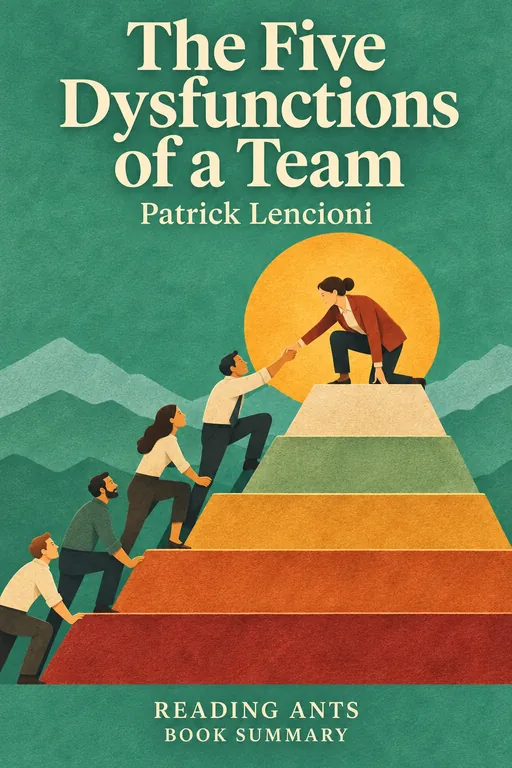
The Five Dysfunctions of a Team
Patrick Lencioni
Teams fail for five connected reasons, starting with a lack of trust, and the way to build a strong team is to fix them in order from the bottom of the pyramid up.
💼 Business
Leaders Eat Last: Why Some Teams Pull Together and Others Don't
Simon Sinek
A book that argues that great leaders create a "circle of safety" for their people, and that trust and cooperation come from the way that our bodies and brains respond to feeling safe.
💼 Business
High Output Management
Andrew S. Grove
Andy Grove, a longtime leader of the chip maker Intel, explains that a manager's real output is the output of the team, and he shows how to raise it with leverage, good meetings, honest measures and one-to-one talks.
💼 Business
How to Win Friends and Influence People
Dale Carnegie
People are driven by emotion and the desire to feel important, so the way to get along with them, and win them to your point of view, is to stop criticizing, show genuine interest and appreciation, and see things from their side.
🌱 Self-Improvement
The Lean Startup
Eric Ries
Startups succeed not by following a detailed plan but by quickly testing their ideas with real customers, learning from the results and changing direction when needed.
💼 BusinessWant something different?
Pick another topic and we will show you three books to start with.