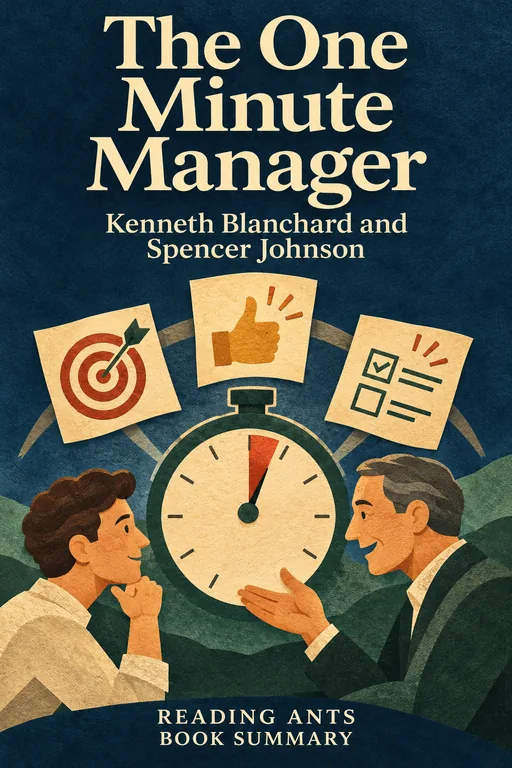
A short story about a young man searching for a good boss teaches three quick habits, clear goals, immediate praise and immediate, fair correction, that can make people more productive and happier.
Overview
The One Minute Manager was written by Kenneth Blanchard, a management expert, and Spencer Johnson, a doctor turned author, and published in 1982. It is a very short book told as a parable. A bright young man wants to become an effective manager, and goes in search of one. He finds that most bosses are either tough and focused on results, or kind and focused on people, and neither produces the best outcome. Finally he meets a manager whom everybody calls the One Minute Manager, who gets great results from happy people and shares three simple secrets. The book became one of the most successful management books ever written.
Full Summary
1. The young man’s search
The idea: The story begins with a young man who is intelligent and eager to work with people. He travels far and wide to talk to managers, and finds two kinds. The first is an “autocratic” manager who cares about results, but whose employees are unhappy. The second is a “democratic” manager who cares about people but whose results suffer. Neither impresses him, until he hears about a manager who has both productive workers and happy ones.
In real life: A coach who only shouts and a coach who only encourages both leave something out, and the best ones do both.
2. A manager with a different style
The idea: The young man meets the One Minute Manager, whose office is calm and whose staff seem to like their work. The manager explains that his job is to help people become high performers, and that the best managers spend time with people to set clear expectations and give quick feedback, which takes only a minute at a time. He says people who feel good about themselves tend to produce good results.
In real life: A teacher who tells students clearly what is expected, and responds quickly, helps everyone do better.
3. Secret one: One Minute Goals
The idea: The first secret is One Minute Goals. Manager and employee agree on a few clear goals and write each one on a single page in brief, plain words, short enough to be read in about a minute. The employee reviews the goals regularly and checks whether behavior matches them. The point is that people can’t hit a target they cannot see.
In real life: A student who writes “finish chapter 3 by Friday” and checks it each day is more likely to succeed than one with a vague wish to “do better.”
4. Secret two: One Minute Praisings
The idea: The second secret is One Minute Praisings. When someone does something right, the manager notices and praises them right away, being specific about what was done well, saying how good it makes them feel, and encouraging them to do more. The praise should be short, and delivered quickly after the good behavior, so that it is clearly linked to the action.
From the book: The manager points out that many bosses only talk to employees when something goes wrong, and so people begin to fear contact with the boss.
In real life: Telling a younger sibling “You read that whole page alone, great job” is better than a general “good boy.”
5. Secret three: One Minute Reprimands
The idea: The third secret is One Minute Reprimands. When someone makes a mistake, the manager speaks to them promptly, says exactly what went wrong, and tells them how it makes him feel. Then, after a pause, he reminds the person that he values them and that the mistake is not who they are. The reprimand is about the behavior, not the person, and once it’s over, it is over. Reprimands are meant for people who already know how to do the task; beginners need instruction and encouragement first.
In real life: “Your report was late, and that put the team behind,” followed by “I know you can do better,” is fair and kind.
6. Why it works
The idea: The book explains that each secret fits human nature. Clear goals reduce confusion, quick praise reinforces good habits, and honest correction, given with respect, helps people improve without feeling attacked. The manager also says that he often spends time just observing, because “catching people doing something right” is easier when you are paying attention.
In real life: A parent who notices good behavior regularly will find that there are many chances to say thank you.
7. Passing it on
The idea: At the end, the young man becomes a One Minute Manager himself, and the story suggests that the habits spread. The manager explains that the real benefit is not only better results but better relationships: people want to work for someone who is fair, clear and encouraging.
In real life: A student leader who uses these habits can improve any club or team.
Why It Matters
The One Minute Manager sold millions of copies and was translated into dozens of languages, and at its peak, it was one of the most popular business books in the world. Its short, simple format made management ideas easy to read and share. Blanchard, who had earlier co-developed the situational leadership model, went on to write many other books, and his company trains managers around the world.
Phrases such as “catch people doing something right” have become common in leadership training. Spencer Johnson also wrote Who Moved My Cheese?, another parable that sold millions. The One Minute Manager’s own habits of quick goal sheets, fast thank-yous and short check-ins still appear in management training today, often without anyone remembering where they came from.
Key Takeaways
- Set clear goals. People do better when they know what success looks like.
- Praise quickly and specifically. Timely praise builds good habits.
- Correct fairly. Speak about behavior, not about the person.
- Be short and direct. A brief conversation can have a big effect.
- Care about people and results. Good management combines both.
What We Can Learn
The book’s ideas are easy to try. Write a goal on a card and read it every morning. When a friend or family member does something kind, say so right away and say exactly what you liked.
It also offers a useful way to give criticism: say clearly what went wrong, share how you feel, and then remind the person that you believe in them. This makes the message easier to hear.
Finally, the book reminds us that small, frequent moments of attention matter. People are shaped less by occasional big speeches than by many tiny signals of what is noticed and valued.
Criticism and Counterpoints
Critics argue that the book is far too simple. Real management involves complicated problems, such as organizational change, conflicts and differences between employees, which a one-minute chat cannot solve. The parable also presents the manager as always calm and always right, which is rarely true.
Some say that the method can feel manipulative, if praise becomes a technique instead of a sincere response. Others note that different people need different approaches: a new employee may need more guidance, while an expert needs more freedom, an idea central to the situational leadership model that Blanchard had developed earlier with Paul Hersey. The book’s examples, from the 1980s, also seem dated. Even so, many readers find its core advice sensible.
Who Should Read It
This short book suits new managers, team leaders, teachers, parents and students. It can be read in about an hour. Experienced managers may find it basic, but may enjoy the reminders.
Want the whole book?
A summary is a taste, not the meal. Here is where to find the full book.
You reached the end 🎉
Nicely done. Mark this one as read, and we will suggest what to read next.
Read this next
Who Moved My Cheese?
Spencer Johnson
This short parable about two mice and two little people in a maze teaches that change is inevitable, and that those who notice it early and adapt, instead of clinging to the past, find new "cheese."
🌱 Self-Improvement
The Five Dysfunctions of a Team
Patrick Lencioni
Teams fail for five connected reasons, starting with a lack of trust, and the way to build a strong team is to fix them in order from the bottom of the pyramid up.
💼 Business
How to Win Friends and Influence People
Dale Carnegie
People are driven by emotion and the desire to feel important, so the way to get along with them, and win them to your point of view, is to stop criticizing, show genuine interest and appreciation, and see things from their side.
🌱 Self-Improvement
The 7 Habits of Highly Effective People
Stephen R. Covey
Lasting success in life and work comes not from quick tricks or a charming personality but from good character, built through seven habits that move us from depending on others, to standing on our own, to working well with others.
🌱 Self-Improvement
Radical Candor
Kim Scott
Kim Scott argues that the best bosses and colleagues combine two habits, caring personally about people and challenging them directly, and she shows how to give honest feedback without being cruel or being fake.
💼 Business
The Lean Startup
Eric Ries
Startups succeed not by following a detailed plan but by quickly testing their ideas with real customers, learning from the results and changing direction when needed.
💼 BusinessWant something different?
Pick another topic and we will show you three books to start with.