 Reading Ants
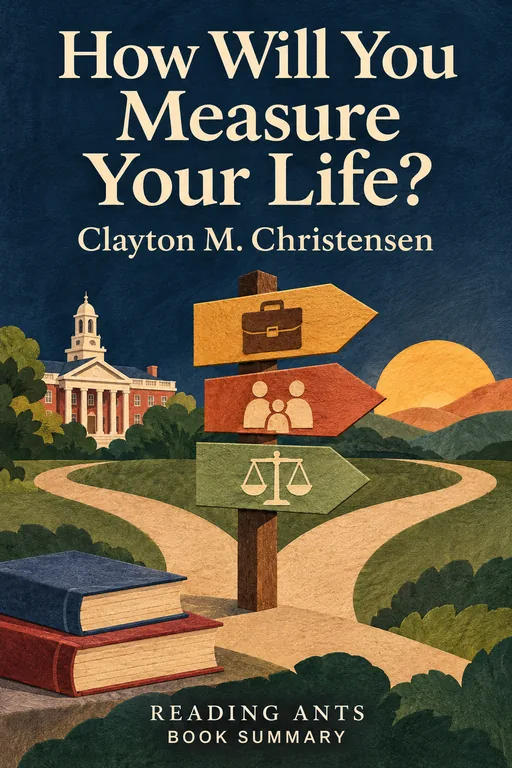
How Will You Measure Your Life?
A Harvard business professor applies the best ideas of management research to personal questions, such as finding a happy career, building lasting relationships and keeping your integrity.
Overview
How Will You Measure Your Life? is a book by Clayton M. Christensen, written with James Allworth and Karen Dillon, and published in 2012. Christensen, a professor at Harvard Business School, was best known for his research on how companies are disrupted by new technologies. In his Harvard course, he used to ask students to apply the course’s theories to their own lives, and the book grew out of that exercise, a 2010 Harvard Business Review article and a talk to the graduating class that spring, when he was being treated for cancer. Soon after he began the book, he also suffered a stroke that took away his speech for a time. His own religious faith shapes how he thinks about purpose, and in the epilogue he says that what matters most to him is the individuals he has helped to become better people. It is a mix of business theory, personal stories and gentle advice.
Full Summary
1. What motivates us is not only pay
The idea: Christensen uses a theory from the psychologist Frederick Herzberg. According to this theory, things like salary and job security are “hygiene factors”: if they are poor, we are unhappy, but when they are good, they do not make us really happy. Real motivation comes from things such as meaningful work, responsibility, achievement and learning.
From the book: He tells how many of his business school classmates chose jobs mainly for income, meaning to follow their real interests after a couple of years, and then found themselves stuck and resentful. He argues that money can at best prevent unhappiness at work, and that challenge, recognition, responsibility and personal growth are what make people love their jobs.
In real life: When choosing a job or a course of study, ask not only how much it pays, but whether it will give you chances to learn and to do something you are proud of.
2. Balance deliberate and emergent strategy
The idea: A good life strategy has two parts. A deliberate strategy is a plan that you make in advance. An emergent strategy is what takes shape when unexpected opportunities and problems arise. Christensen says that neither is better in itself: if you have not yet found work that you love, you should experiment and adjust, and once you have found it, you can pursue it deliberately.
From the book: He explains both kinds of strategy through Honda’s unplanned success in selling small motorcycles in the United States, and through Walmart. He then applies them to his own life: he planned to edit the Wall Street Journal, but ended up as a consultant, a company founder and then a professor.
In real life: You might plan to be a doctor, but a volunteer experience may lead you to teaching. Be ready to test your assumptions and adjust.
3. What you invest in shows your real strategy
The idea: Christensen argues that your real strategy is not what you say, but where you spend your time, energy and money. A person may say that family is the most important thing, but, if all their time goes to work, then work is the real priority.
From the book: He describes former classmates from business school who, without meaning to, put their time and energy into things that gave quick, visible rewards, and ended up with lives that felt empty.
In real life: Look at your calendar for the past week. Does it match what you say matters most? If not, you can begin to change one small thing.
4. Build relationships early
The idea: The rewards of work, such as promotions and praise, come quickly, while those of relationships, with a spouse, children or friends, come slowly. Because of this, we are tempted to give most of our energy to work. Christensen says that investing in relationships early is crucial, as they take a long time to grow.
From the book: He uses the business theory of good money and bad money, which stresses patient investment early on, and warns against postponing investment in family and friends until they seem to need it. He tells of a neighbor whose marriage ended and whose children, who had seen little of him, later began to avoid his visits, and describes research showing how much the way parents talk to babies shapes their later development. He calls relationships with family and close friends the most important sources of happiness.
In real life: Make time each week for a friend or family member, even if it is only a phone call. These small investments add up over years.
5. The “job to be done”
The idea: In his research on innovation and marketing, Christensen found that people “hire” products to do a job in their lives. He suggests that the same idea can help us in our relationships, above all in marriage: each person has jobs that they need done, and we often give what we want to give instead of what the other person needs.
From the book: He gives the example of a fast-food milkshake, which turned out to be “hired” by morning commuters to keep a long, dull drive interesting, and by fathers in the evening who wanted to say yes to their children. He also tells of a husband who cleaned up and cooked dinner when his wife really needed an adult to talk to.
In real life: Before giving advice to a friend, ask what they are trying to achieve. You may find that the problem is not what you assumed.
6. Keep your integrity, always
The idea: Christensen warns of the “just this once” trap. It is easier to keep to your principles all the time than 98 percent of the time, because, once you make an exception, the next one is easier to justify. Small compromises can lead to big ones.
From the book: He opens the book with Jeffrey Skilling of Enron, a classmate who ended up in prison, and later tells how the trader Nick Leeson hid one small mistake and kept going until it brought down his bank. Staying out of jail is the third of the book’s guiding questions. He also tells how, as a student at Oxford, he refused to play in the final of a basketball tournament because it was on a Sunday, since he had decided as a teenager never to play on that day. His team won without him.
In real life: If you decide never to cheat on a test or to copy another person’s work, it is easier to hold to that rule, than to decide each time.
Why It Matters
The book brought the ideas of a famous business thinker to a general audience. It encouraged readers to think about their lives as a whole, and to ask whether their daily choices match their deepest values. Christensen was widely respected, and the book is often read as a kind of legacy, as he died in 2020. Part of its appeal is that it comes from a person who had studied disruption for decades and who then asked, with humility, how to apply it to life, so its advice feels earned and not preachy. It is easy to see why it speaks to students who are about to choose a career.
Key Takeaways
- Meaning matters more than money. Motivation comes from purpose and learning.
- Strategy mixes plan and chance. Be prepared and open.
- Resources show priorities. Where your time goes is what you value.
- Relationships need early investment. Their rewards come slowly.
- Small compromises add up. Hold to your principles consistently.
What We Can Learn
The book invites us to step back and ask what we want our lives to be about. By looking at how we spend our time, we can see whether it matches our goals. It encourages us to put effort into the people who matter, before it is too late.
It also gives a simple rule for facing temptation: decide in advance where your lines are, and stay behind them. Finally, it reminds us that success is not only a matter of status or wealth, but of the difference we make in the lives of others.
Criticism and Counterpoints
Some readers find that the book’s application of business theories to personal life is forced, and that the examples are not always convincing. Others say that it reflects the viewpoint of a privileged, religious, American academic, and that it does not consider people who have to struggle to survive and cannot choose their work. Some feel that the advice is general and repeats ideas found in other self-help books. Still, many find it thoughtful and sincere.
Who Should Read It
This book is for students, young professionals and parents who are thinking about their direction in life. It is clearly written. Those who want a rigorous business book should read Christensen’s earlier work, but those who are looking for a thoughtful guide to life choices will find it helpful.
Want the whole book?
A summary is a taste, not the meal. Here is where to find the full book.
You reached the end 🎉
Nicely done. Mark this one as read, and we will suggest what to read next.
Read this next
The Innovator's Dilemma
Clayton M. Christensen
Great companies often fail not because they manage badly, but because they do everything right: they listen to their best customers and invest in the best products, and so they miss the cheaper, simpler technology that eventually replaces them.
💼 Business
The 7 Habits of Highly Effective People
Stephen R. Covey
Lasting success in life and work comes not from quick tricks or a charming personality but from good character, built through seven habits that move us from depending on others, to standing on our own, to working well with others.
🌱 Self-Improvement
Man's Search for Meaning
Viktor E. Frankl
A psychiatrist who survived the Nazi concentration camps explains that even in the worst suffering, people can choose their attitude, and that finding a reason to live is what gives us the strength to endure.
👤 Real Lives
Deep Work
Cal Newport
Cal Newport argues that the ability to focus without distraction on hard tasks, which he calls deep work, is becoming rare and valuable, and shows how to train it and protect it in a distracted world.
🌱 Self-Improvement
The Last Lecture
Randy Pausch
Dying of pancreatic cancer, computer science professor Randy Pausch shares life lessons about achieving your dreams, helping others and enjoying every moment, in a book based on his famous farewell lecture.
🌱 Self-Improvement
The Lean Startup
Eric Ries
Startups succeed not by following a detailed plan but by quickly testing their ideas with real customers, learning from the results and changing direction when needed.
💼 BusinessWant something different?
Pick another topic and we will show you three books to start with.