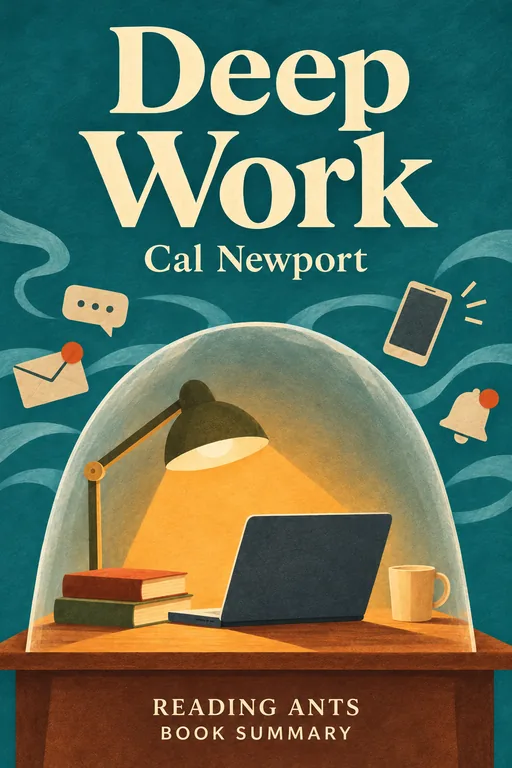
Cal Newport argues that the ability to focus without distraction on hard tasks, which he calls deep work, is becoming rare and valuable, and shows how to train it and protect it in a distracted world.
Overview
Deep Work: Rules for Focused Success in a Distracted World was written by Cal Newport, a computer science professor at Georgetown University who is known for his writing about technology and work, and published in 2016. Newport defines deep work as professional activity performed in a state of distraction-free concentration that pushes cognitive abilities to their limit. This creates new value and is hard to copy. He contrasts it with shallow work, which consists of non-demanding tasks, often done while distracted, such as answering emails. The book has two parts: the first explains why deep work matters, and the second gives four rules for building it.
Full Summary
1. The case for deep work
The idea: Newport argues that deep work is becoming more valuable because the economy rewards people who can quickly master complicated things and produce high-quality results. At the same time, workplaces have moved toward constant connection, open offices and instant messaging, which make deep work harder. This combination means that those who can focus have an increasing advantage. He also says that deep work provides meaning, since craftsmanship and concentration bring a sense of satisfaction.
In real life: A programmer or writer who can focus for several hours produces much more than one who is interrupted every few minutes.
2. Deep work and the cost of switching
The idea: The author cites research on attention residue, which suggests that when we switch from one task to another, part of our attention stays on the first task, reducing performance on the second. Constantly checking messages means that we are never fully engaged. Newport also points to how people’s idea of productivity has drifted toward visible busyness, such as quick replies and being always available, instead of the quality of results.
In real life: Checking your phone every ten minutes while studying can make the same material take much longer.
3. Rule one: work deeply
The idea: Newport’s first rule is to build routines that make deep work a habit. He describes four ways to schedule it: the monastic approach, in which one eliminates shallow obligations; the bimodal approach, dividing time into long periods of deep work and others for ordinary tasks; the rhythmic approach, setting a regular daily time; and the journalistic approach, fitting deep work in whenever there is free time. He also recommends rituals, such as choosing a place, and ways to keep track of progress, for example by marking each deep-work day on a calendar.
In real life: Having a set time each morning for study, with a particular place and a clear goal, makes starting easier.
4. Rule two: embrace boredom
The idea: Deep focus is a skill that must be trained, like a muscle. Newport suggests that if we always switch to something stimulating whenever we are bored, we weaken our ability to concentrate. He recommends scheduling in advance the times when you will use the internet or other distractions, and staying away from them outside those times, instead of taking short breaks from focus at random through the day. This trains you to resist the urge to check devices whenever you feel bored. He also suggests training with practices such as productive meditation, which means focusing on one well-defined work problem during a physical activity like walking, and memorizing information.
In real life: Waiting in line without reaching for your phone is a small way to practice tolerating boredom.
5. Rule three: quit social media
The idea: Newport urges readers to evaluate the tools they use by comparing benefits to costs, rather than accepting any tool that has some benefit. He proposes the “craftsman approach”: adopt a tool only if its positive effects substantially outweigh its negatives for what you care about. He suggests testing by quitting a service for thirty days and seeing if anyone cares, and encourages spending leisure time on high-quality activities instead of mindless browsing.
In real life: Someone who deletes a social app for a month may discover they miss it far less than expected.
6. Rule four: drain the shallows
The idea: The last rule is to reduce shallow work, so that more time is available for deep work. Newport recommends scheduling every minute of the workday, as in a plan that is adjusted when things change; asking how long each task would take a smart college graduate to learn, to decide if it is truly shallow; setting a fixed time for ending work in the evening; and becoming hard to reach by email, for example by setting expectations. He argues that doing less, but better, produces more.
In real life: Blocking out calendar time for a big project makes it less likely that small tasks will fill the day.
Why It Matters
Deep Work became a bestseller and a key text in the productivity world, and the term “deep work” is now widely used in offices, schools and online discussions. It has influenced how many professionals manage their time, set up their workspaces and talk about technology. It is often cited in debates about open offices, constant messaging and remote work.
The book also gave readers a way to understand the feeling of being scattered and a method for improving, and it has been followed by Newport’s later writing on digital minimalism and slow productivity.
Many students and writers say the book helped them to finish large projects, such as theses and books, by giving them a simple permission to turn off notifications and protect long blocks of time.
Key Takeaways
- Focus is a valuable skill. Deep work creates high-quality results.
- Distraction has costs. Switching tasks leaves attention behind.
- Build routines. Schedule and protect time for deep work.
- Train your attention. Embrace boredom and avoid constant stimulation.
- Reduce shallow work. Fewer low-value tasks leave more time for what matters.
What We Can Learn
The book teaches that attention is a limited resource and worth defending. If we want to learn or create something difficult, we need long, uninterrupted stretches of time, and we can arrange our days to get them.
It also suggests that we can be intentional about technology instead of letting it use us. Asking “Does this tool help me do what I value?” and being willing to say no can improve both work and rest.
Finally, it encourages us to treat concentration as a skill that improves with practice, which gives hope to anyone who feels easily distracted.
Criticism and Counterpoints
Critics point out that the book’s advice is easier for people with control over their schedules, such as professors and writers, than for workers with many interruptions, such as nurses, teachers or customer service staff. Others argue that collaboration and communication are also valuable, and that some shallow tasks are necessary.
Some say that Newport’s rejection of social media is too extreme or overlooks its benefits for community and work, and that the book repeats its basic points. Still, many readers find the central insight, that focus is worth protecting, convincing and helpful.
Who Should Read It
This book suits teenagers and adults, especially students and knowledge workers. It is clearly organized and practical. Readers who are already well organized may prefer to skim the first part.
Want the whole book?
A summary is a taste, not the meal. Here is where to find the full book.
You reached the end 🎉
Nicely done. Mark this one as read, and we will suggest what to read next.
Read this next
Flow
Mihaly Csikszentmihalyi
Psychologist Mihaly Csikszentmihalyi shows that people feel happiest not when relaxing but when fully absorbed in a challenging activity that matches their skills, a state he calls flow.
🧩 Mind & Psychology
Atomic Habits
James Clear
Big changes in life come not from huge leaps but from tiny habits repeated every day, and you can build good habits (and break bad ones) by designing your life so the right choices are obvious, attractive, easy and satisfying.
🌱 Self-Improvement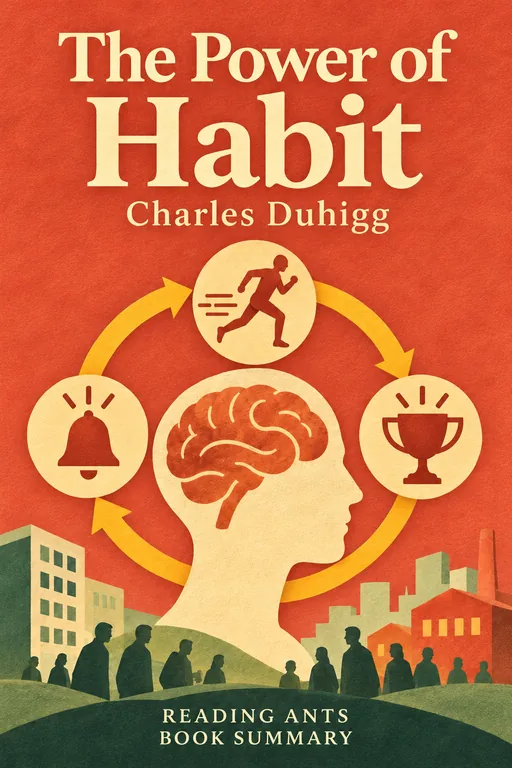
The Power of Habit
Charles Duhigg
Charles Duhigg shows that habits follow a loop of cue, routine and reward, and that by understanding the loop we can change our own habits, as well as those of companies and societies.
🌱 Self-Improvement
Amusing Ourselves to Death
Neil Postman
Neil Postman argues that television has turned serious public discussion into entertainment, so that politics, news, religion and education are shaped by the demand to amuse, and that this threatens our ability to think.
⚖️ Politics & Society
The Anxious Generation
Jonathan Haidt
Jonathan Haidt argues that a shift from a play-based childhood to a phone-based childhood in the early 2010s caused a surge in anxiety and depression among young people, and he proposes four norms to reverse it.
🧩 Mind & Psychology
The 7 Habits of Highly Effective People
Stephen R. Covey
Lasting success in life and work comes not from quick tricks or a charming personality but from good character, built through seven habits that move us from depending on others, to standing on our own, to working well with others.
🌱 Self-ImprovementWant something different?
Pick another topic and we will show you three books to start with.