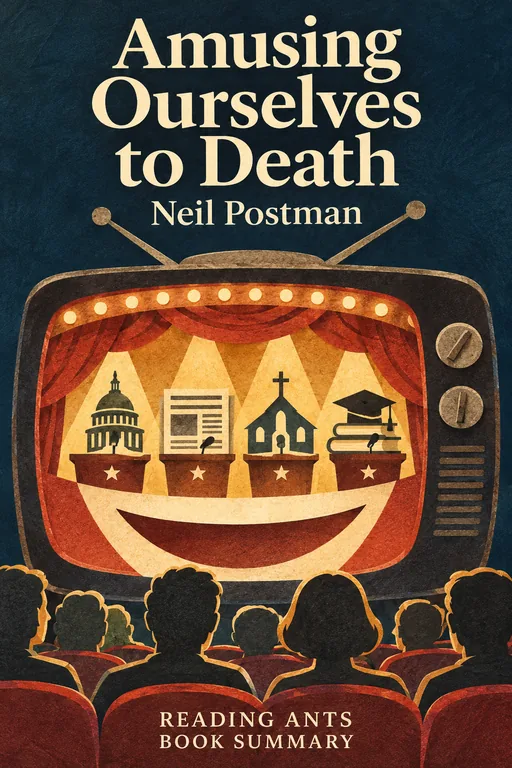
Neil Postman argues that television has turned serious public discussion into entertainment, so that politics, news, religion and education are shaped by the demand to amuse, and that this threatens our ability to think.
Overview
Amusing Ourselves to Death: Public Discourse in the Age of Show Business was written by Neil Postman, an American media critic and professor at New York University, and published in 1985. Postman argues that the medium through which ideas are communicated shapes the kinds of ideas that can be shared, building on the work of Marshall McLuhan. In a society dominated by the printed word, public life was serious and logical; in a society dominated by television, public life became a form of entertainment. Written before the World Wide Web and mass use of the internet, the book has been revived with the rise of social media, and many readers find its warnings newly relevant.
Full Summary
1. The medium is the metaphor
The idea: Postman begins by comparing two famous visions of the future: George Orwell’s 1984, in which people are controlled by force and fear, and Aldous Huxley’s Brave New World, in which they are controlled by pleasure and distraction. Postman says that Orwell feared that books would be banned, while Huxley feared there would be no reason to ban a book, because no one would want to read one. He believes that we are closer to Huxley’s warning, since people are drowning in trivia, not hidden truths.
In real life: A flood of easy entertainment can crowd out hard questions as effectively as censorship.
2. Media as epistemology
The idea: Postman explains that each medium favors a certain kind of content. Smoke signals cannot carry a philosophical argument, and the telegraph reduced information to short, disconnected facts. A culture’s main medium influences how it defines truth. He argues that a printed text encourages logic, argument and sequence, while a visual, fast-moving medium favors images, emotion and brevity.
In real life: A long essay and a short video can both discuss a topic, but they invite different kinds of thinking.
3. Typographic America
The idea: Postman describes nineteenth-century America as a culture shaped by print. People read widely, listened to long speeches and followed arguments that lasted hours, as in the Lincoln-Douglas debates. Public discussion assumed an audience that could follow a line of reasoning. Postman does not claim that everyone was wise, but that the dominant form of communication encouraged serious, rational discussion.
In real life: Imagine an audience standing for hours to hear a debate, a very different habit from today’s brief clips.
4. The telegraph and the world of “Now... this”
The idea: The telegraph and photography changed things, creating a flood of news from far away that people could do nothing about, and which had little relation to their lives. Television took this further. Postman discusses the way television news is arranged as a series of unconnected stories, introduced with the phrase “Now... this,” with no context or memory. This presentation treats a war and a commercial as equals, and trains viewers to expect entertainment.
In real life: A news show may move from a disaster to a weather forecast and then to a laugh, leaving little time to reflect.
5. Television and politics, religion and education
The idea: In the later chapters, Postman shows how television changed key institutions. Politicians now succeed through image and charm and not through argument; religious broadcasts become shows, with appeals to feeling and stardom; and schools, seeing the success of programs like Sesame Street, try to make learning fun, which suggests that education should always be entertaining. He worries that this undermines the idea that learning can be hard and still worthwhile.
In real life: A lesson that is always made into a game may leave students unprepared for tasks that need patience.
6. A call for awareness
The idea: Postman does not call for banning television but for being aware of its effects, and for using it wisely. He argues that the first step to resisting is understanding, and that parents and teachers should teach children how media shape thinking. He ends with the hope that we can keep alive habits of reading, reasoning and conversation, so that we do not “amuse ourselves” into a state where we cannot think about serious matters.
In real life: Setting limits on screen time and making time for reading and discussion are small ways of acting on his advice.
Why It Matters
Amusing Ourselves to Death has become a classic of media criticism, and has been cited widely in discussions about television, news and social media. It is often assigned in communications classes and has been translated into many languages. The comparison between Orwell and Huxley is one of the best-known ideas in modern cultural commentary.
Since the rise of the internet, many readers have found that its argument applies even more strongly to online media, where short clips, headlines and endless feeds shape attention. Postman’s ideas appear regularly in debates on digital culture.
Key Takeaways
- The medium shapes the message. The form of communication affects what we can say.
- Distraction can be a danger. Entertainment can crowd out serious thought.
- News became show business. Fragments replace context.
- Institutions adapt to media. Politics, religion and schools all change.
- Awareness is the first step. We can choose how we use media.
What We Can Learn
The book encourages us to think about how we get information. If most of what we read or watch is short, fast and emotional, we may find it harder to follow long arguments or to feel patient with complicated problems.
It also suggests practical habits. Reading longer texts, discussing issues with others and limiting passive screen time can protect our ability to think deeply.
Finally, it reminds us that technology is not neutral. New tools always bring changes in habits and values, and it is wise to ask what we gain and what we lose.
Criticism and Counterpoints
Critics say that Postman romanticizes the age of print and underestimates the range of television and later media, which include documentaries, news analysis and educational shows. Some argue that print culture had its own sensational and shallow content, and that people are capable of choosing quality material from any medium.
Others point out that the book was written for an era of three TV networks and does not anticipate the diversity and interactivity of the internet, though supporters respond that it predicted many of its problems. Some also find Postman’s tone alarmist or elitist. Still, many find his central warning valuable.
Who Should Read It
This book suits teenagers and adults who use media and care about how it shapes thinking. It is short and clearly written. Readers might find it interesting to compare Postman’s claims about television with their own experience of social media.
Want the whole book?
A summary is a taste, not the meal. Here is where to find the full book.
You reached the end 🎉
Nicely done. Mark this one as read, and we will suggest what to read next.
Read this next
Brave New World
Aldous Huxley
In a future world where people are made in factories, programmed for their roles and kept happy with drugs and entertainment, a man raised outside the system discovers that this perfect comfort comes at the cost of everything that makes us human.
📜 Classics
The Shallows
Nicholas Carr
Writer Nicholas Carr argues that the internet is changing the way our brains work, making us better at skimming and multitasking but worse at deep reading, concentration and contemplation.
💡 Technology
The Anxious Generation
Jonathan Haidt
Jonathan Haidt argues that a shift from a play-based childhood to a phone-based childhood in the early 2010s caused a surge in anxiety and depression among young people, and he proposes four norms to reverse it.
🧩 Mind & Psychology
Deep Work
Cal Newport
Cal Newport argues that the ability to focus without distraction on hard tasks, which he calls deep work, is becoming rare and valuable, and shows how to train it and protect it in a distracted world.
🌱 Self-Improvement
The Prince
Niccolo Machiavelli
A Renaissance diplomat advises rulers to judge their actions by results rather than morality, arguing that a successful leader must sometimes be cunning and ruthless to win and keep power.
⚖️ Politics & Society
The Communist Manifesto
Karl Marx and Friedrich Engels
Marx and Engels declare that all history is the history of class struggle, that capitalism has created a working class that will overthrow it, and that communism will end class divisions.
⚖️ Politics & SocietyWant something different?
Pick another topic and we will show you three books to start with.