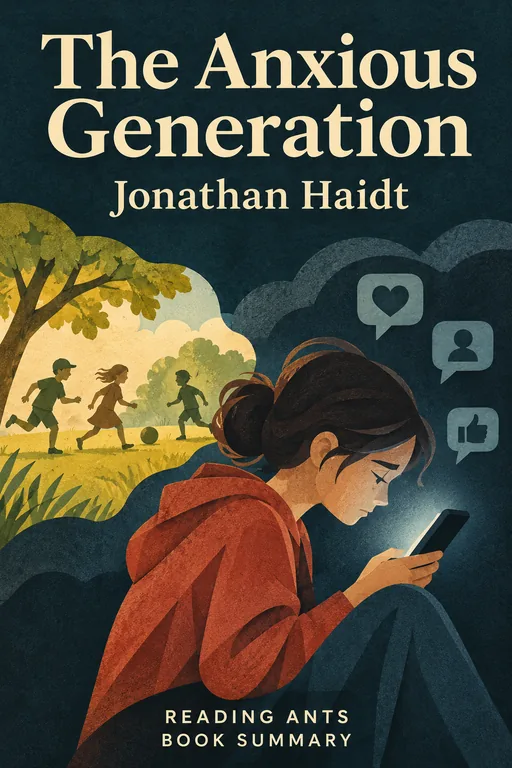
The Anxious Generation
Jonathan Haidt argues that a shift from a play-based childhood to a phone-based childhood in the early 2010s caused a surge in anxiety and depression among young people, and he proposes four norms to reverse it.
Overview
The Anxious Generation: How the Great Rewiring of Childhood Is Causing an Epidemic of Mental Illness was published in 2024 by Jonathan Haidt, a social psychologist at New York University’s Stern School of Business. Haidt had earlier written about moral psychology and, with Greg Lukianoff, about campus culture. In this book, he looks at data showing that, starting around 2010 to 2015, rates of teenage anxiety, depression and self-harm, especially among girls, rose sharply in the United States and other English-speaking countries. He links this to the arrival of smartphones, social media and front-facing cameras, and to a decline in free play and independence. The book was a major bestseller and sparked a wide public debate.
Full Summary
1. A sudden change
The idea: Haidt opens by showing graphs in which indicators of mental health among teenagers, such as depression, anxiety, emergency room visits for self-harm and loneliness, were relatively stable until about 2010 and then rose steeply. He argues that this was not just better reporting or a general trend: the timing coincides with the spread of smartphones with high-speed internet and social media apps. He calls this the Great Rewiring of Childhood, when the way children grew up changed more rapidly than in any earlier generation.
In real life: Parents and teachers often say that the daily lives of teenagers are very different now from just fifteen years ago.
2. Overprotection in the real world
The idea: Haidt argues that, even before smartphones, children had less and less freedom to play, explore and take risks outside, partly because of parents’ fear of crime, a trend he calls overprotection. Children need unsupervised play to develop skills, handle conflict and build resilience. Reduced real-world independence left children less prepared for challenges, and at the same time, screens filled the vacuum, creating what he calls a phone-based childhood.
In real life: Children who once walked to school or played in the street now often spend that time indoors with devices.
3. Four foundational harms
The idea: Haidt identifies four main ways that a phone-based childhood harms children. First, social deprivation: time with screens replaces face-to-face time with friends. Second, sleep deprivation: phones keep children up at night. Third, attention fragmentation: constant notifications make it hard to concentrate. Fourth, addiction: apps are designed to capture attention and bring children back repeatedly. These harms, he says, interfere with learning, relationships and healthy development.
In real life: A student whose phone buzzes every few minutes finds it hard to read a long chapter.
4. Why girls and boys are affected differently
The idea: For girls, Haidt says, social media is especially harmful because of comparisons of appearance, social exclusion and relational aggression, which increase anxiety and depression. For boys, harms include video games and pornography, which can lead to withdrawal from the real world, as many young men drift into isolation. He notes that the effects appear across many countries, and that the problem is not only about content but also about the time and experiences displaced.
In real life: Seeing the carefully edited photos of friends may leave a teen feeling that their own life is worse by comparison.
5. Four norms for change
The idea: Haidt proposes four main solutions, which he thinks require collective action by parents, schools and governments to avoid a trap in which no child wants to be the only one without a phone. They are: no smartphones before high school, no social media before age sixteen, phone-free schools and far more unsupervised play and independence. He suggests that if families and schools coordinate, the social pressure on each child will diminish.
In real life: A group of parents in a neighborhood agreeing to delay smartphones together makes it easier for each family to keep to the rule.
6. A broader vision
The idea: In the final chapters, Haidt addresses adults, technology companies and lawmakers. He urges laws that require stronger age verification and more responsible design, and asks adults to model healthier use of their own devices. He also encourages communities to bring back activities where young people can meet in person and have meaningful responsibilities. He is hopeful that a change in norms can restore a childhood in which young people can develop real-world skills.
In real life: Clubs, sports and volunteer work give teenagers a reason to put the phone down and be with others.
Why It Matters
The Anxious Generation reached the top of bestseller lists and became a central reference in public discussion about children and technology. It influenced parents, schools and policymakers: many schools have adopted phone bans or restrictions, and several governments and states have considered or passed laws regarding social media for minors. Haidt’s website and movement encouraged groups of parents to coordinate on delaying smartphones.
The book fed a broader public debate over how to protect young people online, and provided a simple framework that parents could act on. Whether or not readers accept every part of the argument, many say it gave them words for a worry they already had and a reason to talk with other families about shared rules.
Key Takeaways
- Childhood changed fast. Phones and social media arrived rapidly.
- Four harms. Social deprivation, sleep loss, fragmented attention and addiction.
- Play and independence matter. Real-world freedom builds skills.
- Collective action helps. Families and schools can agree on norms.
- Adults must model good habits. Our own phone use sets an example.
What We Can Learn
The book invites us to think about how much of our time and our children’s time is spent on screens, and what we may be giving up. Even small changes, like keeping phones out of bedrooms at night, can help sleep and mood.
It also shows the importance of letting children try things on their own. Walking to a friend’s house or solving a conflict without an adult is practice in growing up, and it is easy to lose when everything is supervised.
Finally, it demonstrates the value of working together. Many families cannot resist social pressure alone, but a group of parents or a whole school can change what is normal.
Criticism and Counterpoints
Many researchers dispute Haidt’s claim that social media is the main cause of the rise in teen mental health problems. Some, such as the psychologist Candice Odgers, argue that the evidence is mostly correlational, that effects found in studies are small and that other factors, including economic stress, school pressure and changes in how problems are diagnosed and reported, may play a role. Others point out that the trends are not the same in all countries.
Some critics say that the book downplays the benefits of online communities, especially for isolated or marginalized teens, and that it may encourage a moral panic. Supporters answer that the pattern is consistent and the precautionary steps are low-risk. The debate continues, and readers should consider both views.
Who Should Read It
This book suits parents, teachers and older teenagers who want to think about technology and growing up. It is written in clear language with many charts. It is useful as a conversation starter, though readers should also look at critics’ views.
Want the whole book?
A summary is a taste, not the meal. Here is where to find the full book.
You reached the end 🎉
Nicely done. Mark this one as read, and we will suggest what to read next.
Read this next

Amusing Ourselves to Death
Neil Postman
Neil Postman argues that television has turned serious public discussion into entertainment, so that politics, news, religion and education are shaped by the demand to amuse, and that this threatens our ability to think.
⚖️ Politics & Society
The Whole-Brain Child
Daniel J. Siegel and Tina Payne Bryson
Understanding how a child's brain develops helps parents respond to tantrums, fears and conflicts in ways that connect, calm and teach, so that different parts of the brain work together.
🎓 Parenting & Education
Deep Work
Cal Newport
Cal Newport argues that the ability to focus without distraction on hard tasks, which he calls deep work, is becoming rare and valuable, and shows how to train it and protect it in a distracted world.
🌱 Self-Improvement
How to Talk So Kids Will Listen and Listen So Kids Will Talk
Adele Faber and Elaine Mazlish
Parents can get better cooperation and closer relationships by acknowledging children's feelings, describing problems instead of blaming, and using simple, respectful communication skills.
🎓 Parenting & Education
Thinking, Fast and Slow
Daniel Kahneman
Our minds run on two systems, a fast, intuitive one and a slow, careful one, and understanding how the fast system fools us can help us make better decisions about money, risk, work and happiness.
🧩 Mind & Psychology
Predictably Irrational
Dan Ariely
Behavioral economist Dan Ariely uses entertaining experiments to show that people's decisions are shaped by predictable mental quirks, such as relativity, the lure of "free" and social norms, rather than by cool, rational calculation.
🧩 Mind & PsychologyWant something different?
Pick another topic and we will show you three books to start with.