 Reading Ants
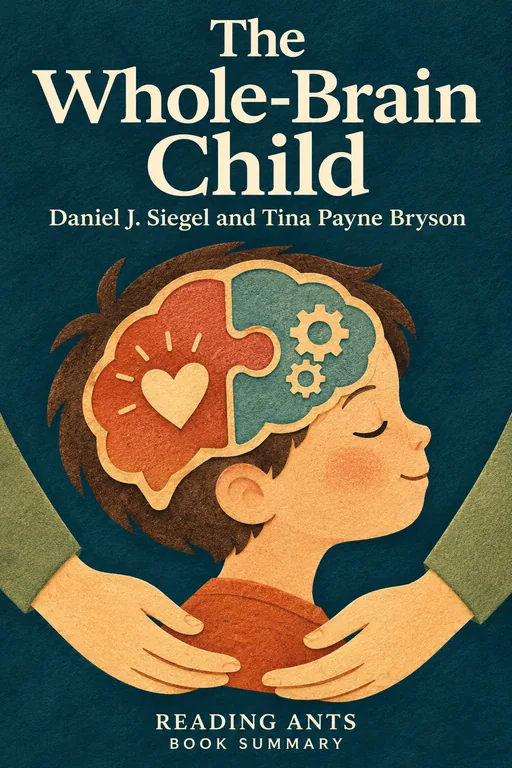
Understanding how a child's brain develops helps parents respond to tantrums, fears and conflicts in ways that connect, calm and teach, so that different parts of the brain work together.
Overview
The Whole-Brain Child: 12 Revolutionary Strategies to Nurture Your Child’s Developing Mind was written by Daniel Siegel, a psychiatrist and professor, and Tina Payne Bryson, a child psychotherapist, and published in 2011. The authors explain, in plain language, how the brain is organized and how it grows, and then offer twelve practical strategies for parents. Their central idea is integration: helping different parts of the brain, such as the thinking and emotional parts, work together. The book uses short stories, cartoons for kids and handy summaries for busy parents, and it has been popular around the world.
Full Summary
1. A brain with parts that must work together
The idea: The authors introduce the idea of integration, which means connecting separate parts so they function as a whole. They say that many childhood struggles, such as meltdowns and fears, happen when the brain is not integrated, for instance when emotions overwhelm reasoning. They use the example of a river, with chaos on one bank and rigidity on the other, to explain that a healthy mind flows between them.
In real life: A child who can say “I’m angry” and still choose a calm response is using more of the brain at once.
2. Left brain and right brain
The idea: The authors describe the left side of the brain as logical, literal and linear, and the right side as emotional, creative and holistic. In the authors’ simplified model, a child in distress is usually “in the right brain,” and logic does not help yet. They recommend connecting before redirecting: first respond with comfort, empathy and touch, then, when the child is calmer, appeal to logic. They also suggest “naming it to tame it”: telling the story of what happened, with words, helps a child feel calmer and make sense of a frightening event.
In real life: After a scary dog encounter, a parent who retells the story together with the child can help the fear lose some of its power.
3. Upstairs brain and downstairs brain
The idea: The authors use a “house” picture. The downstairs brain, including the brainstem and limbic system, handles basic functions, strong emotions and instincts. The upstairs brain, especially the prefrontal cortex, handles planning, empathy and good decisions, but it keeps developing into the mid-twenties. When children are upset, the downstairs brain can take over, and they may “flip their lids.” Parents can help by staying calm, not expecting too much and building skills over time. They suggest engaging the upstairs brain with questions and by letting children practice decision-making, and by moving the body, which helps shift emotional states.
In real life: Letting a young child help decide the family’s weekend activities is practice for the upstairs brain.
4. Memory and the stories we tell
The idea: The book explains how memories form and how they can affect behavior. Some memories are explicit, and others are stored as feelings or body reactions. The authors recommend helping children revisit and talk about hard experiences, so that painful or scary memories can be integrated and lose their grip. They propose a “remote control” idea, where a child can pause, rewind and replay memories while being supported, and they encourage making a habit of recalling happy events.
In real life: A child who had a bad doctor visit may feel better after drawing it and talking with a parent about what happened and how they felt.
5. The many “me”s and mindsight
The idea: Children, like adults, experience a range of feelings and thoughts, which the authors call the “many me’s.” They teach that feelings come and go, like clouds, and are not the whole self. They also introduce mindsight, the ability to see one’s own mind and the minds of others. They suggest a simple tool called SIFT, noticing Sensations, Images, Feelings and Thoughts, and encourage practices that build awareness, such as paying attention to the breath.
In real life: A child who learns that “I feel angry now” is not the same as “I am an angry person” can handle emotions better.
6. Connection and relationships
The idea: The last strategies focus on relationships. The authors note that humans are wired to connect, and that family fun, shared laughter and play build a strong base. They encourage parents to look at conflict as a chance to teach, including how to listen to others and to see different viewpoints. They also provide advice on sibling rivalries and “connecting through conflict,” so that disagreements can strengthen bonds.
In real life: Settling a quarrel by listening to each child’s version helps them learn to understand others.
Why It Matters
The Whole-Brain Child was a New York Times bestseller and was translated into many languages. It brought ideas from neuroscience into everyday parenting, giving parents a clear way to understand why children behave as they do, and an alternative to approaches based on punishment.
The book’s practical summaries and its companion volumes, including No-Drama Discipline and a workbook, are widely used by parents, teachers and therapists, and the phrases “upstairs brain” and “downstairs brain” have become part of common parenting talk. Teachers have also borrowed the pictures to help children describe what they feel in the classroom, which shows how useful a simple image can be for explaining something complicated.
Key Takeaways
- Connect first. Comfort before reasoning.
- Name it to tame it. Telling the story calms big feelings.
- The upstairs brain is still growing. Be patient with kids.
- Memories can be integrated. Talking helps heal fears.
- Feelings pass. Emotions are not the whole self, and they change.
- Play builds bonds. Shared fun strengthens the family.
What We Can Learn
The book gives us a helpful picture of what is happening when a child, or anyone, is overwhelmed. Knowing that a tantrum is partly about a developing brain can help parents respond with calm and compassion.
It also shows that skills such as naming feelings, pausing to breathe and noticing thoughts are learnable. These tools can help adults too, not only children.
Finally, it reminds us of the importance of relationships. Warm, steady connection is the soil in which a child’s emotional growth happens.
Criticism and Counterpoints
Some neuroscientists say that the book simplifies brain science, and that the “left brain, right brain” and “upstairs and downstairs” pictures are metaphors that can mislead if taken too literally. Others note that evidence for particular strategies is limited, and the book relies on the authors’ clinical experience.
Some parents also find that advice assumes a calm and available adult, which may be hard to manage in busy or stressful households. Critics add that the approach may not be enough for children with serious difficulties. Supporters reply that its core message, to connect and teach and not punish, is sound and useful.
Who Should Read It
This book suits parents, grandparents, teachers and caregivers of children of any age. It is clearly written with many practical examples. For serious emotional or behavior concerns, a parent should also talk with a professional.
Want the whole book?
A summary is a taste, not the meal. Here is where to find the full book.
You reached the end 🎉
Nicely done. Mark this one as read, and we will suggest what to read next.
Read this next
How to Talk So Kids Will Listen and Listen So Kids Will Talk
Adele Faber and Elaine Mazlish
Parents can get better cooperation and closer relationships by acknowledging children's feelings, describing problems instead of blaming, and using simple, respectful communication skills.
🎓 Parenting & Education
Mindset: The New Psychology of Success
Carol S. Dweck
Psychologist Carol Dweck shows that people who believe abilities can grow, a growth mindset, learn, cope with failure and achieve more than people who believe their talents are fixed.
🌱 Self-Improvement
Emotional Intelligence
Daniel Goleman
Daniel Goleman argues that the ability to understand and manage emotions, our own and others', matters as much as IQ for success, relationships and well-being, and that it can be learned.
🌱 Self-Improvement
Positive Discipline
Jane Nelsen
Jane Nelsen argues that children behave better when they are treated with both kindness and firmness, and she offers practical tools, such as family meetings and logical consequences, to teach them responsibility without punishment or pampering.
🎓 Parenting & Education
Battle Hymn of the Tiger Mother
Amy Chua
Yale law professor Amy Chua tells, with humor and self-doubt, how she raised her two daughters with strict rules and high expectations in the style she calls Chinese, and what happened when her younger daughter pushed back.
🎓 Parenting & Education
The Book You Wish Your Parents Had Read
Philippa Perry
Psychotherapist Philippa Perry argues that good parenting is less about technique than about the relationship, and that we help our children most when we understand our own past, name feelings and repair the rifts that are bound to happen.
🎓 Parenting & EducationWant something different?
Pick another topic and we will show you three books to start with.